Gold Pendant Representing Amenophis III, New Kingdom
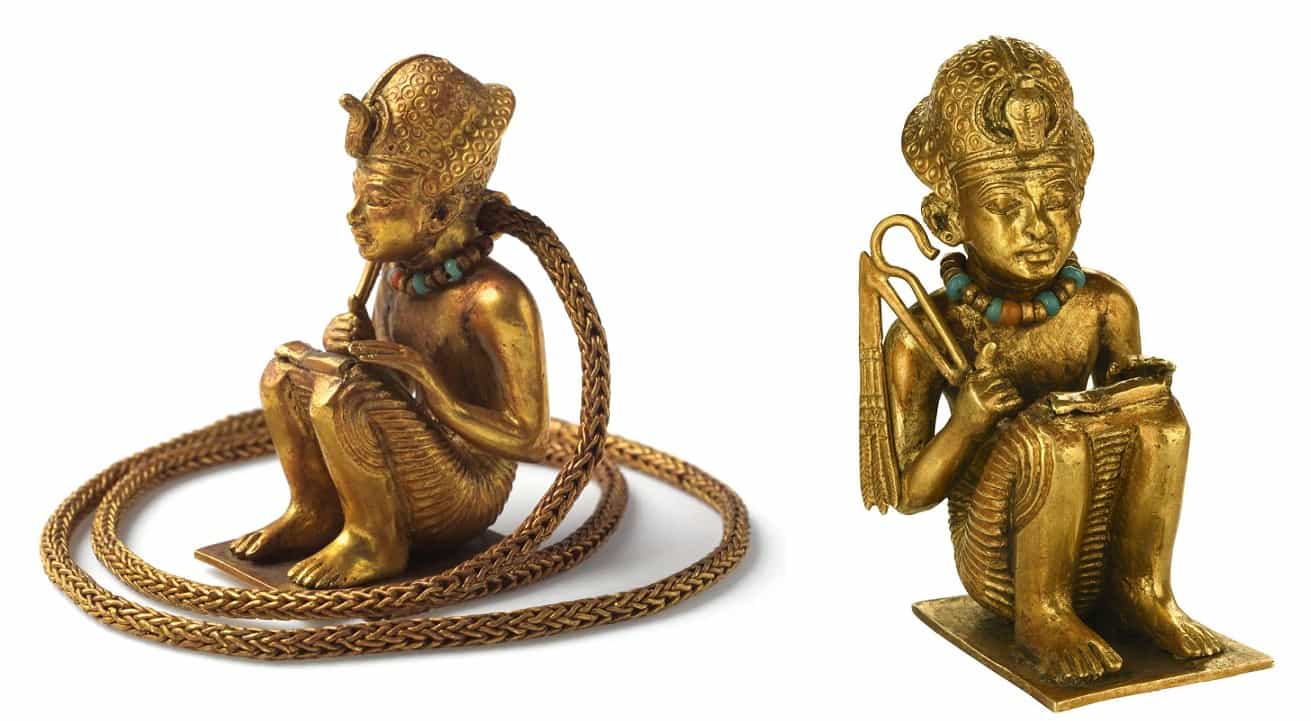
The gold pendant of Amenhotep III, discovered in Tutankhamun’s tomb, is an exceptional piece of jewelry that underscores the connection between these two pharaohs. Featuring intricate designs and symbols associated with royalty and divinity, the pendant demonstrates the extraordinary craftsmanship characteristic of the 18th Dynasty.
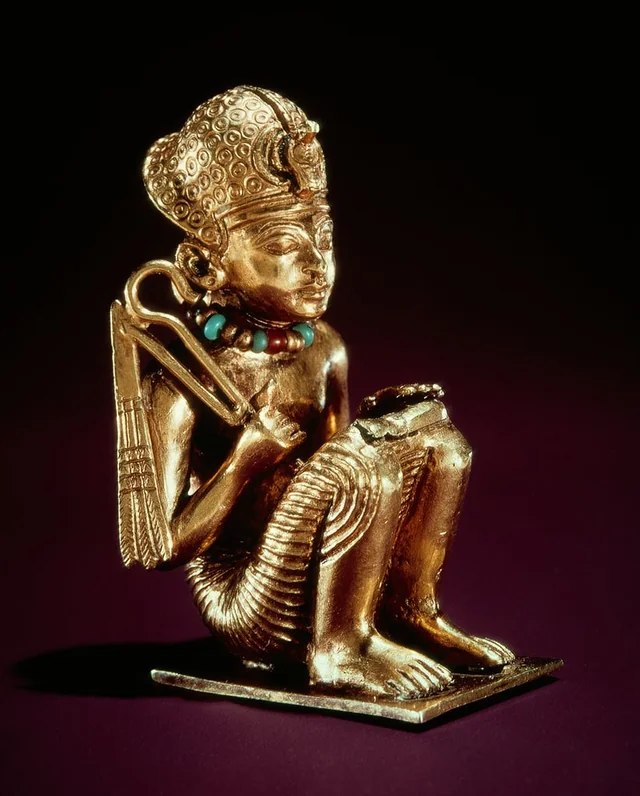
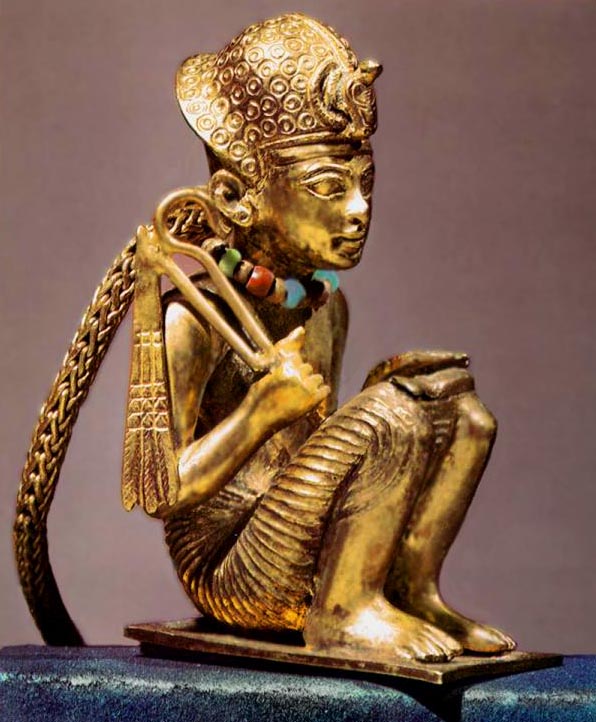
It is believed that the pendant originally belonged to Amenhotep III and was later placed in Tutankhamun’s tomb, perhaps as a symbolic inheritance or as a tribute to the earlier pharaoh. The solid gold pendant depicts Amenhotep III in a squatting position, wearing the Blue Khepresh Crown and holding the crook and flail. He is adorned with a real gold necklace strung with glass beads. The statuette was suspended from a looped gold chain to serve as a pendant.
Amenhotep III was a powerful and prosperous ruler of the 18th Dynasty and the grandfather of Tutankhamun. This golden statuette of Amenhotep III was found in Tutankhamun’s tomb (KV62) in the Valley of the Kings, West Thebes. Tutankhamun never met his grandparents, as Amenhotep III and Queen Tiye, the parents of Akhenaten, had died approximately five years before Tutankhamun’s birth.
When Tutankhamun was interred in his modest tomb, he was accompanied by this solid gold pendant of a squatting king, suspended on a heavy, woven gold chain. Amenhotep III is shown wearing the Khepresh, or Blue Crown, and holding a scepter and flail, the traditional insignia of Egyptian kings. His feet are bare, and a string of tiny colored beads hangs around his neck.

Remarkably, all of this detail is captured in a statuette just over 5.5 centimeters tall. Howard Carter identified the figure as Amenhotep III and regarded it as an heirloom from Tutankhamun’s famous grandfather.
New Kingdom, 18th Dynasty, reign of Tutankhamun, ca. 1332–1323 BC. From the Tomb of Tutankhamun (KV62), Valley of the Kings, West Thebes. Now housed in the Egyptian Museum, Cairo.