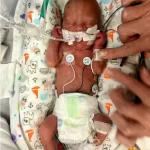
Born to Beat the Odds: Poppy’s Miraculous Fight with a Broken Heart

From the moment Daisy learned she was pregnant, she knew her journey into motherhood would be anything but ordinary. She wasn’t expecting just one baby—she was carrying MCMA twins, a rare and high-risk type of identical twins who share both a placenta and an amniotic sac.
Doctors were clear from the beginning. This pregnancy would require constant monitoring, specialist care, and weekly hospital visits. Every scan carried equal parts hope and fear. Every appointment was a reminder that life, fragile and powerful, was growing inside her.
Then, at 17 weeks, everything changed.
One of the twins, Poppy, was diagnosed with Transposition of the Great Arteries (TGA)—a severe congenital heart defect where the heart’s main arteries are reversed, preventing oxygen-rich blood from circulating properly through the body.
Daisy and her partner had never heard the term before.
A compassionate consultant sat with them, drawing diagrams and explaining what lay ahead: intensive care, complex heart surgery, and a long, uncertain road. In that moment, Daisy realized she wasn’t just carrying twins—she was carrying a tiny fighter whose life would depend on precision, timing, and extraordinary medical care.
A Fight That Began Before Birth
From that point on, weekly fetal heart scans became routine. Because MCMA pregnancies are especially dangerous, doctors planned an early delivery between 32 and 33 weeks. Poppy would be born at a specialist cardiac center, where immediate intervention would be possible.
Before the twins were even born, Daisy and her partner toured the cardiac ward. They wanted to understand every machine, every alarm, every life-saving tool that might one day keep their daughter alive. The hospital became familiar long before it became necessary.
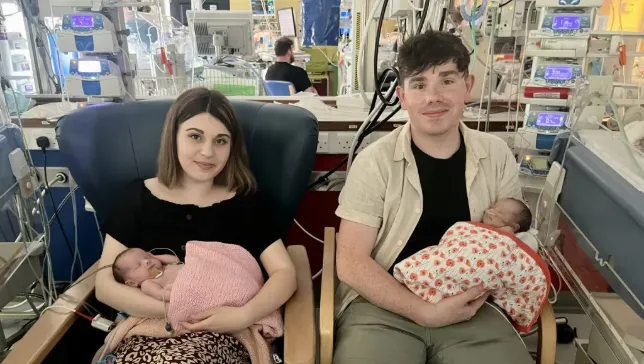
At 32 weeks and 2 days, Daisy underwent a planned cesarean section under general anesthesia. The twins arrived just one minute apart—Posie at 14:24, and Poppy at 14:25.
Both babies were immediately ventilated and transferred to the NICU.
Poppy weighed just 3 pounds 10 ounces. Doctors explained she would need to reach over 6 pounds before undergoing the life-saving arterial switch operation required to correct her heart defect.
Every gram mattered. Every breath mattered.
Complications, Setbacks, and Strength
The early weeks were filled with constant monitoring and anxiety. Poppy struggled with low oxygen levels and worked tirelessly just to breathe. After more than a month, she was transferred to PICU for a balloon septostomy, a temporary procedure designed to improve oxygen flow and buy time.
But complications came swiftly.
On July 7, Poppy suffered a frontal lobe stroke. Soon after, she developed a serious Serratia infection, linked to a PDA stent procedure used to delay her main surgery. Her fragile body faced one setback after another—abdominal swelling, oxygen crashes, and urinary retention.
Then came more devastating news: coarctation of the aorta and unfavorable coronary artery anatomy, both of which made her upcoming surgery even more complex.
Every day became a battle measured in oxygen saturations, heart rhythms, and whispered prayers.
Yet through it all, Poppy showed remarkable resilience.
The Surgery That Changed Everything
On July 28, the day of Poppy’s arterial switch surgery arrived.
Surgeons knew the risks were immense. Poppy was tiny, medically fragile, and had already endured more than most adults ever would. But waiting longer could cost her life.
For hours, her parents waited in silence, suspended between fear and hope.
The surgery was successful.
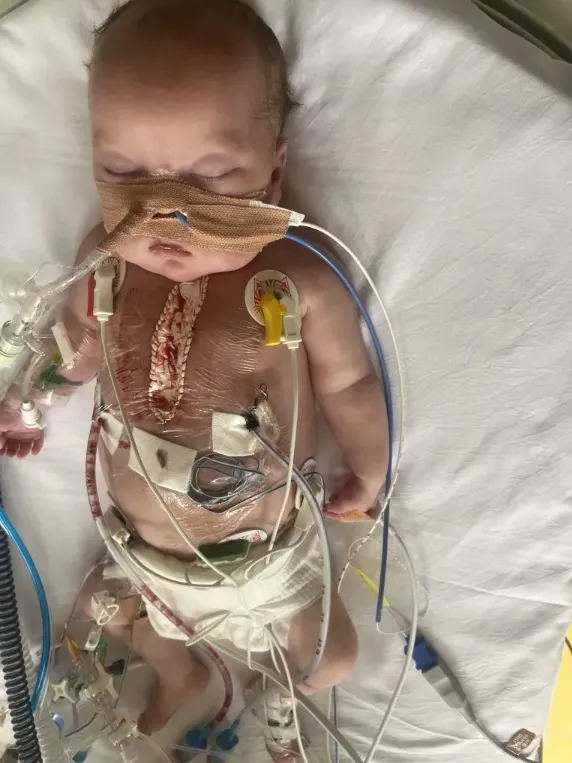
Poppy required delayed chest closure to allow her body to recover, but slowly, steadily, she began to stabilize. Her days in PICU were long and delicate, yet filled with small victories.
By August 4, she was strong enough to move to the cardiac ward. By August 19, she transitioned off CPAP and onto high-flow oxygen. Just one week later, Poppy went home.
A Miracle at Eleven Months Old
Today, Poppy is eleven months old—happy, thriving, and finally home with her twin sister, Posie.
She continues to receive multidisciplinary care, including cardiology, neurology, dietetics, and speech and language therapy. She still uses an NG feeding tube, but feedings are improving. Her heart scans show stability. She’s meeting milestones despite everything she’s endured.
Poppy is, by every definition, a miracle baby.
Her journey highlights the power of early diagnosis, careful planning, and the dedication of highly specialized medical teams. Every nurse, surgeon, and specialist played a vital role in keeping her alive through the most dangerous days of her life.
A Story of Hope for Other Families
Poppy’s story is also a reminder of the risks associated with MCMA twin pregnancies and complex congenital heart defects like TGA. It underscores the importance of parental advocacy, education, and compassionate medical support.
Her parents treasure the small victories—a stable oxygen reading, a peaceful night without alarms, a successful feed. These moments, once unimaginable, are now celebrations of life.
Through it all, Poppy’s spirit remains unmistakable. Her heart may be complex, but her will is clear.
She is here to fight.
She is here to thrive.
She is here to inspire.
For families walking similar paths, Poppy stands as proof that even the smallest hearts can overcome impossible odds—and that with expert care, determination, and love, miracles truly do happen.