“I Died While Giving Birth” — The Rare Medical Emergency That Stopped Her Heart and Redefined Motherhood
A Pregnancy Filled With Quiet Hope
Six months after enduring the heartbreak of an early miscarriage, Kayleigh Summers discovered she was pregnant again, and this time, hope arrived carefully—fragile, restrained, yet deeply cherished. She was carrying a baby boy, a child she and her husband had already begun to imagine in their future, and she named him Callahan, or Cal, a name that felt strong, gentle, and full of promise.
Cal would be the first grandchild on both sides of the family, and throughout the pregnancy, everything unfolded exactly as doctors hope it will. Kayleigh remained healthy, active, and optimistic. There were no complications, no red flags, and no medical concerns to cloud the experience. Two weeks before her due date, she and her husband even moved into a new house. She lifted boxes, took breaks when needed, and felt physically capable and emotionally prepared.
There was nothing—absolutely nothing—to suggest that disaster was coming.
A Routine Appointment That Changed Everything
At 40 weeks and two days, Kayleigh went in for what she expected to be an ordinary prenatal appointment. Instead of reassurance, her doctor noticed something concerning: her blood pressure was elevated and refused to come down despite careful monitoring.
What followed felt sudden and disorienting. Kayleigh was sent directly to the hospital for observation, and as the reality set in, she began to cry—not from pain, but from an overwhelming and unexplainable sense of fear. Her husband noticed immediately, later describing her anxiety as something entirely unfamiliar.
In triage, doctors recommended inducing labor. Kayleigh hesitated. She had fears about induction, worries she couldn’t fully articulate. But after thoughtful discussions and reassurances from her medical team, she agreed. She trusted the doctors. She trusted the process. Most of all, she trusted her body.
The Moment Her Body Gave Out
The induction lasted two and a half days, a long and exhausting experience, yet still medically normal for a first-time mother. Eventually, Kayleigh reached ten centimeters. Her obstetrician briefly stepped out to prepare for delivery.
That was the moment everything collapsed.
Kayleigh turned to her nurse and quietly said, “I’m not feeling well.” The nurse reassured her, explaining that nausea and discomfort are common during transition. Kayleigh reached for a bag, trying to steady herself.
She doesn’t remember exactly what she felt next—only that it was wrong in a way that demanded attention. She spoke up again. Then she screamed.
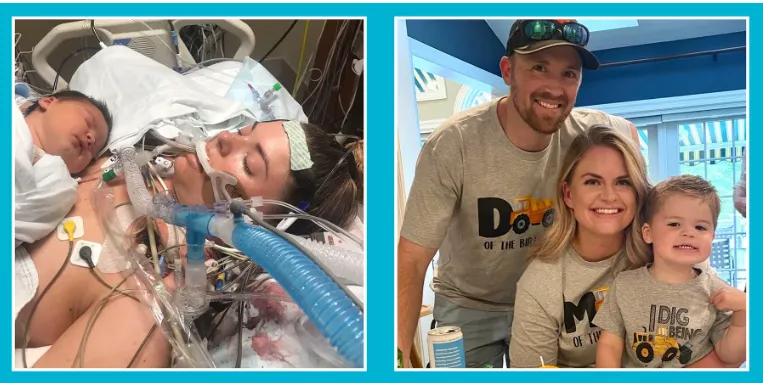
Within seconds, her heart stopped. Her lungs stopped. Her body shut down entirely.
A Code Blue was called, and the room filled with medical staff as CPR began immediately.
A Race Against Death
Doctors made a rapid, life-or-death decision: the baby had to be delivered immediately. In under six minutes, Kayleigh’s obstetrician performed an emergency delivery—a decision that saved her son’s life and gave Kayleigh a chance to survive.
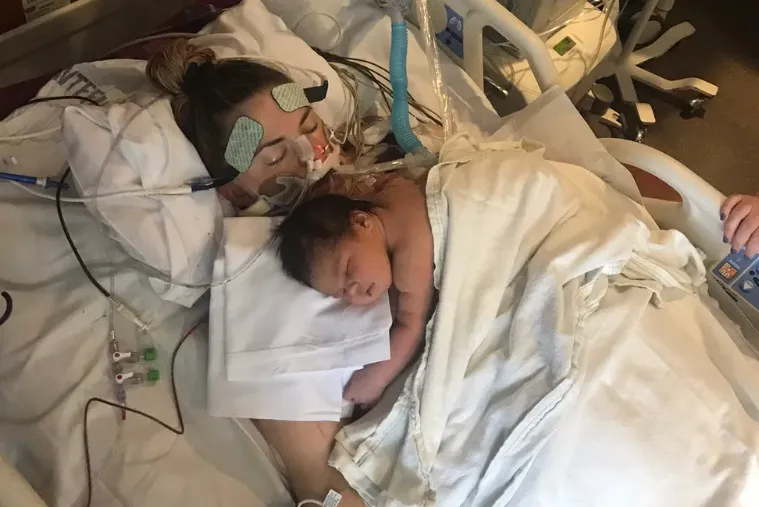
Cal was born silent. He did not cry. He was resuscitated, placed on a ventilator, and rushed into intensive care.
Kayleigh remained unconscious as CPR continued on her body for ten agonizing minutes. Eventually, her heart was restarted.
Doctors soon suspected a terrifying and exceedingly rare condition: Amniotic Fluid Embolism (AFE)—a medical emergency so uncommon that many doctors never encounter it in their careers. AFE occurs when amniotic fluid enters the mother’s bloodstream, triggering a catastrophic immune response. There is no cure, no direct treatment—only supportive care and hope.
When Survival Came at a Devastating Cost
Almost immediately, Kayleigh entered the second deadly phase. Her blood began clotting uncontrollably while she simultaneously started hemorrhaging, a condition known as disseminated intravascular coagulation (DIC), which is often fatal.
Her obstetrician acted decisively, placing a Bakri balloon in Kayleigh’s uterus and ordering massive blood transfusions before the bleeding escalated. In total, Kayleigh would receive 143 units of blood products.
Then, her heart stopped again.
A call was made to a larger medical center. Kayleigh needed ECMO, a machine that acts as the heart and lungs outside the body. Without it, she would die. The machine stabilized her body, but her heart still failed to recover.
Doctors inserted an Impella device, a mechanical pump placed directly into her heart, warning the family that it might not work.
Miraculously, it did.
Awakening to a New Reality
Within 24 hours, Kayleigh’s heart began to recover. The ECMO and Impella were removed far sooner than expected, but the damage had already been done. Doctors were forced to remove her uterus and right ovary to save her life.
Three days later, she was taken off the ventilator. The next day, she met her son—though she has no memory of it. Five days after her heart stopped, Kayleigh formed her first clear memory as doctors explained that she had died and been brought back.
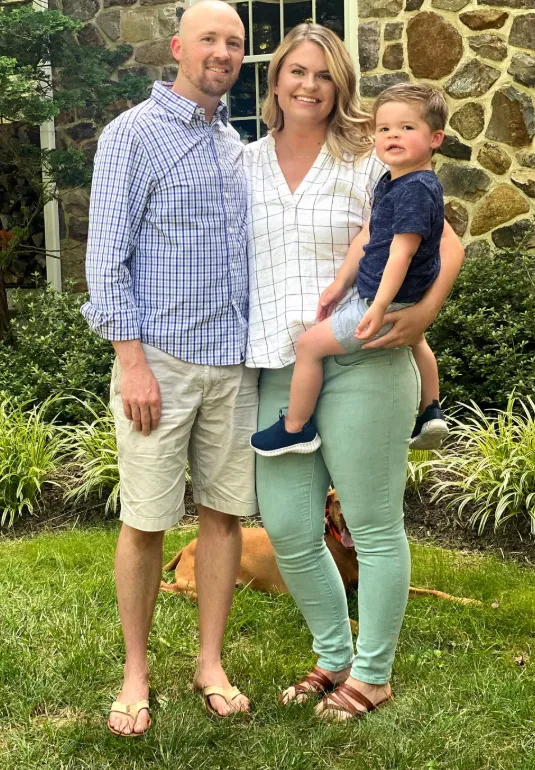
Fourteen days after the embolism, she was discharged directly from the ICU to her home.
Survival Was Only the Beginning
At home, healing did not come easily. Kayleigh struggled physically and emotionally. She couldn’t care for her baby and felt disconnected from motherhood. Her parents moved in to help as she battled guilt, shame, and delayed bonding—an experience common among trauma survivors but rarely discussed.
Losing her uterus became one of the most painful realities to accept. She had dreamed of having more children, and survival had taken that choice away.
Though grateful to be alive, grief lived alongside gratitude.
Turning Trauma Into Purpose
As a licensed therapist, Kayleigh believed in therapy, yet even she was unprepared for how deep the trauma ran. She sought professional help and committed to healing, eventually discovering a truth she now shares openly: birth trauma is real, and it is profoundly misunderstood.
Kayleigh chose to speak publicly, sharing her story not for sympathy, but for awareness. Nurses and medical professionals reached out, saying they learned about AFE from her story—knowledge that later saved another woman’s life.
A Voice That Refuses to Be Silent
Today, Kayleigh speaks with clarity and courage. She urges mothers to trust their instincts and reminds women that surviving childbirth does not mean escaping trauma.
Her heart stopped while giving birth.
But her voice did not.
And because she survived, other women may, too.