Lyly and the Power of a Simple “Hello”
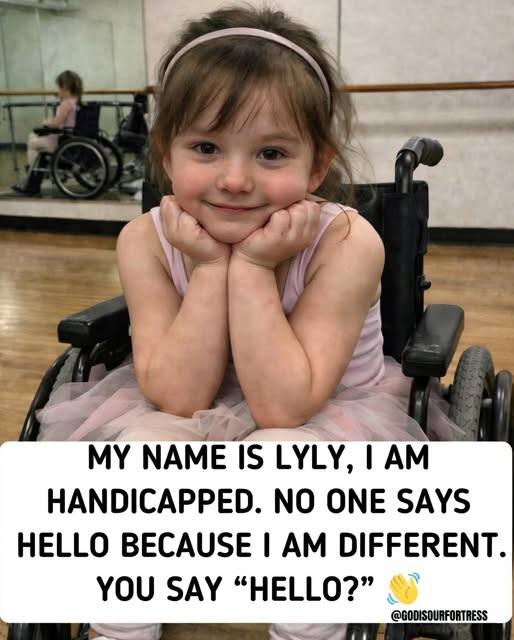
“Hi, my name is Lyly.”
It is a simple introduction from a little girl sitting quietly in a wheelchair, her chin resting gently on her hands, her eyes bright with curiosity and warmth. In the photo, Lyly is smiling—softly, sincerely. Yet the words that accompany her image tell a story that is both tender and unsettling: sometimes, people do not say hello to her simply because she is different.
Lyly’s story is not loud. It does not demand attention. But it carries a message powerful enough to stop people mid-scroll and ask an uncomfortable question: When was the last time we chose silence over kindness because difference made us uneasy?
When Difference Becomes an Invisible Barrier
Lyly is a child with a physical disability. She uses a wheelchair to move through the world. That difference, though small in the grand picture of who she is, often becomes the first thing people notice—and, too often, the reason they look away.
Not because Lyly is unfriendly.
Not because she does not smile.
Not because she is unkind.
But because difference can make people uncomfortable.
In everyday spaces—classrooms, studios, sidewalks, public rooms—children like Lyly are sometimes met not with cruelty, but with avoidance. And while avoidance may seem harmless, its impact can be quietly painful. To be unseen. To be unacknowledged. To feel as though your presence makes others unsure of how to act.
A Child’s Question for the Adult World
Lyly is young. She may not yet have the words to explain why some people greet her warmly while others pretend not to notice her at all. But through her story, she asks a question that challenges adults far more than children:
Why is saying “hello” so hard?
For Lyly, a greeting is not just politeness. It is recognition. It is a moment that says, I see you. It is reassurance that she belongs in the same spaces as everyone else.
A single word—hello—can turn a quiet moment into a meaningful one. A small wave can change the tone of an entire day.
“I Was Made on Purpose”
What makes Lyly’s story especially powerful is that it is not rooted in sadness. It is grounded in dignity.
In the caption accompanying her image, Lyly’s message is clear: she believes she was made on purpose. That she carries joy in her heart, dreams in her eyes, and a smile meant to be shared.
There is no request for pity. No appeal for sympathy. Just a gentle reminder that worth is not defined by physical ability, and joy does not require permission.
Lyly does not ask to be treated as special. She asks to be treated as human.
The Cost of Kindness Is Nothing—Its Value Is Everything
Kindness is often imagined as something grand: donations, speeches, heroic actions. But Lyly’s story reminds us that kindness is more often found in the smallest gestures.
A greeting.
A smile.
A moment of acknowledgment.
These actions cost nothing. They require no training, no preparation, no perfect words. And yet, for someone who is used to being overlooked, they can mean everything.
For a child navigating the world with a disability, these moments help shape how they see themselves. They influence whether they feel welcome or tolerated, included or invisible.
What Lyly Teaches Us About Inclusion
Lyly’s experience reflects a broader reality faced by people with disabilities of all ages. Many do not encounter open hostility—but instead, something quieter and harder to address: discomfort, uncertainty, silence.
True inclusion does not come from knowing the perfect thing to say. It comes from choosing connection over avoidance.
Teaching children to say hello to someone who looks or moves differently is not just about manners. It is about empathy. It is about normalizing difference instead of treating it as something to be feared or ignored.
The Ripple Effect of One Small Moment
If someone says hello to Lyly, the impact may seem small. But that moment carries forward.
She may smile a little wider.
She may feel a little more confident.
She may remember that moment long after the day ends.
And the person who offered that greeting gains something too—a quiet reminder of shared humanity, of the goodness found in choosing kindness without hesitation.
These moments ripple outward, shaping how communities feel, how children grow, and how society learns to see difference not as distance, but as diversity.
A Reminder We All Need
In a world that moves quickly and often looks past those who stand out, Lyly’s story invites us to slow down.
To notice.
To acknowledge.
To engage.
It asks us to examine the moments when we feel unsure, and to choose warmth instead of withdrawal. Because inclusion does not begin with policy or programs—it begins with everyday human interaction.
Conclusion: Start With “Hello”
Lyly’s story does not ask for applause. It does not demand attention. It simply offers an invitation.
An invitation to pause.
To look.
To speak.
If today, Lyly’s face crossed your screen—or if tomorrow, you meet someone who seems different from you—remember how much a single word can matter.
Because sometimes, the smallest act of kindness is also the most powerful.
And sometimes, all it takes to remind someone they belong…
is a simple, heartfelt “hello.”