A Son’s 65-Kilometer Promise: How Love Carried an 80-Year-Old Mother to Safety
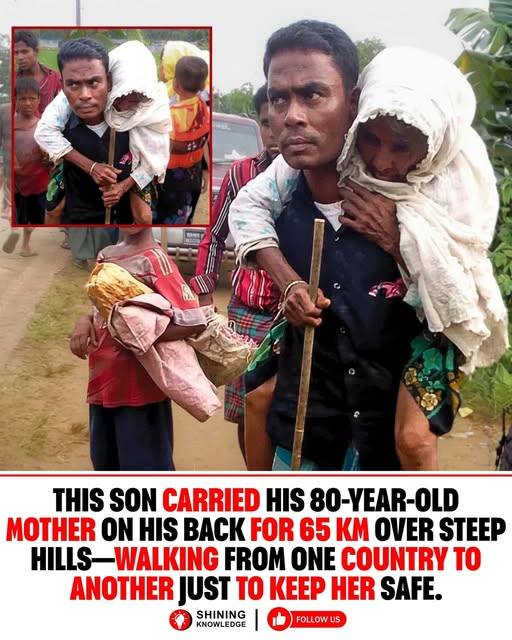
Sometimes love doesn’t say “I love you.”
Sometimes it says, “I’ll carry you until we’re safe.”
In September 2017, in the small town of Balibazar, Myanmar, fear arrived quietly—then all at once. Nights were pierced by gunfire. Homes were abandoned. Neighbors disappeared without explanation. What once felt familiar became dangerous, and survival turned into an urgent question with no easy answers.
For Zafor Alam, the reality was painfully clear: staying was no longer an option.
He had to leave.
But escape was not simple.
Not when the person he loved most—his 80-year-old mother, Achhia Khatun—could no longer walk.
There was no vehicle.
No safe road.
No help coming.
When Survival Demands an Impossible Choice
Like many families caught in conflict, Zafor faced an impossible decision. He could run alone and survive—or he could stay with his mother and risk everything. Achhia Khatun was frail, exhausted, and unable to travel long distances. The journey ahead would be dangerous even for someone young and strong.
But Zafor did not hesitate.
He bent down.
He lifted his mother onto his back.
And he started walking.
It was not a dramatic moment. There were no speeches, no tears for the world to see. Just a quiet decision made by a son who refused to leave his mother behind.
A Journey Meant to Last Two Days
The plan was simple: walk for two days and reach safety across the border in Bangladesh. But plans mean little when fear, terrain, and exhaustion take control.
What should have been a 48-hour journey stretched into five brutal days.
The path ahead was unforgiving—steep hills, rocky ground, narrow hidden trails, and long stretches with no food or clean water. Zafor’s legs ached. His shoulders burned. His back screamed under the weight he carried.
Still, he kept moving.
When the Body Breaks, Love Continues
There were moments when Zafor’s body begged him to stop. His muscles trembled. His feet blistered and bled. Hunger hollowed him from the inside out. Sleep came only in fragments, wherever the ground allowed.
But every time he felt himself weakening, he felt his mother’s arms tighten around his shoulders.
And that was enough.
Achhia Khatun never complained. She never asked her son to put her down. She trusted him completely—her life resting on his strength, his determination, and his love.
At night, they slept wherever they could, listening for sounds that might signal danger. Each morning, Zafor stood up again, adjusted his grip, and took another step forward.
65 Kilometers of Pure Devotion
By the time they reached the Kutupalong refugee camp in Bangladesh, Zafor had walked 65 kilometers carrying his mother on his back.
There were no fireworks.
No applause.
No headlines waiting at the gate.
Just safety.
Just relief.
Just a mother and son who had survived what many could not.
A Photograph That Stopped the World
When a photo of Zafor carrying his mother began circulating online, it struck something deep in people everywhere. The image was raw, unfiltered, and powerful. A man walking forward with exhaustion written across his face. An elderly woman clinging to him, trusting him with her life.
The world called it heroic.
Extraordinary.
Unbelievable.
But to Zafor, it was simply necessary.
He did not carry his mother to be admired.
He carried her because love gave him no other choice.
What This Story Truly Represents
This is not just a story about refugees or borders.
It is a story about what love looks like when everything else is taken away.
Love is not always poetic.
It is not always spoken.
Sometimes love is silent footsteps on a dangerous road.
Sometimes it is an aching back that refuses to bend.
Sometimes it is a son who gives his strength so his mother can live.
In a world that often turns away from suffering, Zafor Alam did not.
When fear said run, love said carry.
When exhaustion said stop, love said one more step.
When the world offered nothing, love became everything.
A Lesson the World Should Never Forget
Zafor’s journey reminds us that courage does not always wear armor. Sometimes it wears worn shoes and blistered feet. Sometimes it carries an elderly mother through hills and hunger, guided by nothing but devotion.
And sometimes, love doesn’t say “I love you.”
It says:
“I’ll carry you until we’re safe.”