🎥🌲 Bigfoot Legend Revisited: Bob Gimlin Speaks on the Patterson–Gimlin Encounter
- HoaiLinh
- February 27, 2026
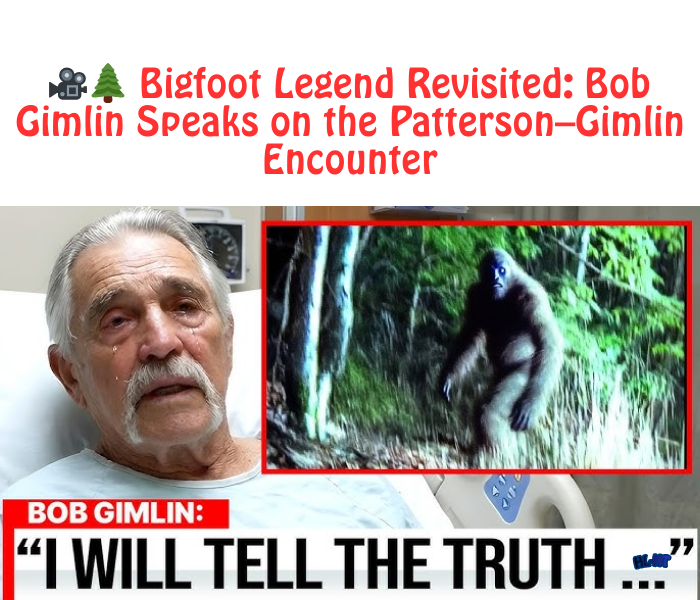
🎥🌲 Bigfoot Legend Revisited: Bob Gimlin Speaks on the Patterson–Gimlin Encounter
🔥 Viral headlines claiming “Before I die, I need to tell the truth” suggest a dramatic confession from Bob Gimlin — the last surviving witness to one of the most famous alleged Bigfoot sightings in American history.
The teasers imply:
-
🤯 A hidden cover-up
-
🎭 A stunning reversal
-
🔐 A secret withheld for decades
But when examining the historical record, the narrative appears far less explosive — and far more consistent.
Rather than a shocking confession, the story remains what it has always been:
A mystery that refuses to fade.
 🎞️ The Patterson–Gimlin Film: A Moment Frozen in 1967
Bob Gimlin is best known for his involvement in the Patterson–Gimlin film, recorded in October 1967 at Bluff Creek, California.
Alongside filmmaker Roger Patterson, Gimlin reported encountering a large, upright, hair-covered figure walking along a sandbar near the creek.
According to their account:
-
🐾 The figure moved across the clearing
-
🎥 Patterson filmed roughly 59 seconds of footage
-
👀 The creature briefly turned its head toward the camera
-
🐎 Gimlin, mounted on horseback, observed the encounter from nearby
The short clip would go on to become one of the most scrutinized pieces of footage in cryptozoological history.
🦍 “Patty”: The Figure That Sparked a Movement
Enthusiasts later nicknamed the filmed figure “Patty.”
In the footage, the subject appears:
👣 Muscular
🦍 Broad-shouldered
🌑 Covered in dark hair
🚶 Moving with a heavy yet fluid gait
Supporters argue the body proportions and stride appear difficult to replicate convincingly with 1960s costume technology.
Skeptics counter that:
-
🎭 A well-designed suit could explain the appearance
-
🎥 Film grain and motion blur exaggerate anatomical features
-
🧍 A human actor could reproduce the gait under controlled conditions
More than half a century later, both sides remain entrenched.
🧠 Bob Gimlin’s Consistent Account
Despite sensational headlines, Bob Gimlin has largely maintained the same version of events for decades:
He claims the encounter was real.
He denies participation in a hoax.
He states he gained little financially from the film’s fame.
Unlike his late counterpart Roger Patterson — who passed away in 1972 — Gimlin has continued to speak publicly at conferences and interviews, often emphasizing that he stands by the original account.
Importantly, there is no verified record of a dramatic deathbed confession or reversal from Gimlin.
The viral framing appears to exaggerate routine interviews into something more explosive.
🔍 Why the Debate Never Ends
The Patterson–Gimlin film occupies a unique space in American folklore because it resists easy resolution.
It is:
-
Too clear to dismiss casually
-
Too ambiguous to confirm definitively
-
Too culturally iconic to ignore
Scientific institutions have never officially recognized the footage as proof of an unknown primate species.
At the same time, no conclusive evidence has emerged proving it was a staged hoax either.
This unresolved tension fuels continued fascination.
📚 Cultural Impact Beyond the Footage
Since 1967, the Patterson–Gimlin film has influenced:
-
📺 Television documentaries
-
📖 Books on cryptozoology
-
🎬 Pop culture portrayals of Bigfoot
-
🌲 Tourism in Northern California
The clip became foundational to the modern Bigfoot movement — shaping how the creature is visually imagined across generations.
Without it, the Sasquatch legend might look very different today.
⚖️ Science, Skepticism, and Storytelling
Mainstream science generally requires:
-
Biological specimens
-
DNA evidence
-
Verifiable physical remains
-
Repeatable observational data
The Patterson–Gimlin footage, while intriguing, does not meet those criteria.
However, folklore and cultural mythology operate under different standards — driven by narrative continuity and emotional resonance rather than laboratory validation.
That duality keeps the film alive in public consciousness.
🌲 A Mystery That Endures
So what about the headline claiming a final revelation?
As of now, there is no documented confession overturning the 1967 story.
Instead, Bob Gimlin continues to affirm what he has said for decades:
He believes he witnessed something extraordinary at Bluff Creek.
Whether that “something” was an undiscovered species, a misidentification, or an elaborate hoax remains unsettled.
Not because of a last-minute confession.
But because the footage — brief, grainy, and iconic — sits permanently in the gray area between proof and possibility.