🏺📜 Jerusalem Discovery Debate: What Did Eilat Mazar Really Find?
🏺📜 Jerusalem Discovery Debate: What Did Eilat Mazar Really Find?
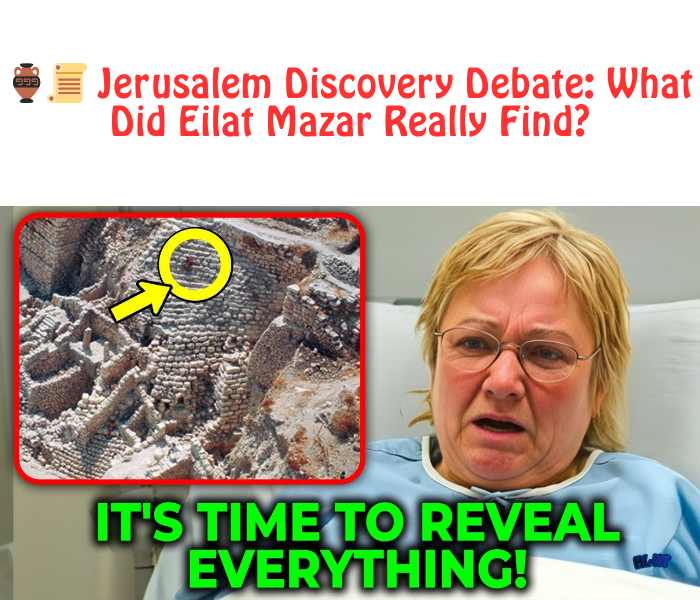
🔥 Online headlines sometimes hint at a dramatic “deathbed confession” — a hidden structure beneath King David’s palace that could supposedly rewrite biblical history.
They suggest:
-
🔐 Suppressed knowledge
-
📜 Secret revelations
-
⚡ A seismic shift in archaeology
But the documented work of Eilat Mazar tells a far more nuanced — and academically grounded — story.
There is no verified public record of a hidden final confession overturning her life’s work. Instead, her legacy rests on careful excavation, bold interpretation, and vigorous scholarly debate.
 🏙️ Excavating the City of David
For decades, Mazar conducted excavations in the City of David, located just south of Jerusalem’s Old City. The area is traditionally associated with the earliest urban core of ancient Jerusalem.
Her research focused heavily on the Iron Age (10th century BCE) — the period historically linked in biblical tradition to the reigns of:
-
👑 King David
-
👑 King Solomon
Archaeological work in Jerusalem is uniquely complex. The city contains thousands of years of layered occupation, meaning discoveries must be interpreted within overlapping historical strata.
🧱 The 2005 “Large Stone Structure”
In 2005, Mazar announced the discovery of what she described as a “Large Stone Structure” at the excavation site.
Based on pottery analysis, architectural style, and stratigraphy, she proposed that the structure could date to the 10th century BCE — potentially aligning with the biblical description of a royal building.
Some supporters suggested it might even be connected to the palace of King David.
⚖️ That proposal immediately sparked intense academic debate.
📚 Scholarly Debate: Evidence and Interpretation
Archaeology rarely offers instant consensus — especially in a city as historically and politically significant as Jerusalem.
Following Mazar’s announcement:
✔️ Some archaeologists supported her dating methods and interpretation.
❓ Others questioned whether the structure might belong to a later period.
🧪 Additional analysis examined pottery typology, carbon dating, and architectural parallels.
Critics argued that while the structure was undoubtedly significant, linking it directly to King David required interpretive leaps beyond currently available evidence.
Supporters countered that the dating evidence reasonably aligned with biblical chronology.
The disagreement was methodological — not conspiratorial.
🔍 No “Deathbed Confession” in the Record
Despite viral claims implying a final revelation, there is no credible documentation of Mazar retracting her findings or exposing hidden contradictions.
Instead, her published work and public statements consistently reflected:
-
Commitment to textual-historical correlation
-
Willingness to propose bold hypotheses
-
Engagement with peer criticism
-
Continued excavation and refinement of interpretation
Her academic legacy is not defined by secrecy — but by participation in an ongoing scholarly conversation.
🧠 How Archaeology Actually Works
Jerusalem excavations are rarely definitive.
They proceed:
🧱 Layer by layer
📚 Evidence by evidence
🗣️ Debate by debate
Artifacts must be interpreted within context:
-
Stratigraphic positioning
-
Associated pottery styles
-
Radiocarbon results
-
Architectural comparisons
-
Historical texts
Even then, conclusions often remain provisional.
That is not weakness.
It is the scientific process.
🌍 Why Jerusalem Discoveries Spark Global Attention
Few cities carry the symbolic weight of Jerusalem.
Findings there intersect with:
-
Religious tradition
-
National identity
-
Academic scholarship
-
Cultural heritage
Because of this, archaeological interpretations often draw intense global scrutiny.
A proposed connection to King David — a foundational figure in biblical history — naturally amplifies debate.
🏺 Mazar’s Lasting Impact
Eilat Mazar’s work contributed significantly to the understanding of Iron Age Jerusalem.
Her excavations uncovered:
-
Monumental architectural remains
-
Administrative bullae (seal impressions)
-
Pottery assemblages tied to specific strata
Whether or not every interpretation gains universal acceptance, her research expanded the dataset available to future scholars.
That is the true foundation of archaeological progress.
📌 The Real Story
The Jerusalem discovery debate is not about hidden confessions or suppressed truths.
It is about:
✔️ Competing interpretations
✔️ Evolving evidence
✔️ Ongoing research
✔️ Academic rigor
In a city layered with millennia of history, few discoveries emerge without controversy.
And that’s exactly how archaeology is supposed to work.
Not through dramatic revelations.
But through careful excavation, critical analysis, and open debate.