Middle East Update — March 1: Iran Blocks Strait of Hormuz, U.N. Security Council Holds Emergency Meeting
Middle East Update — March 1: Iran Blocks Strait of Hormuz, U.N. Security Council Holds Emergency Meeting
Tensions in the Middle East continued to escalate sharply on March 1, 2026, as the impact of renewed U.S.–Israeli strikes on Iran and subsequent Iranian retaliation have reshaped regional security dynamics and triggered high-level diplomatic responses.
📍 Iran Blocks the Strait of Hormuz
In response to ongoing military confrontations, Iran’s Islamic Revolutionary Guard Corps issued warnings via radio that “no ship is allowed to pass the Strait of Hormuz,” effectively signaling a blockade of this crucial waterway.
The Strait of Hormuz — the narrow sea channel linking the Persian Gulf to the Gulf of Oman and the Arabian Sea — is one of the world’s most critical maritime routes. It handles roughly 20% of global oil shipments, including crude oil and liquefied natural gas (LNG).
The Iranian announcement has prompted:
-
Major shipping companies to halt or reroute transits through the strait amid safety concerns.
-
Oil and gas traders to suspend crude and LNG movements in the region, contributing to severe disruptions in global energy transport.
-
Commercial insurers and naval advisories to warn vessels to avoid the Persian Gulf and adjacent waters pending stabilization.
Although the blockade order has not been formally confirmed by Tehran as a legal decree, repeated radio warnings and heightened tensions have significantly curtailed maritime traffic.
🛑 Emergency Meeting at the United Nations Security Council
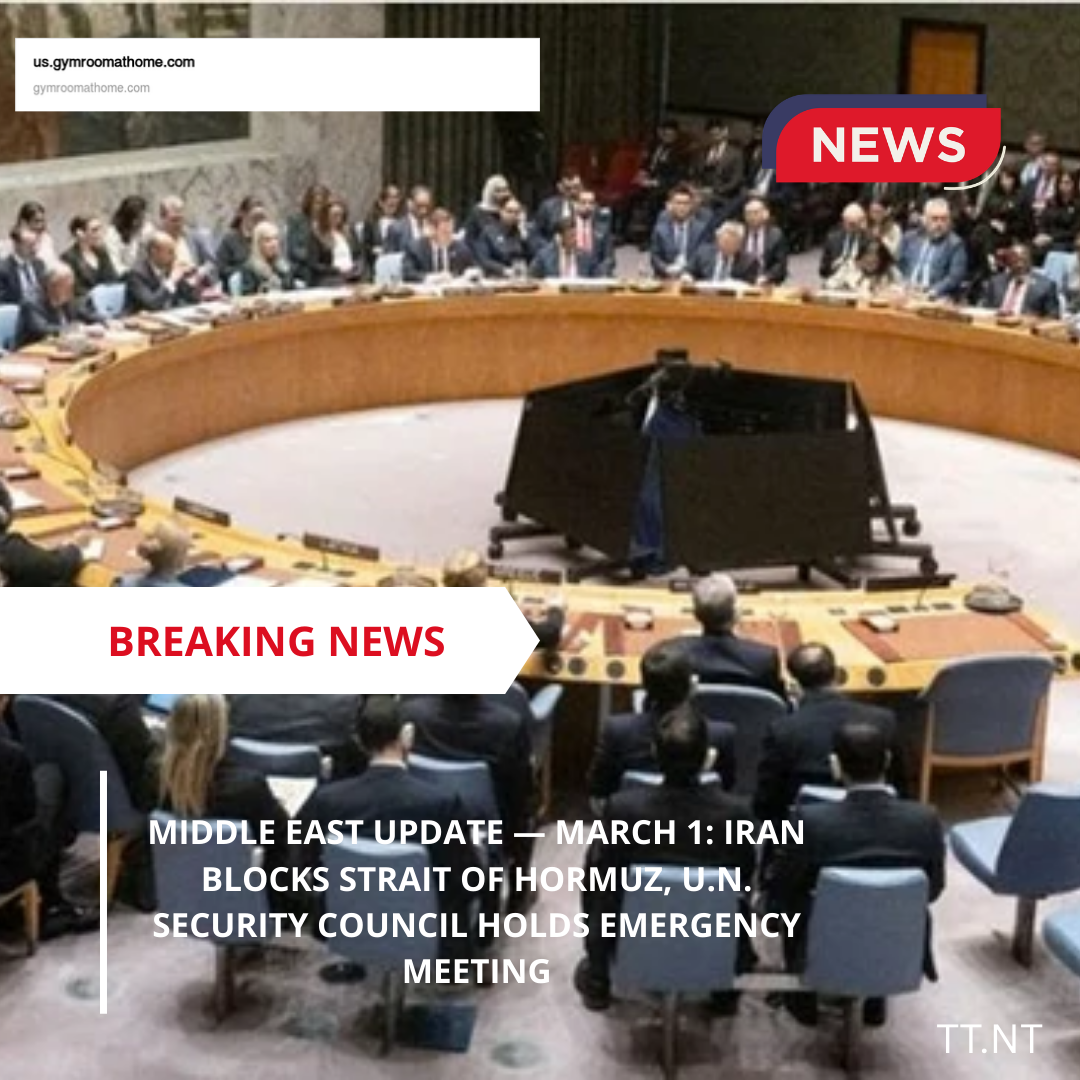
Amid the escalating military situation, the United Nations Security Council convened an emergency session to address the rapidly deteriorating crisis.
During the meeting:
-
U.N. Secretary-General António Guterres condemned both U.S.–Israeli strikes and Iranian retaliatory attacks, cautioning that continued violence risks spilling into a broader regional war.
-
The U.S. defended its military action as lawful, asserting national and international security justifications.
-
Iran’s U.N. ambassador accused U.S. and Israeli forces of violating international law and committing war crimes, highlighting reported civilian casualties and infrastructure damage.
-
Russia and China urged an immediate halt to hostilities and a return to diplomacy, underscoring concern about a wider humanitarian and security crisis.
The sharp diplomatic divisions at the council reflect broader global unease over the conflict’s implications for international peace and stability.
🌍 Wider Regional Impact
The blockade of Hormuz and the Security Council’s urgent discussions underscore both economic and geopolitical fallout:
-
Global energy markets are facing one of the biggest supply shocks in decades, with oil prices rising amid fears of prolonged disruption.
-
Nations with strategic interests in the Gulf — especially those hosting foreign military assets — remain on high alert amid ongoing missile and drone exchanges.
-
The heightened instability has prompted travel advisories, airspace closures, and evacuations of foreign nationals from the region.