The First Face of Memory: A 9,000-Year-Old Portrait from Jericho
- SaoMai
- March 3, 2026
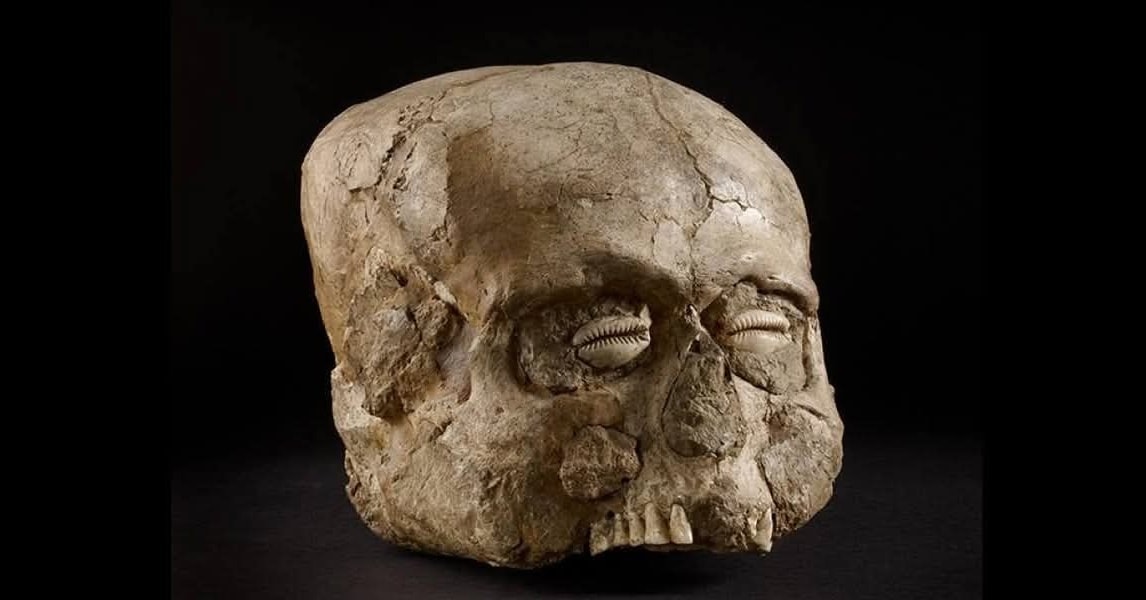
Around 7000 BC, in one of the world’s earliest settled communities, a remarkable act of remembrance took place. In the ancient city of Jericho, mourners carefully removed the skull of a deceased man and transformed it into something extraordinary—what may be the oldest surviving portrait in the collection of the Ashmolean Museum.
This haunting artifact was unearthed in 1953 by the renowned British archaeologist Kathleen Kenyon, who discovered it alongside six other similarly treated skulls. Her interpretation was both bold and evocative: these were not merely human remains, but deliberate attempts to preserve the likeness of the dead. If correct, this plastered skull represents one of humanity’s earliest efforts to capture an individual’s face—an intimate portrait crafted nearly 9,000 years ago.
 The skull belonged to an adult male. Evidence suggests that his head had been intentionally shaped during infancy, possibly by binding cloth tightly around it while the bones were still soft. Such cranial modification may have signified elevated status, identity, or belonging within his community from an early age. Whoever he was, he appears to have been someone important.
After death, his body was likely left to decompose naturally. Only once the flesh and sinews had decayed was the skull carefully removed. Artisans then modeled fine plaster over the front of the bone, delicately reconstructing the contours of his face. The eye sockets were filled with cowrie shells, their smooth white surfaces creating a striking, almost lifelike gaze. The back of the skull, however, was left uncovered—perhaps originally adorned with organic materials to represent hair, now long vanished with time.
This remarkable object dates to a transformative era in human history. Around 7000 BC, clay technology was reshaping Neolithic societies. Communities were experimenting with early pottery, crafting figurines of animals and humans, and building more permanent settlements. The plastered skull belongs to this creative surge—a testament not only to technical skill but to emotional depth.
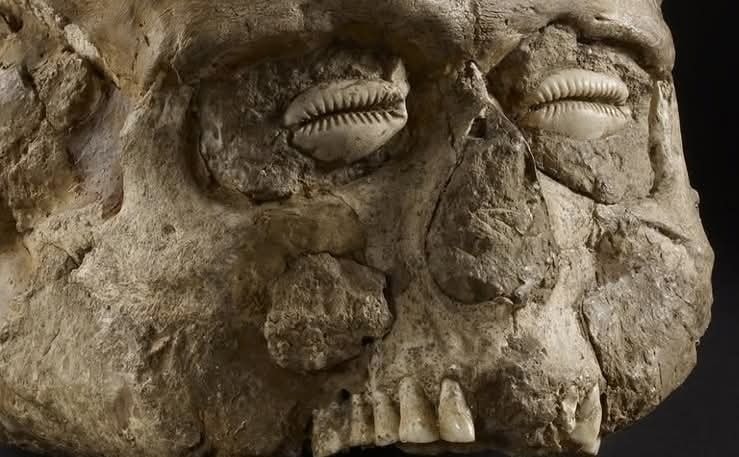 More than a ritual artifact, the skull speaks to memory and identity. It suggests that these early communities sought to maintain bonds with their ancestors, preserving their presence within the living world. By recreating a recognizable face, they may have reinforced lineage, continuity, and social cohesion.
In this silent, shell-eyed visage, we glimpse one of humanity’s first attempts to defy oblivion—to hold onto a face, a story, a life. It is not merely an object from the past. It is a portrait of remembrance itself.