Face to Face with a Giant: The Astonishing Scale of Argentinosaurus
- SaoMai
- March 3, 2026
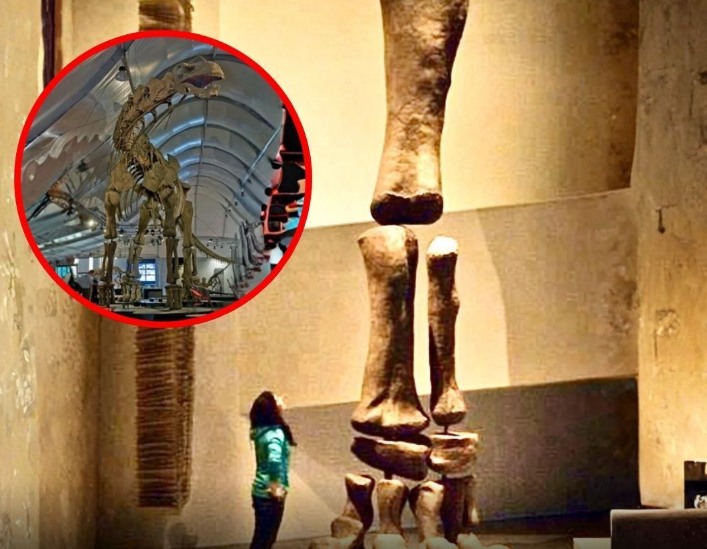
Imagine standing beside a creature so vast that your entire body would barely reach the height of its knee. That staggering comparison becomes reality when placed next to the leg of Argentinosaurus huinculensis, one of the largest land animals ever to walk the Earth. Living approximately 94 to 97 million years ago during the Late Cretaceous period, this colossal herbivore roamed the ancient floodplains of what is now Argentina, dominating its environment through sheer scale alone.
Argentinosaurus belonged to the titanosaurs, a subgroup of sauropods recognized for their elongated necks, immense torsos, and thick, pillar-like legs built to bear unimaginable weight. Estimates suggest this giant could stretch up to 35 meters in length—longer than a blue whale—and weigh between 70 and 100 metric tons. To put that into perspective, that’s equivalent to the combined mass of dozens of elephants. Its leg bones, among the largest ever discovered, were engineered like living columns, capable of supporting the weight of an entire crowd of people.
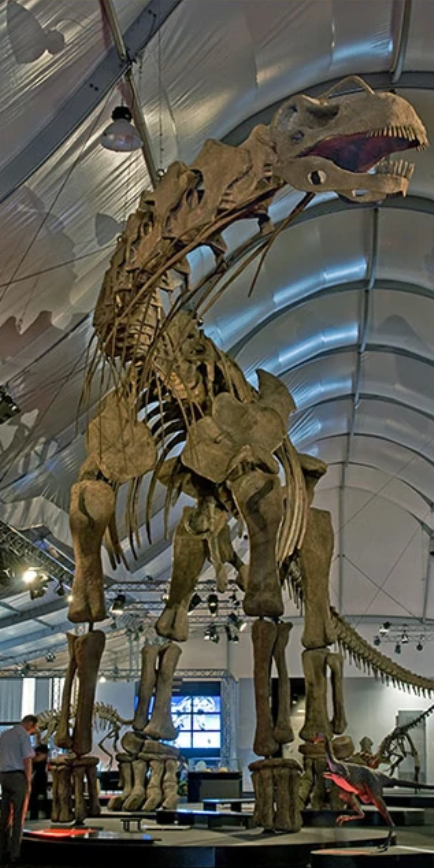 The first fossils were uncovered in 1987 in Patagonia’s Huincul Formation. Although only partial remains have been found, paleontologists reconstructed its extraordinary proportions by comparing the recovered bones—especially the massive femur and tibia—with those of related titanosaurs. Even these fragments reveal an animal of almost incomprehensible magnitude. Every ridge and muscle attachment point hints at the tremendous strength required to move such a body.
Standing next to a reconstructed leg bone in a museum display is a humbling experience. A full-grown human appears almost miniature, like a figurine placed beside a monumental column. Movement for Argentinosaurus would have required immense muscular coordination, and its cardiovascular system must have been equally impressive.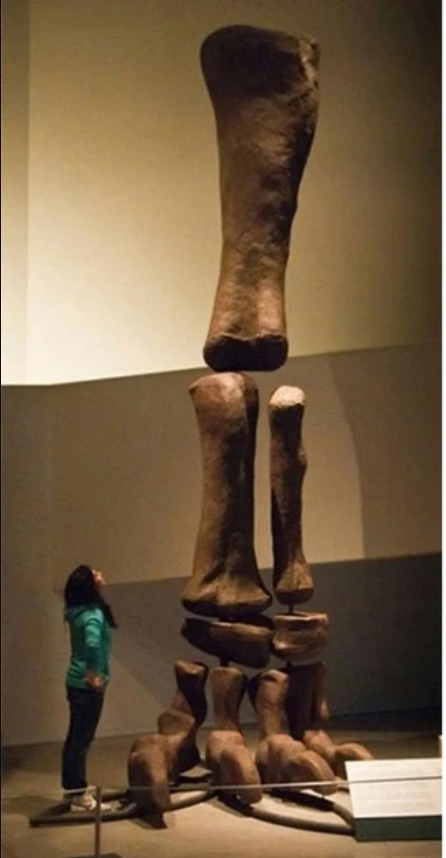 Its heart likely needed to pump blood several meters upward to reach its brain, while enormous lungs sustained its vast body. The long neck—one of its defining features—allowed it to feed efficiently, sweeping across wide stretches of vegetation or reaching high into treetops without shifting its tremendous bulk.
Yet Argentinosaurus was more than just size. It was part of a dynamic ecosystem in Cretaceous South America, sharing its world with formidable predators and other giant herbivores. Studying these animals helps scientists understand evolutionary biology, biomechanics, growth rates, and the environmental conditions that permitted sauropods to reach such record-breaking dimensions.
And here’s a fascinating twist: despite weighing up to 100 tons, Argentinosaurus likely laid eggs measuring only about 30 centimeters in length—astonishingly small compared to its adult size. From such modest beginnings emerged one of the most colossal creatures in Earth’s history, a true titan of the prehistoric world.