The Sun Throne of Persia: Power, Splendor, and the Lady Peacock
- SaoMai
- March 3, 2026
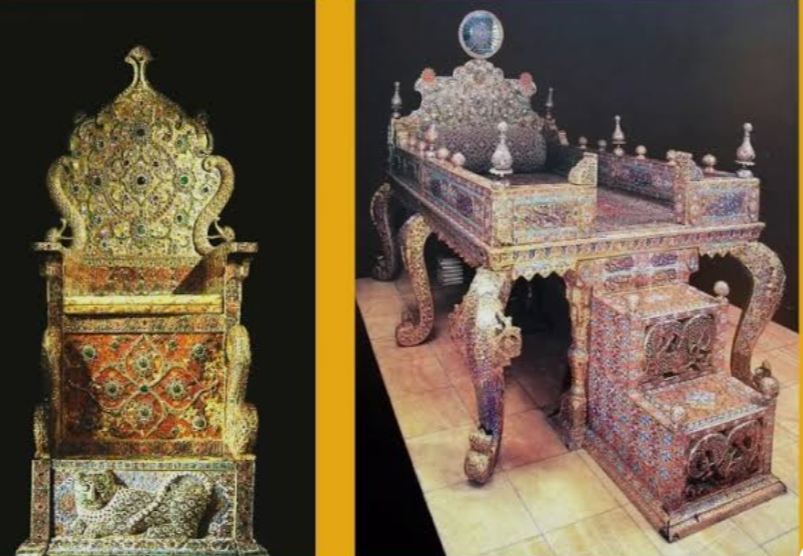
Few royal objects capture the drama of Persian history like the Sun Throne—later known to the world as the Peacock Throne—the imperial throne of Iran. Radiant in symbolism and layered with romance, politics, and ceremony, it stands as a striking emblem of Qajar grandeur.
Commissioned in the early nineteenth century for Fath-Ali Shah Qajar, the throne was conceived as a powerful visual statement of kingship. Its formal name, the Sun Throne, derives from the large, dazzling sun disk mounted on its headboard—a symbol deeply rooted in Persian concepts of divine glory and royal authority. The sun, long associated with sovereignty and cosmic order in Iranian tradition, reinforced the Shah’s image as a ruler illuminated by celestial favor.
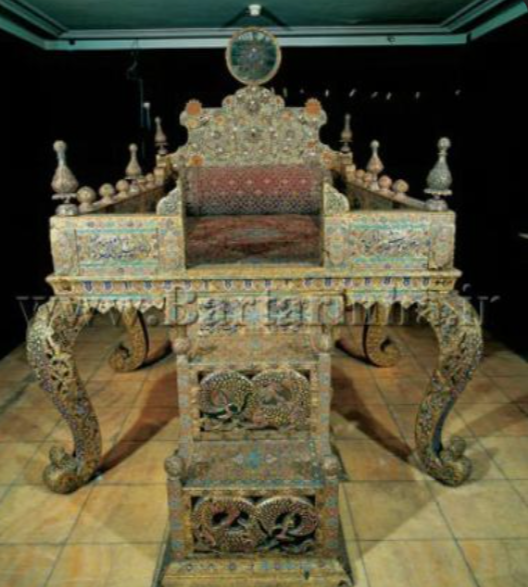 Architecturally, the throne takes the form of an elevated platform rather than a conventional chair. In this respect, it resembles the famous Marble Throne at Golestan Palace in Tehran. The platform design allowed the monarch to sit visibly above courtiers during ceremonies, emphasizing hierarchy and magnificence. A later royal seat, the Naderi Throne, would adopt a more chair-like appearance, marking a stylistic shift in court presentation.
From its creation onward, the Sun Throne became the official coronation seat of the Qajar shahs. It was not merely furniture; it was a stage upon which dynastic legitimacy was performed. Crowning rituals, diplomatic receptions, and grand celebrations unfolded upon its elevated surface, embedding it deeply into Iran’s royal identity.
Yet its most poetic association comes from a royal marriage. Among Fath-Ali Shah’s many consorts was Tavous Khanum Taj ol-Doleh. In Persian, “Tavous” means peacock, and her name translates into English as “Lady Peacock.” 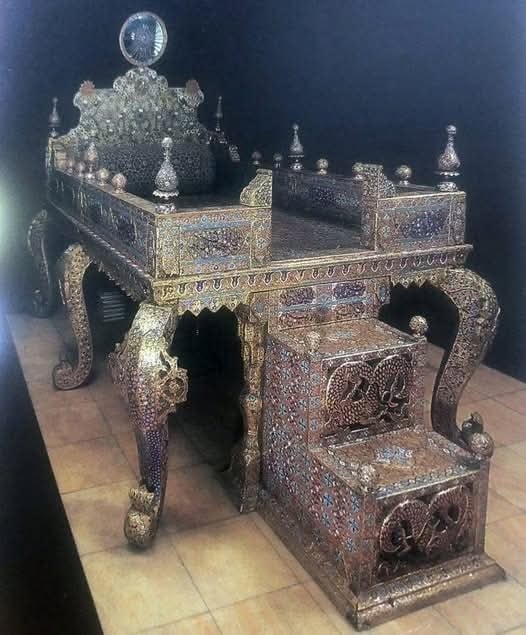 Their wedding ceremony was held upon the throne itself, and she soon became the Shah’s favorite wife. Over time, the throne became popularly known as the “Peacock Throne,” not because of an elaborate bird motif, but because of this cherished consort’s name. The romantic connection gradually overshadowed its original solar symbolism.
Since 1980, the throne has been displayed at the Central Bank of the Islamic Republic of Iran, where it remains a treasured artifact of Iran’s imperial past. Though dynasties have fallen and political systems transformed, the Sun—Peacock—Throne endures as a glittering witness to ceremony, ambition, and love within the Qajar court.
It is a reminder that history’s grandest symbols often carry not just political power, but deeply human stories woven into their golden frames.