The Mystery of the Pyramids: How Ancient Egyptians Built the Wonders of Giza – Detailed Reconstruction and Modern Theories
The Mystery of the Pyramids: How Ancient Egyptians Built the Wonders of Giza – Detailed Reconstruction and Modern Theories
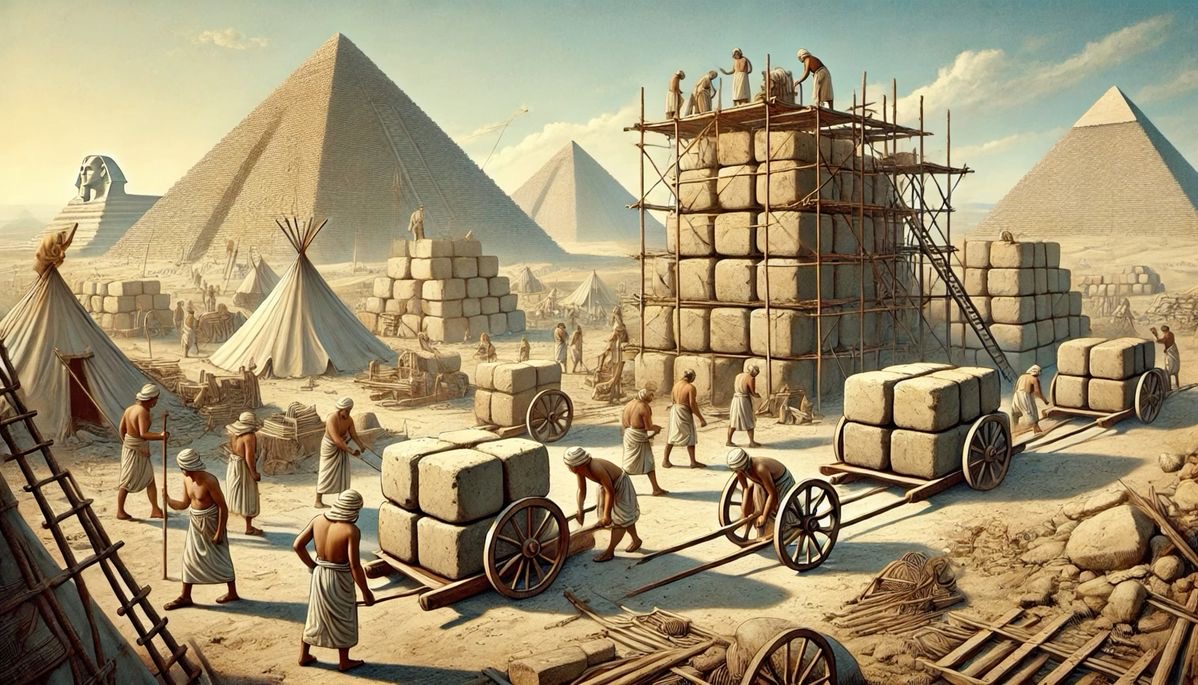
 The Pyramids of Giza stand as one of humanity’s greatest architectural achievements, built over 4,500 years ago during Egypt’s Old Kingdom. These colossal structures – especially the Great Pyramid of Khufu (also known as Cheops), the Pyramid of Khafre, the Pyramid of Menkaure, and the iconic Great Sphinx – continue to captivate the world with their precision, scale, and enduring mystery. How did the ancient Egyptians, without modern machinery, move and place millions of massive limestone blocks weighing an average of 2.5 tons each (some up to 80 tons for granite elements)? This comprehensive guide explores the historical context, key construction techniques, leading modern theories, and visual reconstructions that bring the building process to life.
The Evolution from Step Pyramids to True Pyramids
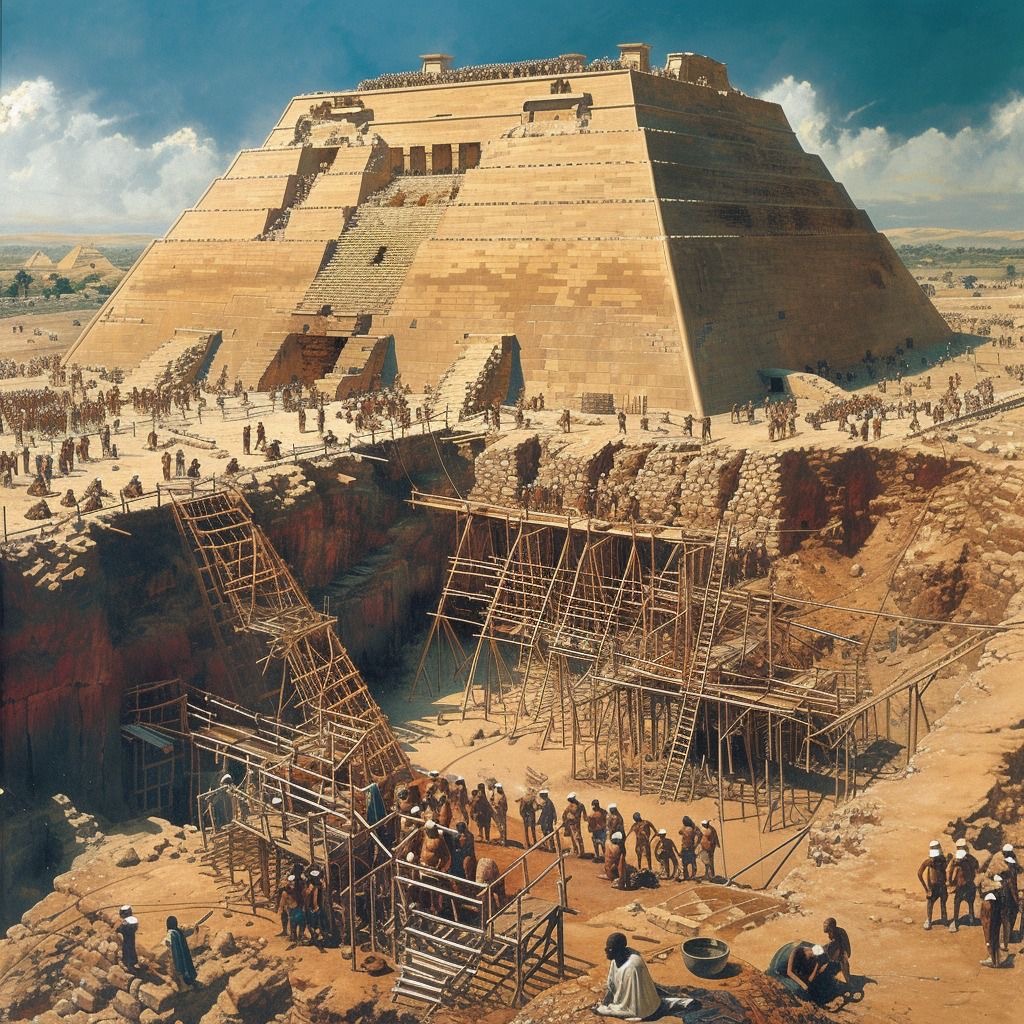
Pyramid construction began with the Step Pyramid of Djoser at Saqqara, designed by the architect Imhotep around 2630–2611 BCE. This was the world’s first large-scale stone monument, evolving from earlier mastaba tombs into a six-tiered stepped structure reaching about 62 meters tall. Reconstructions show thousands of workers swarming scaffolding-covered levels, hauling stones up zigzag ramps, and coordinating in organized teams. Recent studies (2024) propose an innovative hydraulic lift system inside the pyramid: water from a nearby “dry moat” filled shafts, creating pressure to float platforms carrying heavy blocks upward in a “volcano fashion.” This advanced water management – including dams, filtration, and controlled flow – highlights early Egyptian hydraulic engineering genius.
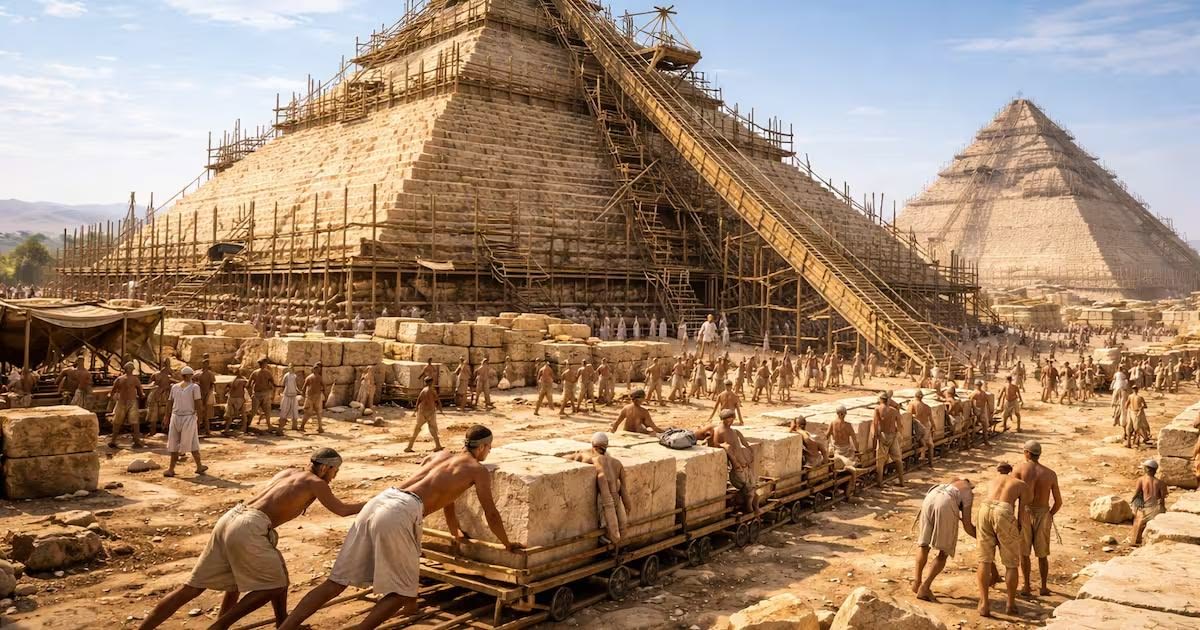
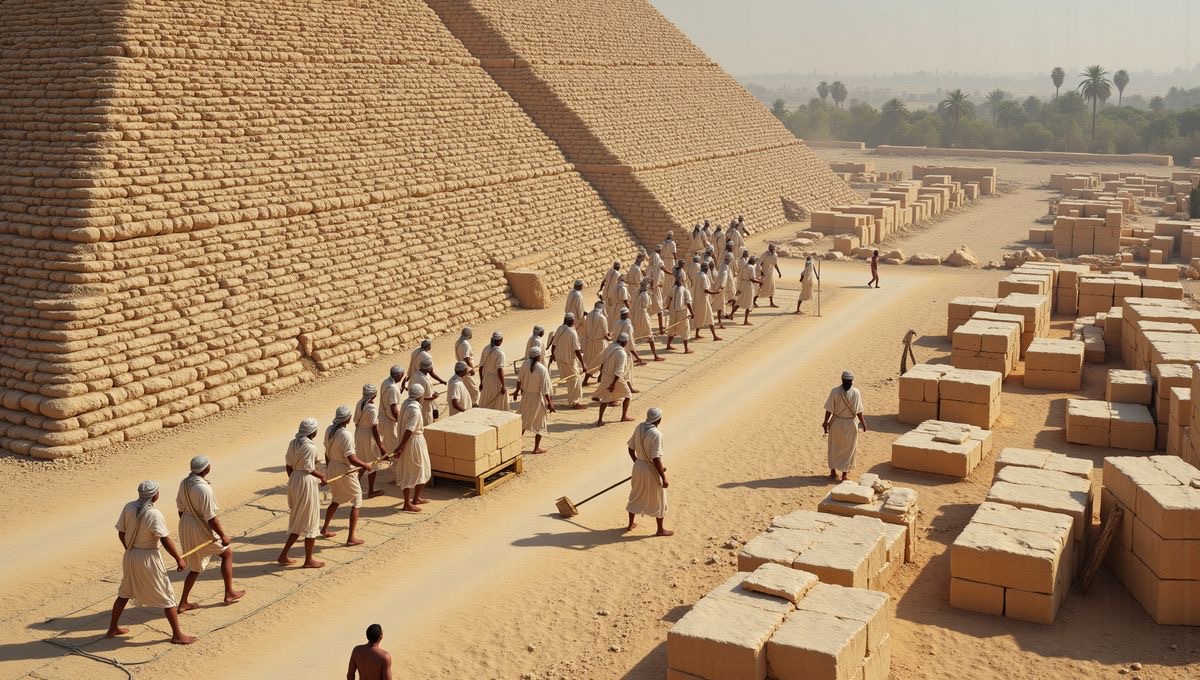
From Djoser’s stepped design, builders progressed to smoother, true pyramids at Giza. The Great Pyramid (completed around 2560 BCE) used over 2.3 million blocks, built in roughly 20 years with an estimated workforce of 20,000–30,000 skilled laborers (not slaves, but paid workers, farmers during Nile floods, and overseers). Reconstructions depict bustling sites: long human chains pulling sleds along paths, scaffolding enveloping half-built structures, and ramps climbing toward the apex under golden desert sunsets.
Core Construction Techniques: Ramps, Sleds, and Ingenious Hacks
The most widely accepted foundation for pyramid building involves ramps combined with simple yet brilliant tools:
- Sleds and Wet Sand Trick — Workers dragged blocks on wooden sleds using thick ropes. Modern experiments confirm pouring water on sand reduced friction dramatically, allowing fewer people to pull heavier loads efficiently.
- Levers, Rollers, and Pulleys — Teams used wooden levers to pry and position blocks precisely, rollers for flat movement, and early pulley-like systems for lifting.
- On-Site Quarrying — Much limestone came from nearby Giza quarries; granite from Aswan traveled via the Nile on barges. Stones were shaped at the base before hauling upward.
- Layer-by-Layer Precision — Blocks were placed in precise courses, with the pyramid growing from the inside out or via external supports.
A 2018 discovery at the Hatnub alabaster quarry revealed a 4,500-year-old ramp system with a central incline flanked by staircases and post holes. Ropes tied to wooden posts allowed teams to pull sleds up steep slopes (over 20% grade), multiplying human effort through mechanical advantage.
Leading Modern Theories on How the Great Pyramid Was Built
Scholars debate ramp configurations due to the pyramid’s massive scale and the lack of direct evidence (most ramps were dismantled after completion). Key theories include:
- External Straight or Zigzag Ramps
The classic model: long, straight ramps extended from the pyramid base, gradually raised as layers added. Zigzag or wrapping ramps spiraled around the structure. Pros: Simple and supported by quarry evidence. Cons: A ramp to the top would require enormous material and space, potentially blocking views or requiring massive dismantling. - Spiral External Ramp
A ramp wrapping around the pyramid like a spiral staircase. This minimizes material but creates steep turns challenging for heavy blocks. - Internal Spiral Ramp (Jean-Pierre Houdin Theory)
Popularized by French architect Jean-Pierre Houdin, this suggests an internal ramp spiraling inside the pyramid (about 7% grade, 6 feet wide). Short external ramps at the base transitioned to internal ones. The Grand Gallery may have served as a counterweight system for lifting heavier stones. Microgravimetry scans show possible voids supporting hidden internal structures. This explains missing external ramp debris and fits the pyramid’s internal features. - Internal Pulley and Counterweight System (Recent 2025–2026 Studies)
Emerging research proposes the pyramid was built “inside-out” using pulley-like mechanisms powered by sliding granite counterweights down internal sloped passages (reinterpretations of the Ascending Passage and Grand Gallery). This allowed rapid, precise lifting without massive external ramps. Calculations suggest it matches the 20-year timeline and explains architectural anomalies. - Hybrid and Alternative Ideas
Some combine short external ramps with internal systems. Fringe theories (e.g., geopolymer concrete casting) have been largely debunked by stone analysis showing natural limestone with tool marks.
The Great Sphinx: Guardian of the Plateau
Carved from the same limestone bedrock as the pyramids (around 2558–2532 BCE, likely under Khafre), the Great Sphinx measures 73 meters long and 20 meters high. It guards the complex with a lion’s body and pharaoh’s head (possibly Khafre’s face). Reconstructions show it emerging from a deep quarry pit, surrounded by scaffolding during carving and restoration. Tourists today swarm its paws, emphasizing its colossal scale against the pyramids.
Why the Pyramids Remain an Enduring Marvel
The Giza complex demonstrates extraordinary organization: precise astronomical alignment, advanced surveying, and logistical mastery (feeding workers, transporting materials via Nile canals). Modern aerial views show the pyramids rising amid Cairo’s sprawl – ancient eternity against modern chaos.
From stepped beginnings at Djoser to the perfect geometry of Khufu, ancient Egyptians achieved feats that still inspire awe. Ongoing discoveries – ramps, voids, hydraulic clues – continue refining our understanding, proving human ingenuity, not extraterrestrial help, built these wonders.
What theory resonates most with you? The internal ramps? Hydraulic lifts? Or the sheer power of organized labor? Share in the comments! #AncientEgypt #PyramidsOfGiza #GreatPyramid #Sphinx #Archaeology #EngineeringHistory #AncientWonders