Hudson’s Heart Journey: A Family’s Battle with SVT and the Miracle of Expert Care
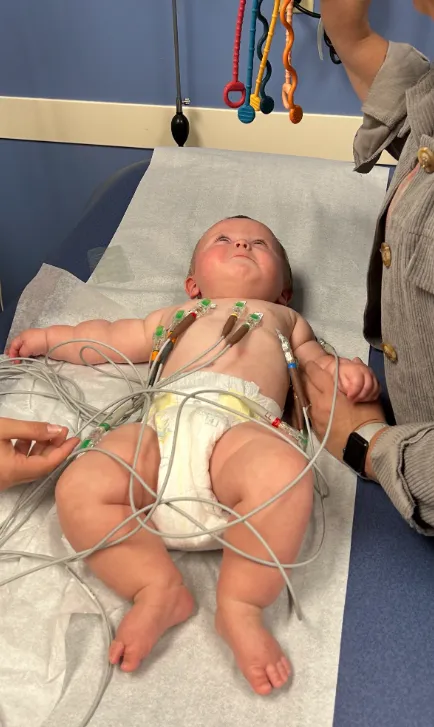
A frightening moment no parent expects
When baby Hudson was just 17 days old, his parents were still adjusting to life with their newborn. Like most families welcoming a new baby, their days were filled with feeding schedules, sleepless nights, and the quiet joy of watching their son grow.
Everything seemed perfectly normal.
But one day, their peaceful routine suddenly turned into a terrifying emergency.
Hudson’s mother noticed that something was wrong. The baby who had been alert and lively suddenly looked pale and unresponsive. His behavior felt different, and her instincts told her something was seriously wrong.
To check on him, she looked at their Owlet baby monitor, a device designed to track a baby’s heart rate and oxygen levels during sleep.
The reading confirmed her fear — Hudson’s heart was beating abnormally fast.
Within minutes, the family rushed their tiny newborn to the emergency room.
A dangerous heart rhythm
At the hospital, doctors quickly discovered the cause of the emergency.
Hudson was experiencing Supraventricular Tachycardia (SVT).
SVT is a condition in which the heart suddenly begins to beat much faster than normal due to electrical signals in the upper chambers of the heart. When this happens, the body may struggle to circulate blood efficiently.
In infants, the condition can cause symptoms such as:
-
Pale or gray skin
-
Difficulty feeding
-
Unusual sleepiness or lethargy
-
Rapid breathing
In severe cases, babies can become dangerously weak or unresponsive.
For Hudson’s parents, hearing that their newborn’s heart was racing uncontrollably was terrifying.
Doctors immediately began treatment.
After several rounds of medication, Hudson’s heart rhythm finally returned to normal.
For the first time since the crisis began, his parents could breathe again.
A cautious return home
Hudson stayed overnight in the hospital so doctors could monitor his condition closely.
By the next day, his heart rhythm remained stable, and the medical team felt confident enough to allow the family to return home.
The relief was enormous.
Still, Hudson’s parents carried a quiet fear with them.
Doctors could not guarantee the episode would never happen again.
And unfortunately, only three days later, their fears became reality.
Hudson’s heart began racing again.
Once more, the family rushed to the emergency room.
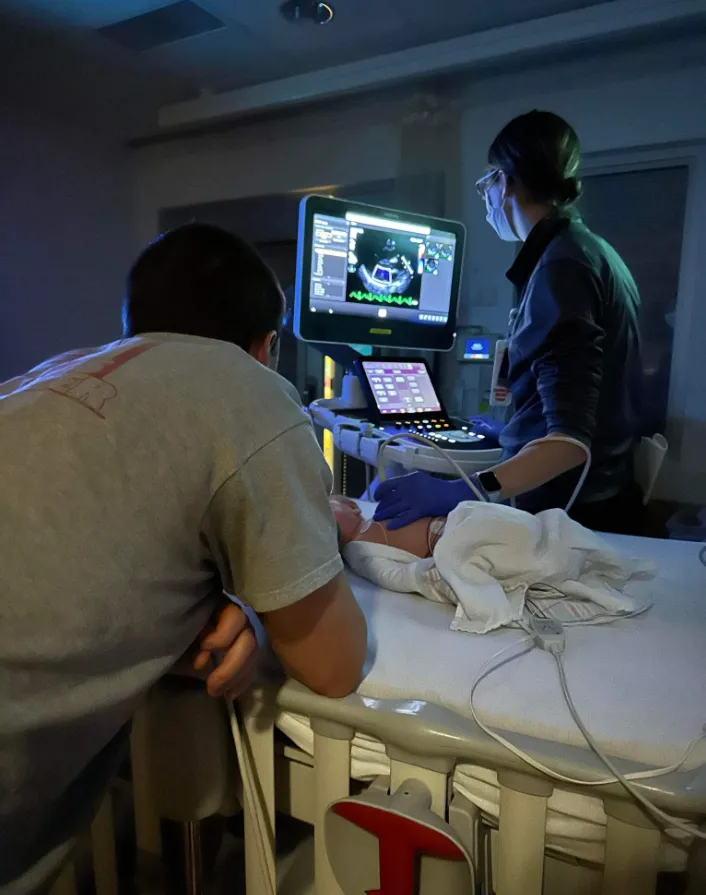
Five anxious days in the hospital
This second episode meant Hudson would remain in the hospital longer.
Doctors admitted him for observation and began adjusting medications to control his heart rhythm.
For the next five days, the family lived inside the hospital walls.
Each day brought a mixture of anxiety and cautious hope. Doctors carefully monitored Hudson’s heart while experimenting with medication doses safe enough for such a tiny patient.
Treating newborns is especially delicate.
Their bodies are incredibly small, and medications must be carefully measured to balance effectiveness and safety.
Throughout the process, the family worked closely with specialists at Cincinnati Children’s Hospital Medical Center, one of the leading pediatric hospitals in the United States.
Doctors who never stopped fighting for Hudson
Hudson’s parents quickly developed deep trust in the doctors and nurses caring for their son.
The medical team remained committed to finding the right treatment plan. Every adjustment to medication, every test, and every observation was made with careful attention to Hudson’s well-being.
Families facing serious medical conditions often describe hospital staff as more than just healthcare workers.
They become partners, guides, and emotional support during one of the most stressful periods of a parent’s life.
For Hudson’s parents, the dedication of the Cincinnati Children’s team made an enormous difference.
Gratitude in the middle of a difficult journey
Despite the fear and uncertainty, Hudson’s parents tried to focus on gratitude.
They knew that many children with heart rhythm disorders require far longer hospital stays and more complicated treatments.
Compared with those situations, Hudson’s hospital stay was relatively short.
They also felt incredibly fortunate that one of the country’s top pediatric hospitals was located close to their home.
Knowing that expert care was nearby provided comfort during every follow-up visit.
Hudson’s cardiologist, Dr. Baskar, continued monitoring his progress carefully through regular check-ups.
Each appointment brought the family a little more hope.
Seven months later: a thriving baby
Seven months after that terrifying first emergency, Hudson’s life looked very different.
The fragile newborn who once struggled with dangerous heart rhythms had grown into a happy, energetic baby.
His personality was shining through.
Friends and family adored his chubby cheeks and bright smile, and it was hard to believe that only months earlier his life had hung in the balance.
For his parents, every milestone now carried deeper meaning.
A giggle.
A new sound.
A tiny hand reaching out.
All of these moments felt like victories.
A hopeful update
During one recent follow-up appointment, Hudson’s family received wonderful news.
Doctors felt confident enough to begin slowly reducing his medication.
This step suggested that his heart might be stabilizing as he grows.
Although doctors will continue monitoring him carefully, the possibility of living without medication felt like a major milestone for the family.
It was proof of how far Hudson had come.
A reminder of life’s fragility
Looking back, Hudson’s parents say the experience changed the way they see life.
They learned how quickly normal days can turn into emergencies.
But they also discovered the incredible strength that can emerge during moments of crisis.
Most importantly, they learned never to take a single moment with their son for granted.
A story of resilience and care
Hudson’s journey is a powerful reminder of the importance of early detection, skilled medical care, and parental intuition.
Without his mother noticing the early signs — and acting quickly — the outcome could have been very different.
Today, Hudson continues growing into a lively little boy surrounded by love.
His story is not just about surviving a heart condition.
It’s about the dedication of doctors, the strength of parents, and the resilience of a tiny heart that refused to stop fighting.
And for Hudson’s family, every smile and every heartbeat is a reminder of how precious life truly is.