The Long Road to Healing: What Families Face After Heart Surgery Isn’t What Anyone Warns Them About
They believed survival would be the finish line.
For many parents, the hardest part of their child’s heart surgery seems obvious: the long hours in hospital corridors, the tension before the operation begins, the surgeon walking out with news that could change everything in a single sentence. That moment becomes the emotional peak of the journey—the point where fear either turns into relief or heartbreak.
But what comes after is rarely talked about.
Because for countless families, survival is not the end of the story. It is the beginning of a quieter, longer, and often far more confusing battle—one that unfolds slowly at home, away from monitors and medical teams, where progress is no longer measured in survival alone but in development, recovery, and uncertain milestones.
And nothing truly prepares parents for that shift.
When “Successful Surgery” Doesn’t Mean Recovery Is Over
At first, everything seems to be going well.
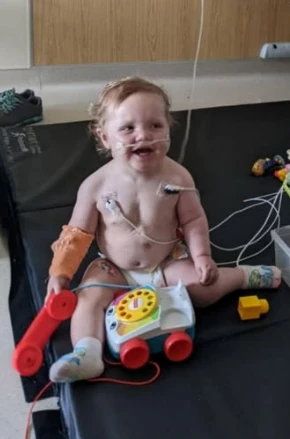
The child is alive. Breathing without machines. Eating again. Smiling, even laughing. Parents return home with a fragile sense of relief, believing the worst has passed.
But then something subtle begins to change.
The milestones that once felt natural suddenly feel delayed. A child who should be rolling over struggles to move. Holding a toy becomes difficult. Sitting upright takes more effort than expected. Crawling, walking, speaking—each stage of early development begins to stretch further away than it should.
These changes are easy to miss in isolation. After all, recovery is supposed to take time. Doctors say this repeatedly: healing is not linear.
But what they don’t always explain is just how uneven that path can be.
The Hidden Developmental Struggles No One Talks About
As weeks turn into months, patterns emerge.
Parents start noticing gaps between their child and others of the same age. Not because the child is not trying—but because their body simply isn’t keeping pace. Muscles may be weaker. Coordination may be delayed. Fatigue may appear where energy should be.
The realization is slow, then overwhelming.
Research shows that a significant number of children who undergo major cardiac procedures experience developmental delays after surgery. Yet for parents living through it, statistics feel distant. What matters is the day-to-day reality: the frustration of waiting, the fear of regression, the emotional exhaustion of trying to help a child catch up while not knowing if they will.
It becomes a cycle of hope and uncertainty.
Life at Home Becomes a New Kind of Hospital
Therapies begin to fill the calendar.
Physical therapy. Occupational therapy. Follow-up appointments. Specialist visits. Medical routines that stretch across weeks, months, and sometimes years.
Home stops feeling like home in the way it once did. It becomes an extension of care—structured, monitored, filled with exercises and reminders. Parents become caregivers, advocates, researchers, and emotional anchors all at once.
And yet, progress often feels painfully slow.
Some days bring small wins: a new movement, a stronger grip, a brief moment of independence. Other days feel like setbacks, where exhaustion or illness erases recent progress in a single stretch of time.
The emotional toll is constant.
The Silent Emotional Weight on Parents
Behind every appointment and therapy session is a parent carrying invisible weight.
There are questions that never fully leave their minds.
Did we miss something early on?
Could we have done more?
Will our child ever catch up?
Even when doctors reassure them that recovery takes time, uncertainty lingers. Not because they distrust medical advice—but because they are the ones living in the in-between, where progress is not guaranteed and comparison to other children feels unavoidable.
Grief, in these situations, is not always about loss. Sometimes it is about expectations. About the version of childhood that feels just out of reach.
Small Victories Become Everything
And yet, within this long and uncertain journey, something powerful emerges.
Perspective shifts.
A single step becomes a celebration. A new word becomes a milestone worth remembering forever. A moment of strength—however small—becomes proof that progress is still happening.
Doctors, therapists, and specialists often witness these children closely, and they too become part of this quiet ecosystem of hope. They understand that healing is not just physical—it is layered, complex, and deeply emotional for families navigating it every day.
Every small improvement carries weight far beyond what outsiders might see.
Because in these families, progress is not measured in speed. It is measured in resilience.
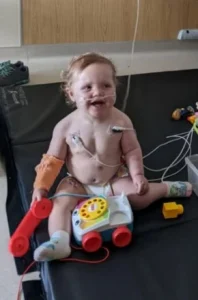
A Journey Defined by Persistence, Not Perfection
There is no simple version of recovery after pediatric heart surgery.
It is not a straight path, nor a predictable one. It bends, pauses, and sometimes moves backward before moving forward again. But through it all, one thing remains constant: the determination of families who refuse to stop showing up for their children.
They learn to adapt. To celebrate differently. To redefine what “normal” looks like.
And in doing so, they discover something unexpected.
Strength is not always loud.
Sometimes it looks like a child trying again after falling. Sometimes it looks like a parent refusing to give up after another difficult appointment. Sometimes it is simply the decision to keep going, even when the future feels unclear.
The Real Meaning of Survival
Survival begins in the operating room—but it does not end there.
It continues in living rooms, therapy centers, playgrounds, and quiet moments at home where progress happens slowly and invisibly. It lives in the patience of parents and the resilience of children learning, step by step, how to reclaim their world.
For these families, the journey is not just about healing a heart.
It is about rebuilding a life.
And while the road may be long, uncertain, and emotionally exhausting, it is also filled with moments of quiet courage that most people never see—but that define everything.
Because in the end, healing is not just about surviving surgery.
It is about learning how to live again afterward.