ThThe Goblin Shark: Prehistoric Nightmare With Extendable Jaws
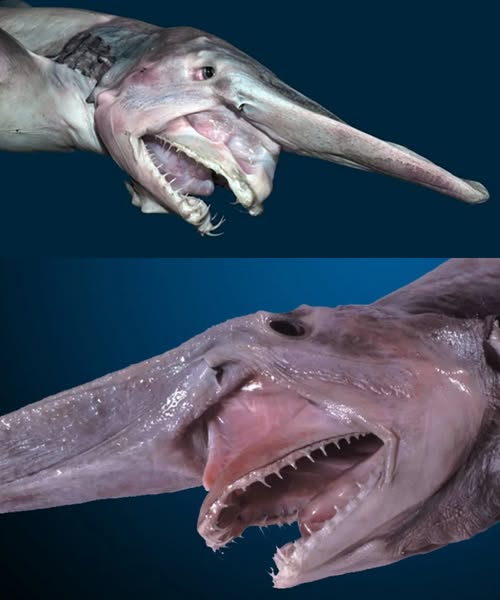
Meet the Goblin Shark (Mitsukurina owstoni) — one of the strangest and most terrifying creatures still swimming in our oceans today. Often called a “living fossil,” this deep-sea predator has barely evolved in over 100 million years, preserving its ancient form from the Cretaceous period.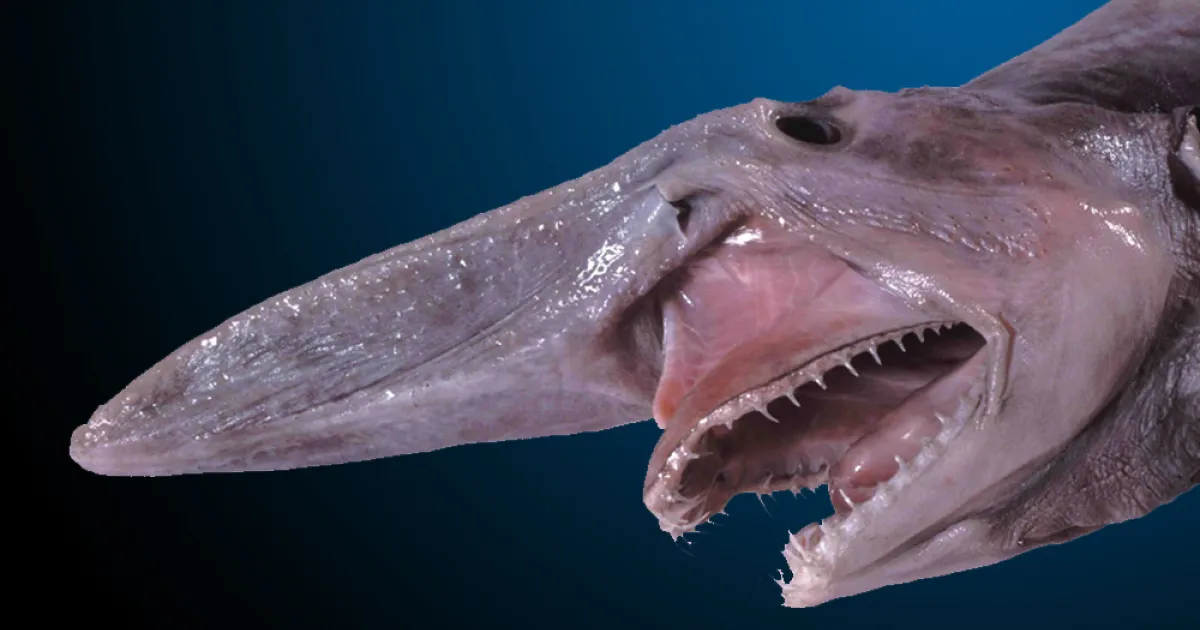
The Goblin Shark lurks in the crushing darkness of the ocean, usually between 200 and 1,200 meters below the surface, where sunlight never reaches. With its pale pinkish-gray skin, long flattened snout, and tiny eyes, it looks like something straight out of a science-fiction horror film.
But its most shocking feature is the protrusible jaws — a slingshot-like mechanism that allows its entire mouth to shoot forward like a trap. When hunting, the Goblin Shark uses specialized electro-sensitive organs to detect the faint electrical signals of nearby fish, squid, or crustaceans in total darkness. In a lightning-fast strike, its jaws rocket outward up to 10 centimeters in just milliseconds, snatching prey with long, needle-sharp teeth before snapping back into its creepy, flattened face.
Though it looks like a deep-sea nightmare, the Goblin Shark is rarely seen alive by humans. Most specimens are accidentally caught in deep-sea fishing nets. It can grow up to 6 meters (20 feet) long, yet much of its life and behavior remains a mystery to science.
In our increasingly explored oceans, the Goblin Shark stands as a chilling reminder that prehistoric monsters still roam the unexplored depths — silent, patient, and perfectly adapted after more than 100 million years of survival.