A Fierce Battle Between Predator and Prey
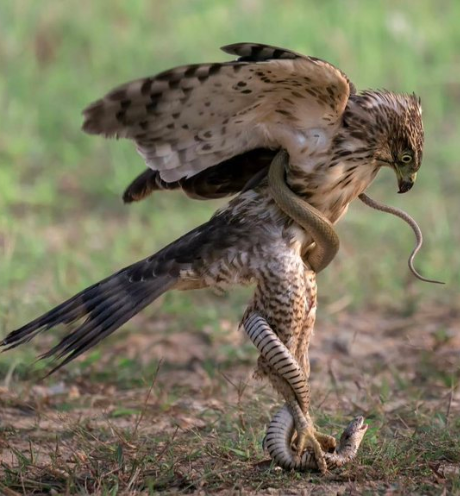
In the unforgiving arena of the wild, the line between hunter and hunted is often razor-thin and dangerously unpredictable. A powerful photograph, captured by Chinese wildlife photographer Wang Cheng, has gone viral for its raw depiction of this eternal struggle: a Crested Serpent Eagle (Spilornis cheela) locked in a life-or-death battle with a snake that has coiled tightly around its body and wings.
This single image offers far more than dramatic spectacle. It serves as a compelling case study in predator-prey dynamics, evolutionary arms races, and the delicate balance of natural ecosystems.
The Hunting Mastery of the Crested Serpent Eagle
Crested Serpent Eagles are highly specialized snake hunters found across Southeast Asia and parts of East Asia. Equipped with exceptional eyesight, powerful talons, and lightning-fast strikes, they are among the most effective avian predators of reptiles. Unlike many eagles that hunt from dramatic high-altitude dives, serpent eagles often employ a “sit-and-wait” strategy — perching motionless on high branches before launching a precise, explosive attack.
Their typical kill sequence is ruthlessly efficient: seize the snake with strong talons, immobilize the head immediately to neutralize venom or constriction, then either dismember or swallow the prey. In this photograph, however, the eagle has not yet secured a clean victory. The snake has successfully wrapped its muscular body around the bird’s torso and wings — a classic defensive maneuver designed to constrict, exhaust, or even drown the attacker if near water.
Although serpent eagles have thick, scaled legs (tarsi) that offer some protection against bites, these encounters remain extremely hazardous. A misplaced strike or prolonged struggle can result in exhaustion, injury, or even death for the eagle.
Evolutionary Arms Race in Action
This image perfectly illustrates the concept of an evolutionary “arms race.” Over millions of years, serpent eagles have developed resistance to certain snake venoms, specialized handling techniques, and the instinct to fly upward immediately after capture to escape ground threats. Snakes, in response, have evolved cryptic camouflage, rapid coiling power, and potent venom as countermeasures.
The outcome of this particular battle remains uncertain in the frozen moment. The eagle appears determined to maintain dominance, while the snake fights desperately for survival. Such standoffs are not uncommon; there are documented cases of snake-eagles being constricted so severely they required significant effort to break free. Experience, physical strength, and split-second decision-making usually favor the eagle — but nature offers no guarantees.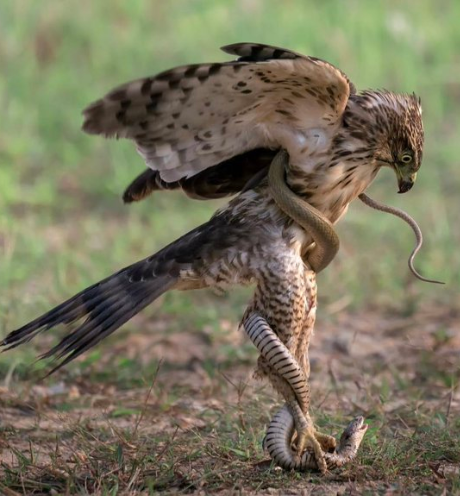
Ecological Significance and the Balance of Nature
Beyond the drama, this encounter highlights the critical role both species play in maintaining ecosystem health. Crested Serpent Eagles help regulate snake populations, indirectly protecting smaller mammals, birds, and reptiles from over-predation. Snakes, in turn, control rodent and amphibian numbers. Every such interaction contributes to the complex web of checks and balances that sustains biodiversity.
For wildlife photographers, capturing such rare, high-stakes moments is the ultimate reward. Wang Cheng’s image not only showcases technical skill and patience but also reminds viewers of nature’s unfiltered reality: brutal, beautiful, and utterly indifferent to human notions of heroism or villainy.
Final Reflection
The photograph of the Crested Serpent Eagle entangled with its serpentine prey stands as a powerful symbol of survival in the wild. It captures both the majesty of apex avian predators and the fierce resilience of their prey. In an increasingly human-dominated world, images like this serve as vital reminders of the raw, untamed forces that continue to shape life on Earth — and the importance of preserving the habitats where these ancient dramas still unfold.
Nature does not take sides. It simply demands one thing from every creature: the will to survive.