THE WIDOW WHO RENTED A CAR JUST TO SIT INSIDE AND REMEMBER HER HUSBAND
**PART 1: **
The woman at the car rental counter asked if she could rent a car without driving it anywhere.
Not for a road trip.
Not for errands.
Just to sit in it.
I was working the evening shift at a rental desk inside a small airport in Boise, Idaho, where the carpet had seen too many rolling suitcases and the printer only jammed when people were already angry.
Most customers came in tired.
Delayed flights. Lost bags. Wrong reservations. People standing in line with phones in one hand and patience dying in the other.
But this woman came up to the counter carrying nothing but a small black purse and a paper envelope.
She was maybe seventy-two, with silver hair tucked behind one ear and a green cardigan buttoned all the way to her throat. Her shoes were polished. Her lipstick was careful. She looked dressed for something important, but not happy about it.
“Can I rent a car for one hour?” she asked.
I clicked into the system.
“Our minimum is one day.”
She nodded like she knew that already.
“I won’t be taking it off the lot.”
I looked up.
“You won’t?”
“No.”
The man behind her, holding a ski bag, sighed so loudly I felt it in my teeth.
The woman glanced back, then stepped closer to the counter.
“I just need to sit in one,” she said quietly. “A blue one, if you have it.”
I had heard strange requests at that job.
People asked if they could rent convertibles in snowstorms. People asked for cars with “good energy.” One man asked if we had anything that looked “less like a divorce.”
But the way this woman held the envelope made me stop typing.
“What kind of blue?” I asked.
Her eyes lifted.
“Dark blue. Like a Chevy Impala, but I know those are older.”
That made it even stranger.
“We don’t have Impalas anymore,” I said gently. “But we might have a navy sedan.”
She pressed the envelope against her chest.
“That would be fine.”
The man with the ski bag sighed again.
This time, I looked at him.
He stopped.
I asked the woman, “Is everything okay?”
She smiled.
Not because anything was okay.
Because some people would rather smile than explain why their hands are shaking.
“My husband drove a blue Impala for twenty-eight years,” she said. “Drove me to church in it. Drove our boys to Little League. Drove my mother to dialysis. Drove across three states once because I said I wanted to see the ocean before I turned fifty.”
Her thumb rubbed the edge of the envelope.
“He passed in November.”
“I’m sorry,” I said.
She nodded.
“I sold the car in January.”
Her voice thinned.
“My sons said it was too much upkeep. They were right. The transmission slipped. The heater only worked when it felt generous. The passenger window had to be pulled up with both hands.”
She gave a small laugh.
“Still, I should have sat in it one more time.”
The printer behind me clicked and groaned.
Someone’s suitcase wheel squeaked across the tile.
The airport announcement overhead called for a passenger on a late flight to Salt Lake City.
The woman looked toward the rental lot through the glass doors.
“Tomorrow is our anniversary,” she said. “Forty-nine years. I found his old driving gloves in the hall closet this morning.”
She opened the envelope.
Inside was a pair of brown leather gloves, soft and worn flat at the palms.
“He kept them in the console every winter. Said the steering wheel got cold before he did.”
She smiled down at them.
“I just wanted to sit in a blue car and put them in the cup holder for a minute. Then I’ll go home.”
There are policies at rental counters.
Insurance. Deposits. Licenses. Fuel charges. Liability forms. Hold amounts that make people furious.
There is no policy for a widow who does not want transportation.
Only a place to put a pair of gloves.
I checked the lot.
We had one navy sedan.
A Ford Fusion with a dent near the rear bumper and 62,000 miles on it. It was technically clean, technically available, and technically supposed to be rented only through the system.
I looked at my manager, Daryl, who was in the back office eating pretzels and watching the security monitor.
He had heard everything.
He came out slowly.
“Ma’am,” he said, “do you have a driver’s license?”
She nodded and pulled it from her purse.
He looked at it.
Then looked at me.
Then looked back at her.
“We can’t rent by the hour,” he said.
Her face fell.
“But,” he added, “I need someone to check the interior on a returned vehicle. Make sure it meets customer standards.”
She blinked.
“I don’t work here.”
“You do for ten minutes,” Daryl said. “Temporary quality inspector.”
The woman looked confused.
I grabbed the keys.
“Come on,” I said. “We’ll inspect it together.”
The navy sedan was parked under a yellow lot light, still wet from the wash bay. It was not an Impala. Not close. It smelled faintly of lemon cleaner and cold upholstery.
But it was blue.
The woman stood beside it, looking at the passenger door.
“Would you mind opening that side?” she asked.
“Of course.”
I opened it.
She did not get in right away.
She touched the roof with one hand, then the door frame, then the seat.
Like she was asking permission from a memory.
Finally, she sat down.
Slowly.
Carefully.
She placed her purse on her lap and looked straight ahead through the windshield.
I stood outside the open door.
Daryl had followed us but stayed several spaces away, suddenly fascinated by a tire.
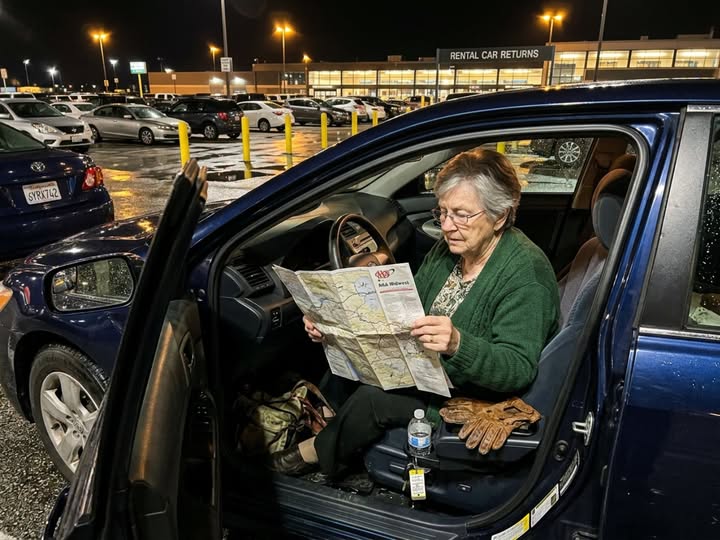
The woman opened the envelope and took out the gloves.
She set them in the cup holder.
Then she reached over and rested one hand on the empty driver’s seat.
“My Harold always drove,” she said.
I nodded.
“Even when his eyes got bad, he’d say, ‘I know the road by feel.’ Which was not comforting, but he meant it sweet.”
She laughed once.
Then the laugh broke.
“I keep thinking grief will be in the big things. The funeral. The paperwork. The empty side of the bed.”
She looked at the gloves.
“But it sneaks up in stupid places. Like the grocery store when I reach for two cans of peaches. Or at church when I scoot over to make room. Or when I pass the airport exit and remember he used to park here and watch planes take off because he said every runway looked like somebody getting another chance.”
I leaned against the door.
The cold air moved around us.
She pulled a folded paper from the envelope.
It was a map.
Not a printed GPS route.
A real paper road map, worn soft at the creases.
Red pen circled a spot on the Oregon coast.
“He drew that circle,” she said. “Said one day we’d go back and stay three nights instead of one. We never did.”
She touched the map.
“He got sick. Then I got practical. Practical is useful, but it steals things if you let it.”
She sat with that map in her lap and the gloves in the cup holder.
For ten minutes, she said nothing.
**PART 2: THE ROAD STILL EXISTS – A WIDOW’S QUIET ANNIVERSARY JOURNEY**
The airport lights reflected on the windshield. A plane lifted off in the distance, climbing into the dark over Boise like it had somewhere urgent to be.
The woman watched until it disappeared.
Then she whispered, “Happy anniversary, Harold.”
I looked away.
So did Daryl.
Even rental car managers have hearts, though most hide them under polo shirts.
When she stepped out, she seemed embarrassed by how carefully we were not watching her cry.
“I’m sorry,” she said. “I know this is silly.”
Daryl shook his head.
“My wife made me keep a broken toaster for six years because her dad fixed it once,” he said. “Nothing’s silly if love knows where it lives.”
The woman looked at him.
Then at the gloves.
She picked them up, but not the map.
She stared at the circled coast.
“I don’t even know why I brought this.”
I said, “Maybe because it’s still a place.”
She smiled sadly.
“I’m too old to drive that far alone.”
Before I could answer, a shuttle driver named Marcy rolled up in the employee van.
Marcy had worked airport shuttles for fifteen years and knew everyone’s business by instinct.
“What’s happening?” she called.
Daryl said, “Anniversary inspection.”
Marcy looked at the woman, the map, the gloves, the blue car.
Then she turned off the van.
“My sister lives in Newport,” Marcy said. “Oregon coast. Pretty as a postcard and twice as windy.”
The woman looked up.
“Newport?”
Marcy nodded.
“I drive there every summer. Roads aren’t bad if you break it up.”
The woman shook her head.
“Oh, I couldn’t.”
“Didn’t say you had to,” Marcy said. “Just said the road still exists.”
That sentence stayed with all of us.
The woman thanked us three times and left without renting anything.
Before she walked through the airport doors, she turned back toward the lot.
The navy sedan sat under the yellow light, ordinary again.
But she looked at it like it had given something back.
Two weeks later, a card arrived at the rental desk.
No return address.
Inside was a photo.
The woman stood beside a wooden railing overlooking the gray Oregon coast, hair blowing across her face, Harold’s brown driving gloves folded over the rail beside her.
On the back, she had written:
I took the road by daylight. Stopped twice. Cried three times. Stayed three nights. Practical can wait.
Daryl taped it inside the back office above the key cabinet.
After that, something changed at our counter.
Not officially.
Officially, we still rented compact cars to people who wanted SUVs for compact prices. We still explained fuel policies. We still apologized for dents we did not personally create.
But we started listening differently.
A man rented a minivan to drive his late wife’s quilts to their granddaughters.
A college student rented a car to bring his little brother to see snow for the first time.
A woman rented a red convertible and admitted she had always wanted one, but her husband said it was impractical.
Daryl upgraded her for free.
“Temporary quality inspection,” he said.
One evening, almost a year later, the woman came back.
Same green cardigan.
Same careful lipstick.
But this time, she had a small rolling suitcase.
She placed her license on the counter.
“I’d like to rent a car,” she said.
“For how long?”
“Four days.”
“What kind?”
She smiled.
“Something blue if you have it.”
We did.
This time, she signed the paperwork.
This time, she drove it off the lot.
Before she left, she handed me a small envelope.
Inside was a photocopy of the map, the Oregon coast still circled in red.
Below it, in her handwriting, she had added:
THE ROAD STILL EXISTS.
I keep that copy in the drawer where we store spare key tags.
Because sometimes a rental car is not about going somewhere new.
Sometimes it is about sitting still long enough to remember you are allowed to keep moving.
Sometimes a pair of old driving gloves in a cup holder can become permission.
And sometimes the kindest thing you can do for a grieving person is not tell them to move on.
It is to open the passenger door and let them say goodbye in the seat where love used to ride.