THE WOMAN WHO PAID TO DUMP HER FATHER’S CHAIR BUT COULDN’T LET IT GO
**PART 1: **
The woman at the county dump asked if she could take one broken chair back home.
Not drop one off.
Take one.
I was working the scale house at the transfer station outside Bangor, Maine, where Saturdays smelled like wet cardboard, pine needles, diesel, and everybody’s bad decisions from cleaning out their garages.
People came through with old mattresses, busted snow blowers, paint cans they swore were empty, and furniture that had survived three generations only to lose a leg during a move.
The woman pulled up in a blue Subaru with rust over the wheel wells and a back seat full of black trash bags.
She was maybe in her late fifties, wearing a green raincoat, jeans tucked into rubber boots, and no makeup except the kind of redness people get around their eyes when they have been pretending all morning they are fine.
In the back of the car was an old wooden kitchen chair.
One back spindle was cracked.
The seat was scratched.
The right front leg had been repaired with silver duct tape.
She rolled down her window.
“How much to dump a chair?” she asked.
“Five dollars,” I said.
She nodded, paid, and drove toward the furniture pile.
Ten minutes later, she came back.
With the chair still in the car.
I leaned out the window.
“Changed your mind?”
She gave a small embarrassed laugh.
“I’m trying to.”
Behind her, a pickup honked because transfer station people are patient about exactly nothing.
I waved the truck around.
The woman looked toward the furniture pile.
“I got it out of the car,” she said. “I really did. I set it down. Then I picked it back up.”
“That happens.”
“No,” she said. “It doesn’t. Not to normal people.”
I had worked at that dump long enough to know normal people cry over stranger things than chairs.
I stepped out of the scale house and walked over.
“What’s special about it?”
She looked down at the steering wheel.
“My father sat in it every morning.”
The whole place kept going around us. A man threw broken shelves into the wood pile. Seagulls screamed over the dumpsters. Somebody’s kid kept asking if they could keep a cracked aquarium.
But inside that Subaru, the air went still.
“He passed in March,” she said. “I’m cleaning out the house because the realtor comes Monday.”
She glanced back at the chair.
“It’s not valuable. It wobbles. My husband says we already kept too much. My sister said Dad would laugh himself sick if he knew I was crying over trash.”
Her hand tightened around the wheel.
“But every morning, he sat in that chair with his coffee and did the crossword in pen because he said pencil was for cowards.”
I smiled before I could stop myself.
She smiled too, just barely.
“He wore one spot smooth on the seat. Right there.”
She pointed.
I saw it then.
Not damage.
A shine.
The kind wood gets when somebody belongs to it for a long time.
“I threw away his recliner,” she said. “His old boots. The stack of coffee cans in the garage. The calendars from 1998 through God knows when. I did all that.”
Her voice broke.
“But I put that chair on the pile and suddenly it felt like I was throwing away breakfast.”
I looked at the chair again.
One cracked spindle. One duct-taped leg. One worn-smooth seat.
A whole father, if you knew where to look.
“You want to keep it?” I asked.
She laughed, wiping under one eye.
“I don’t have room.”
That was not an answer.
That was a sentence people use when they are trying to be sensible about something the heart has already voted on.
I said, “Can I see it?”
She opened the back hatch.
I pulled the chair out and set it on the gravel.
It wobbled immediately.
She winced.
“See? It’s junk.”
From the scrap metal area, Pete, our maintenance guy, looked over.
Pete was seventy-two, smoked one cigarette a day he claimed was “medicinal,” and could fix almost anything with a coffee can full of screws.
“That ain’t junk,” he called.
The woman turned.
Pete walked over slowly, wiping his hands on a rag.
“That’s maple,” he said, like he was identifying a rare bird.
“It’s broken,” she said.
“So am I most mornings.”
He crouched, grabbed the chair by the frame, and tested the leg.
“Loose joint. Bad repair. Whoever used duct tape on furniture ought to write an apology letter to trees.”
For the first time, the woman laughed for real.
Then she covered her mouth like laughter had surprised her.
Pete looked at me.
“Scale house got wood glue?”
“No.”
“Office?”
“No.”
“My truck?”
“Probably.”
He pointed at the woman.
“You got ten minutes?”
She blinked.
“For what?”
“To keep from making a mistake.”
She looked back at the furniture pile.
Then at the chair.
Then at us.
“I have to get the rest unloaded.”
“We’ll help,” I said.
**PART 2: THE CHAIR THAT REFUSED TO BE THROWN AWAY**
People think dumps are where things end.
Sometimes they are.
But sometimes they are full of men who have been quietly waiting their whole lives to be useful in exactly the wrong weather.
Pete fixed the chair under the awning beside the hazardous-waste shed while I helped the woman unload bags of old curtains, cracked planters, and a box of National Geographic magazines her father had apparently believed would someday become important again.
Her name was Karen.
Her father’s name was Walter.
He had lived in the same white Cape Cod house for forty-one years. He shoveled his own walkway until he was eighty-six. He listened to Red Sox games on a radio by the sink. He called every cashier “boss.” He wrote grocery lists on envelopes and then forgot the envelopes at home.
The more Karen talked, the less the chair looked like furniture.
It started looking like a witness.
Pete worked without much ceremony. He pulled the duct tape off. Sanded the old glue. Clamped the leg. Found two screws in his truck that did not match but did their job anyway.
Then he looked at the cracked spindle.
“Can fix it proper later,” he said. “But it’ll hold.”
Karen touched the back of the chair.
“How much do I owe you?”
Pete looked offended.
“You already paid five dollars to dump it. Consider this a refund from the universe.”
She shook her head.
“I can’t just—”
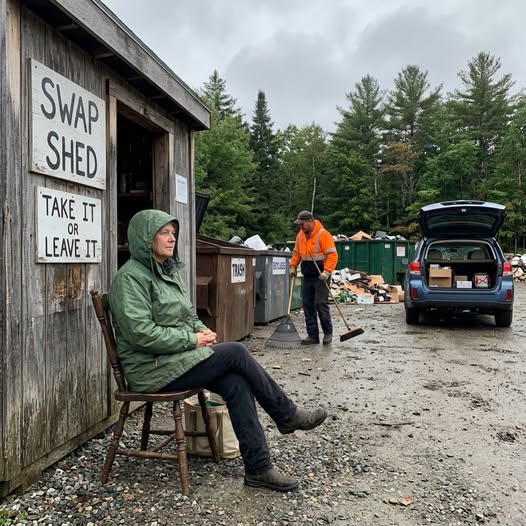
I pointed toward the little shed where people left things others might still use. Lamps. Flowerpots. Kids’ bikes. Bookshelves with one shelf missing.
“We have a swap shed,” I said. “You can pay by putting something good in someday.”
She looked toward it.
Then she nodded.
Dignity, again, finding a place to stand.
Before she left, Pete carried the chair back to her car.
But Karen didn’t close the hatch right away.
She ran her palm over the worn-smooth seat.
“My dad used to tap this spot when I came over,” she said. “He’d say, ‘Sit down two minutes. World won’t end.’”
She looked at the chair.
“I never sat long enough.”
Nobody knew what to say to that.
So Pete, who rarely said anything soft unless forced, said, “Then start now.”
Karen stared at him.
Then she sat down right there.
In the transfer station.
Beside dumpsters, wet leaves, broken furniture, and a seagull trying to murder a sandwich wrapper.
She sat in her father’s chair for two minutes.
Exactly two.
I know because I watched the clock on the scale house wall.
She didn’t cry much.
Just enough.
Then she stood, closed the hatch, and drove away with the chair in the back.
I thought that was the end of it.
But the next Saturday, Karen came back.
No trash bags.
No realtor panic.
Just the blue Subaru and the chair.
Only now the chair had a small cushion tied to it. Blue gingham. Handmade or close enough.
She opened the hatch.
“I brought something for the swap shed,” she said.
In the back were three boxes.
Clean dishes. Paperback mysteries. A working toaster. Two lamps. A stack of folded blankets.
“My husband and I cleaned out our own basement,” she said. “Figured somebody might need these before winter.”
Pete walked over and looked at the chair.
“You kept it.”
Karen smiled.
“It sits by my kitchen window.”
“Wobble?”
“A little.”
“Good,” Pete said. “Keeps people humble.”
Then she reached into her coat pocket and pulled out a small framed photo.
It showed the chair by a window, morning light across the seat, a mug on the sill beside it.
On the back, she had written:
Two minutes every morning.
I taped that photo inside the scale house.
After that, something changed at the dump.
Not officially.
Officially, we still charged by the bag, separated metal from wood, and told people for the hundredth time that no, they could not throw a propane tank into general waste.
But people started hesitating before tossing certain things.
A man brought in a cracked birdhouse and said, “My wife’s dad made this. Can anyone fix it?”
Pete fixed it.
A young mother tried to throw away a rocking horse with one missing handle, then stood there crying because her twins had outgrown it and she was pregnant again and did not know why that made her sad.
We put it in the swap shed. Someone took it the same day.
An old teacher dropped off a box of classroom books and came back an hour later for one with her name written inside the cover.
Nobody laughed.
We started keeping a small table near the swap shed.
Pete made the sign from scrap plywood.
THINGS THAT AREN’T DONE YET
People left objects there when they could not decide.
Sometimes they came back for them.
Sometimes somebody else took them home.
Sometimes the object sat there until weather made the decision.
But at least it had a chance.
The following spring, Karen returned with tomato plants.
Six of them, in yogurt cups.
She set them on the table.
“Dad started tomatoes every year in the wrong containers,” she said. “Thought these might belong here.”
By noon, they were gone.
The week after that, someone left a note on the table:
Took a tomato. Left a lamp. Fair trade?
Pete read it and said, “Capitalism has peaked.”
Near Father’s Day, Karen came again.
This time, she brought the chair.
Not to leave it.
To show us.
Pete had fully repaired it over the winter. Sanded, glued, tightened, oiled. The wood still had scratches. The worn spot was still there. He had refused to make it look new.
“You don’t erase fingerprints from a thing like that,” he said.
Karen set the chair beside the swap shed and placed a small sign on the seat.
SIT DOWN TWO MINUTES.
WORLD WON’T END.
People did.
A truck driver sat there after unloading construction debris.
A young woman sat there after leaving boxes from a divorce.
A grandfather sat there with his little grandson eating crackers.
I sat there once after a hard phone call from my brother.
Two minutes is longer than you think when you stop running from yourself.
At the end of the day, Karen loaded the chair back into the Subaru.
Before she left, she looked around the transfer station like she was seeing it differently.
“You know,” she said, “I thought this was where I came to get rid of him.”
She touched the chair.
“Turns out it’s where I learned what to keep.”
I still have her photo in the scale house.
The chair by the kitchen window.
The mug on the sill.
Morning light on the worn-smooth seat.
Because sometimes a dump is not just a dump.
Sometimes a broken chair is not broken enough to stop being loved.
And sometimes the kindest thing a stranger can do is stop you beside the trash pile and say, “Wait. Are you sure that part is done?”