BREAKING: Oxygen Toxicity or Absolute Terror? The Maldives Cave Mystery Deepens
BREAKING: Oxygen Toxicity or Absolute Terror? The Maldives Cave Mystery Deepens
A recovered camera, an unmapped passage and new forensic findings are giving investigators a clearer picture of the terrifying final moments inside a deep underwater cave in the Maldives — but the biggest questions are still unanswered.

The mystery surrounding the Maldives diving disaster has taken another important turn. Five Italian divers disappeared inside the Devana Kandu cave system near Alimatha Island in Vaavu Atoll on May 14, 2026. More than three months later, investigators are still trying to reconstruct exactly what happened beneath the surface.
The case has attracted international attention because of the extreme environment, the depth involved, the equipment reportedly being used, and evidence recovered from inside the cave. Among the most important pieces of evidence are underwater cameras, including a GoPro recovered during the specialist recovery operation. Investigators believe the recordings could help establish the divers’ route, movements and decisions during the final part of the dive. (Maldives Independent)
But there is an important distinction behind the dramatic question of “oxygen toxicity or absolute terror?” Current evidence does not establish oxygen toxicity as the cause. Preliminary forensic findings reported in May indicated that two of the Italian divers, Monica Montefalcone and her daughter Giorgia Sommacal, were believed to have died from anoxia or drowning associated with their oxygen supply being exhausted. Final findings were still pending, and investigators continued examining the diving equipment and recovered footage. (Atoll Times)

A Dive That Began Far Deeper Than Ordinary Recreational Diving
Devana Kandu, also known as Dhekunu Kandu, is not an ordinary recreational dive site. Its entrance is roughly 50–58 metres below the surface, while the cave system extends through several chambers and passages. The Maldives’ recreational diving regulations set a 30-metre depth limit, making this environment far beyond normal recreational diving. (Maldives Independent)
The five Italians were aboard the live-aboard vessel Duke of York as part of a larger trip connected to marine research and diving. Authorities said the group had received a research permit, but officials stated they were not aware that the expedition would involve entering the underwater cave.
A sixth person who had initially been expected to dive ultimately decided not to enter the water and later assisted investigators.
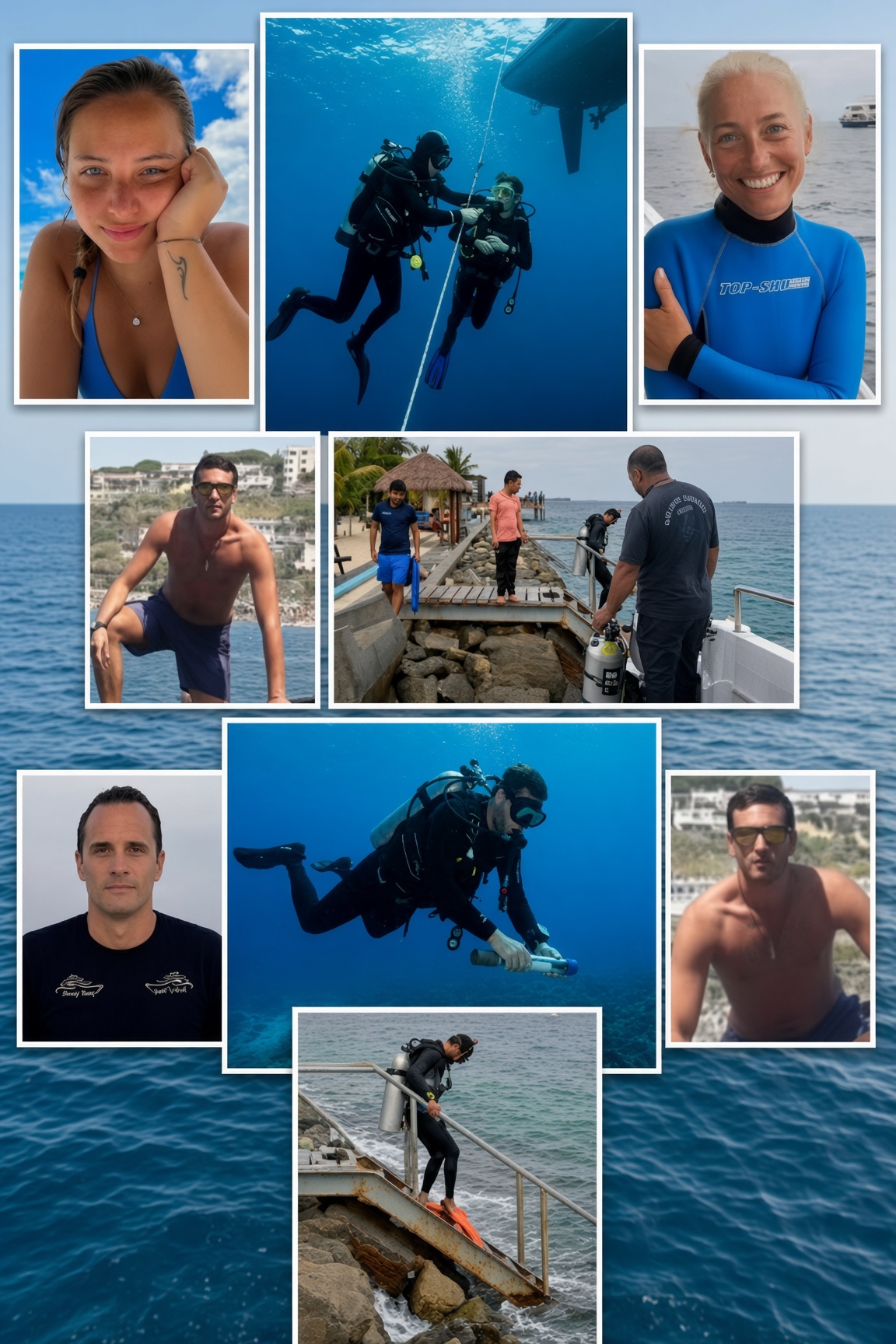
The five who entered the cave were marine ecology professor Monica Montefalcone, her daughter Giorgia Sommacal, researcher Muriel Oddenino, marine biology graduate Federico Gualtieri and diving instructor Gianluca Benedetti. Their disappearance triggered a major search operation involving Maldivian authorities and, later, international technical cave-diving specialists. (Maldives Independent)

Then Investigators Found Something Unexpected
One of the most significant discoveries came during the recovery operation.
Finnish technical cave divers working with Divers Alert Network Europe located the four missing divers who had not initially been recovered. They were found deep inside the cave at approximately 60 metres.
But investigators also discovered that the cave’s internal structure was more complicated than previously understood.
According to the Finnish recovery team’s account, the divers were located through a passage that was not marked on the existing cave map. The team followed marks in the sand to reach the area where the victims were found. (Maldives Independent)
That discovery matters because navigation is one of the greatest dangers in underwater cave diving.
Once divers enter an overhead environment, they cannot simply swim upward to the surface. They must know exactly where the exit is and maintain a reliable route back.
If sediment is disturbed, visibility can deteriorate rapidly. In darkness, even experienced divers can lose their orientation within seconds.
The Finnish recovery team said the missing divers appeared to have reached a dead-end side passage. Four of them were found together in the deepest part of the cave. Their tanks had reportedly run out of air. (Maldives Independent)

The “Oxygen Toxicity” Question Is More Complicated Than It Sounds
The phrase oxygen toxicity has circulated widely in discussions about the disaster, particularly because the divers were operating at extreme depth.
However, oxygen toxicity and oxygen depletion are very different phenomena.
Oxygen toxicity can occur when divers breathe a gas containing too much oxygen at elevated pressure. At extreme depths, the partial pressure of oxygen increases, potentially creating serious physiological risks.
But the preliminary autopsy information publicly reported in May pointed in another direction for at least two victims: anoxia associated with the exhaustion of their breathing supply, rather than confirmed oxygen toxicity. (Atoll Times)
At great depth, breathing gas is consumed considerably faster than it would be near the surface. That means a diver who becomes disoriented or trapped can lose precious reserves rapidly.
Inside a cave, that problem becomes even more serious.
There is no direct route to the surface.
There may be no natural light.
And if visibility suddenly disappears, the diver may have only a limited amount of time to find the exit.

Why the GoPro Could Be the Most Important Evidence
This is where the recovered camera becomes so important.
Maldives Independent reported in its August 6 update that investigators in Rome were seeking the equipment used by the five divers, with particular attention focused on a GoPro recovered from inside the cave.
Italian prosecutors have formally requested cooperation from Maldivian authorities concerning the equipment and belongings.
Investigators also seized electronic devices belonging to the victims, including phones, computers, tablets, USB drives and a hard drive. (Maldives Independent)
The recovered footage could potentially answer questions that eyewitness testimony cannot.
Did the divers intentionally enter the deeper cave?
Did they become disoriented?
Did visibility suddenly deteriorate?
Was there an unexpected change in the environment?
How long were they inside?
And most importantly, where were they when they realized they could no longer easily find their way out?
Those questions remain central to both the Maldivian and Italian investigations.
A Different Theory Has Also Emerged
Not everyone agrees that a simple navigational error explains everything.
One alternative theory proposed by Alfonso Bolognini of the Italian Society of Underwater and Hyperbaric Medicine suggested that the cave’s geometry could have created a powerful water-flow effect near the entrance.
The theory involves what is commonly called a Venturi effect, where water accelerates through a narrowing passage.
However, Finnish recovery diver Sami Paakkarinen disputed the idea that the current was strong enough to pull the entire group deep into the cave. He described currents inside the cave as relatively weak during the recovery dives. (Maldives Independent)
That disagreement is important.
It means investigators are not simply looking for one obvious explanation. They are examining several possibilities, including navigation, equipment, gas consumption, depth, environmental conditions and the decisions made before and during the dive.
The Equipment Question
Another major issue concerns the equipment reportedly used by the Italian group.
The Finnish recovery specialists said the victims appeared to have been using standard recreational compressed-air cylinders rather than the highly redundant equipment normally associated with deep technical cave diving.
The Finnish team itself used closed-circuit rebreathers, underwater scooters and redundant life-support systems during the recovery operation. (Maldives Independent)
That difference is enormous.
A conventional scuba cylinder supplies breathing gas from a finite tank. At extreme depth, gas is consumed much faster because the surrounding pressure is significantly greater.
A closed-circuit rebreather, by contrast, recycles exhaled gas and replaces consumed oxygen while removing carbon dioxide. It is specialized equipment requiring advanced training and careful maintenance.
The recovery divers therefore entered the same dangerous environment with a very different level of equipment redundancy and preparation.
The Investigation Is Still Open
More than anything, the latest developments show that the story is not yet completely solved.
The autopsies conducted in Italy found no obvious traumatic injuries, according to reporting by Maldives Independent, while toxicology and other investigative evidence remained important to determining the precise causes of the deaths. (Maldives Independent)
Meanwhile, the recovered cameras and diving equipment remain crucial pieces of evidence.
The case is being investigated in parallel by authorities in Italy and the Maldives. Italian prosecutors are examining potential negligence, while Maldivian authorities are investigating whether the appropriate precautions were taken.
The tragedy also raises broader questions about how deep cave expeditions are planned, what permits are required, what equipment should be mandatory, and how operators communicate the risks of extreme underwater environments.
For the families of the five Italian divers, however, the investigation is about more than diving procedures or technical theories.
It is about understanding what happened to their loved ones during those final minutes beneath the surface.
And until investigators can fully examine the recovered footage, equipment and forensic evidence, one question remains at the center of the mystery:
Did the divers run out of breathable gas after becoming trapped in the cave — or did something unexpected happen first that set the entire chain of events in motion?
For now, the evidence points toward a catastrophic combination of depth, navigation difficulties, limited breathing reserves and an unforgiving cave environment. But the final answer may still be hidden inside the footage recovered from the darkness.
Sources: Maldives Independent — Five weeks after the Devana Kandu deaths · Maldives Independent — The Devana Kandu tragedy · Atoll Times — Preliminary autopsy findings · ABC News Australia — Five Italian divers died in a Maldives cave system