The Boy With the Giant Foot: The Extraordinary Story of Vedant Joshi
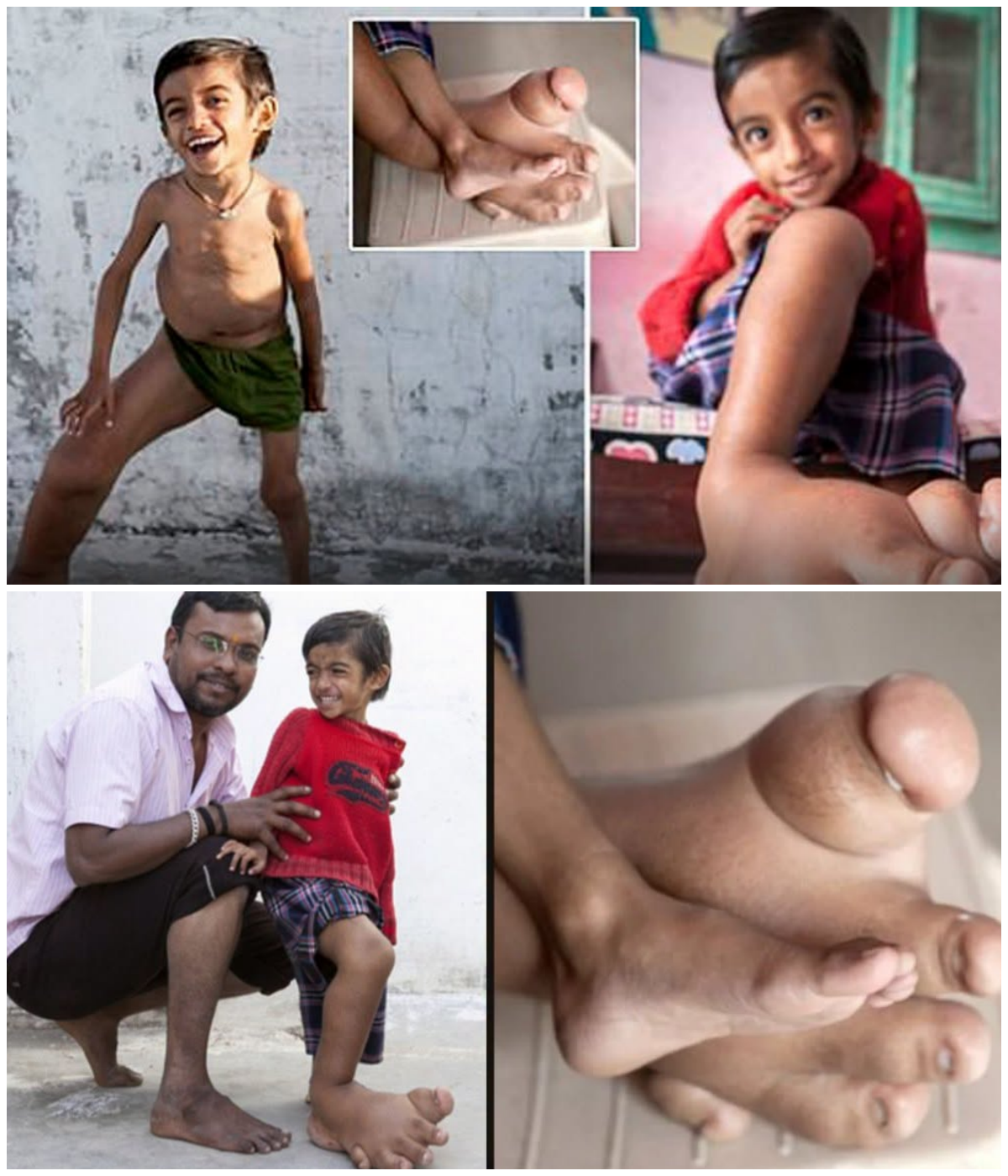
Gujarat, India — When Vedant Joshi was just four years old, his right foot had grown to an astonishing size—about 28 centimeters long and weighing roughly 5.4 kilograms. Despite its extraordinary appearance, the young boy could still walk, run and even ride a bicycle.
But behind that remarkable mobility was a childhood marked by medical uncertainty, bullying and social isolation.
Vedant was born in Gujarat, western India, with a noticeable difference between his right and left legs. As he grew, the affected foot continued to enlarge. By 2015, it had become so large that finding ordinary shoes was virtually impossible. His family eventually had to have footwear specially made for him. Contemporary reports said his parents had already taken him to more than 100 doctors over four years, yet specialists had been unable to establish a definitive diagnosis.
A Foot That Kept Growing
The condition was particularly unusual because the enormous foot did not appear to prevent Vedant from performing many everyday physical activities.
Reports from the time described him as being able to walk and run without significant pain. He could cross his legs and sit on a bicycle without assistance. Nevertheless, the sheer size of the limb created serious practical problems, from finding clothes and shoes to participating normally with other children.
His father, Dilip Kumar Joshi, reportedly spent a large portion of the family’s limited resources searching for an explanation. Doctors from different specialties and even physicians from outside India examined the child, but no consensus diagnosis was reached. Some doctors reportedly suggested hormonal imbalance, abnormal blood flow or fluid retention, while others discussed amputation as a possible option.
For Vedant’s father, however, amputation was a frightening prospect. His son could still move independently, and the family feared that removing the limb would leave him permanently disabled.
The Human Cost Was Just as Serious
Although Vedant could physically move, his condition profoundly affected his childhood.
He reportedly faced teasing and rejection from other children. He said classmates laughed because he could not run as quickly as they could and would not invite him to play football or other games.
He also wanted to attend school, but his parents said teachers had discouraged him from doing so because of his physical condition. As a result, much of his childhood was spent at home with his mother and younger sister.
The emotional impact on the family was considerable. Contemporary accounts described Vedant’s parents as increasingly desperate for a specialist who could determine what was causing the abnormal growth and whether his limb could be preserved.
Was It Really Macrodystrophia Lipomatosa?
The condition shown in the widely circulated photographs is sometimes described online as macrodystrophia lipomatosa (MDL). However, there is an important distinction between the viral descriptions and the medical evidence available about Vedant’s case.
The contemporaneous reports from 2015 did not establish a confirmed diagnosis of macrodystrophia lipomatosa. Instead, they repeatedly stated that doctors were baffled and had been unable to determine the precise cause of the abnormal enlargement. One physician quoted in reports believed the condition could have a genetic basis but said he could not establish the underlying cause.
Macrodystrophia lipomatosa is nevertheless a real and extremely rare medical condition that can produce localized gigantism. It is a developmental disorder characterized by disproportionate proliferation of fibrofatty tissue and can affect one or more digits or, more rarely, a larger portion of an extremity. Lower-limb involvement is often unilateral. Diagnosis generally relies on clinical examination and imaging such as X-rays and MRI, sometimes supplemented by histopathological examination.
Because several different disorders can cause localized limb overgrowth—including vascular and other overgrowth syndromes—an enlarged limb cannot be confidently labeled MDL from photographs alone.
His Story Continued
Vedant’s extraordinary case later attracted international attention and was featured in the television documentary series Body Bizarre. A synopsis for the program reported that, by the age of seven, his right leg and foot were continuing to grow disproportionately and were increasingly restricting his movement. The program followed Vedant and his father as they began a journey of roughly 2,000 kilometers to a specialist center in Coimbatore, southern India, searching for answers.
The story demonstrates how difficult rare disorders can be to diagnose, particularly when the physical presentation does not fit neatly into a single recognized condition.
More Than a Medical Mystery
Vedant’s story is ultimately about more than an unusually large foot.
At an age when most children are concerned with school, sports and playing with friends, he and his family were forced to navigate hospitals, medical opinions and the possibility of life-changing surgery.
Yet the photographs also reveal something that medical statistics cannot fully capture: a child who continued to smile, play and move despite a condition that made him visibly different from everyone around him.
Whether his condition was ultimately classified as macrodystrophia lipomatosa or another form of localized overgrowth, the case remains a striking example of the challenges faced by children with rare congenital and developmental disorders—and of the importance of finding specialists willing to look beyond the obvious.
For Vedant and his family, the goal was never simply to make his foot look normal. It was to find a way for him to remain mobile, attend school and grow up with the same opportunities as other children.
Sources: Indian Journal of Dermatology / PubMed Central