Tres Johnson: The Boy Who Defied Every Medical Prediction
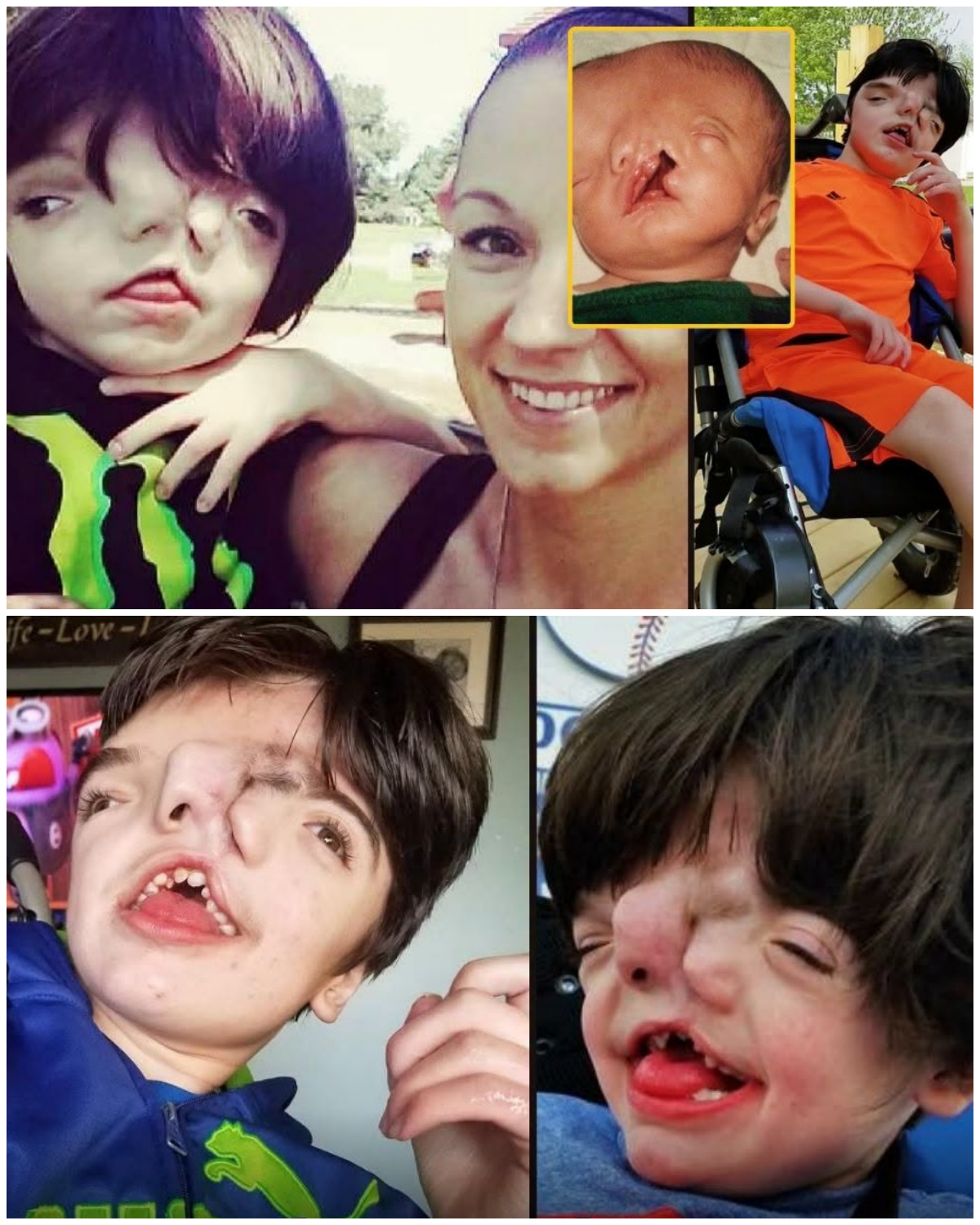
When Tres Johnson was born in Missouri in 2004, his parents, Brandy and Joshua Johnson, were confronted with a medical situation that few families could ever imagine. Tres had an extraordinarily rare congenital condition known as diprosopus, or craniofacial duplication, in which facial structures partially or completely duplicate on a single head.
Doctors initially gave the newborn almost no chance of survival. Most documented cases of diprosopus have resulted in stillbirth or death shortly after birth, making Tres’s survival into childhood an extraordinary medical rarity. At the time, reports described only a few dozen documented cases worldwide.
Tres was born with a large facial cleft, widely spaced eyes, separate nostrils and an unusually shaped skull. His condition was also accompanied by serious neurological problems, including severe epilepsy. His family reported that, during the worst periods of his childhood, he experienced as many as 400 seizures a day.
Diprosopus is one of the rarest developmental abnormalities affecting the face. Medical researchers believe that abnormal signaling during early embryonic development may play a role. The Sonic hedgehog, or SHH, signaling pathway is important in forming the face and other structures of the developing embryo, and researchers have proposed that excessive SHH activity may contribute to craniofacial duplication. However, the precise cause of diprosopus remains uncertain, and no specific genetic mutation has been definitively established as the cause of the condition.
For the Johnson family, however, Tres was never simply a medical case. He was their son.
Throughout his childhood, Tres underwent multiple operations, including procedures intended to close his facial cleft and reshape his skull. His parents continued searching for ways to manage his severe epilepsy after conventional treatments failed to provide sufficient control.
In 2014, when Tres was 10 years old, his mother spoke publicly about his condition and the family’s efforts to find additional treatment options. At that time, reports said he was experiencing up to 120 seizures per day, while some of his most severe episodes required emergency resuscitation.
Three years later, Tres reached another milestone that his family had once been told was unlikely: his 13th birthday.
His mother described the occasion as deeply emotional because she had lost count of how many times doctors had warned that her son might not survive. Instead of focusing on predictions about how long he might live, the family chose to concentrate on each day they had together.
Tres’s story also exposed a painful side of life for people with rare medical conditions. His family reported that strangers sometimes made cruel comments about his appearance, including remarks suggesting that he should not be alive. His parents refused to allow those reactions to define their son’s life.
Brandy and Joshua continued to care for Tres and advocate for him, emphasizing that their priority was not making him look “normal,” but keeping him comfortable, safe and loved.
Tres ultimately lived far beyond the expectations given to his parents at birth. He reached adulthood and celebrated his 21st birthday in 2025.
According to his obituary, Tres Anthony Johnson died on September 9, 2025, at his home in Missouri, surrounded by his family. He had lived for 21 years, six months and six days. His family remembered him as a source of love, light and hope.
Tres’s life was extraordinarily difficult, but it was also far longer than anyone expected when he first entered the world. His journey challenged early medical predictions and demonstrated the determination of a family that refused to give up on their child.
His story is not simply about a rare medical condition. It is about a mother and father who continued to see their son as a person rather than a diagnosis, and about a young man whose life became a reminder that a prognosis is not the same thing as a person’s worth.
Tres Johnson’s life may have begun with doctors predicting that he would survive only hours. Instead, he lived for more than two decades, surrounded by the people who never stopped believing that his life mattered.
Sources
National Institutes of Health, Genetic Testing Registry and MedGen
National Organization for Rare Disorders, GARD
PubMed and medical literature on diprosopus and craniofacial duplication
Associated Press, Missouri mom pushes for medical treatment for Tres Johnson
New Zealand Herald, Boy with two faces defies the odds to reach teenage years
The Epoch Times, Miracle Boy With 2 Faces Was Given Zero Chance of Survival
Bradshaw Funeral Home / Legacy.com, Obituary of Tres Anthony Johnson