FLORIDA FOUND 163 MISSING CHILDREN — SO WHY ARE SO MANY QUESTIONS STILL UNANSWERED?
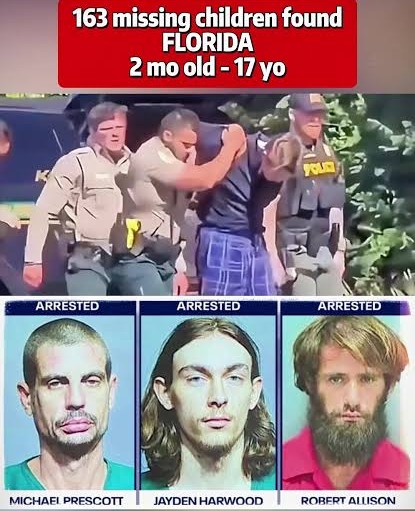
The operation was hailed as a historic success. But behind the celebration is a troubling reality: locating 163 children does not automatically explain why they disappeared or what happened to them.
For five days in August, law-enforcement officers across Florida worked through missing-child cases that stretched from local communities to international jurisdictions.
When Operation Statewide Shield ended, officials announced that 163 children had been recovered.
The children ranged from only two months old to 17 years old.
For investigators, the result was unprecedented.
For families, it could mean the end of an agonizing wait.
But for the authorities now responsible for investigating what happened to each child, the work may be considerably more complicated than the headline suggests.
Operation Statewide Shield was carried out August 17–21 and was led by Florida agencies with assistance from partner law-enforcement organizations. Florida officials called it the first statewide child-recovery initiative of its kind and the largest such operation in the state’s history.
The recovery numbers were spread across major regions.
Tampa Bay accounted for 46 children.
Miami accounted for 41.
Jacksonville accounted for 32.
Orlando accounted for 21.
Fort Myers accounted for 12.
Pensacola accounted for eight.
Tallahassee accounted for three.
Additional recoveries and locations extended beyond Florida, including six other states, one U.S. territory and 12 countries.
That international dimension is one of the most important aspects of the operation.
A missing-child investigation can become extraordinarily complicated when the child crosses state or national borders.
Records may exist in different systems.
Names may change.
Custody arrangements may be disputed.
Children may be located with relatives, acquaintances, strangers or in circumstances that authorities did not initially understand.
And not every missing-child case is a kidnapping.
This point has become especially important because social media dramatically reshaped the story after the operation was announced.
Posts began suggesting that all 163 children had been kidnapped by traffickers and that three arrested men were behind the entire operation.
Authorities have not said that.
The three arrests publicly connected to the operation involved separate allegations and individual victims.
That does not make those allegations less serious.
But it does mean the public should resist turning separate criminal cases into one giant conspiracy without evidence.
Florida officials said some recovered children had experienced abuse, neglect, exploitation or exposure to criminal activity. Other reporting also described children as runaways or children who had been abandoned or otherwise endangered.
Those circumstances demand different investigations and different forms of intervention.
Imagine, for example, an infant found in an unsafe environment.
That case may require child-welfare intervention, medical evaluation and a custody investigation.
Now compare that with a teenager who repeatedly ran away from home.
The underlying circumstances could involve family conflict, abuse, exploitation, homelessness, mental-health challenges or something else entirely.
Putting both cases under the same label would hide the very information investigators need.
That is why the number 163 should be treated as a starting point rather than a conclusion.
The recovery hubs established during the operation were designed to address that reality.
Children who needed help could be connected with medical providers, social-service professionals, child-welfare workers and victim advocates. Some were reunited with families, while others entered foster care or remained under protective supervision.
The system therefore moved from search to recovery.
But recovery is not the same as justice.
Florida officials initially announced three felony cases generated by the operation. Officials also indicated that numerous investigations had been opened and that additional arrests could follow.
As of September 14, however, there is no verified announcement that the original figure of 163 has increased or that a new wave of major arrests has been publicly announced.
That is an important update.
The operation is still being discussed online as though new developments are appearing every day, but the verified picture is more restrained.
The 163 recoveries remain the central confirmed result.
The investigations continue.
And some international questions have now been answered.
After the recovery announcement, Brazilian families contacted authorities because they feared that children missing in Brazil could potentially be among those found in the United States.
One of those cases involved José Arthur Sousa Barros.
His family reportedly sought assistance from Brazil’s Federal Police and asked whether identification methods could be used to determine whether he was among the recovered children.
The development briefly raised the possibility of a major international breakthrough.
But Brazil’s Federal Police later issued a clarification: according to information from U.S. authorities, no Brazilian child was among the 163 children recovered in the operation.
That means families searching for missing children in Brazil must continue their own investigations.
The same clarification applied to the case of Ágatha Isabelly and Allan Michael, siblings missing from Bacabal, Maranhão.
Brazilian authorities said the children were not part of the group recovered in the United States and moved toward additional international cooperation, including Interpol mechanisms.
For those families, the Florida operation did not provide the answer they hoped for.
And that is perhaps the most painful reality behind the headline.
A historic recovery operation can produce extraordinary results while still leaving families without answers.
The 163 children who were found matter.
But so do the children who remain missing elsewhere.
The story has also demonstrated how quickly public outrage can be manipulated.
Videos unrelated to Operation Statewide Shield were circulated as supposed evidence of the operation.
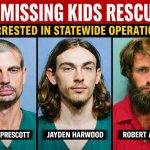
Mugshots of suspects were presented alongside claims that they were responsible for hundreds of children.
Those claims were not supported by the evidence.
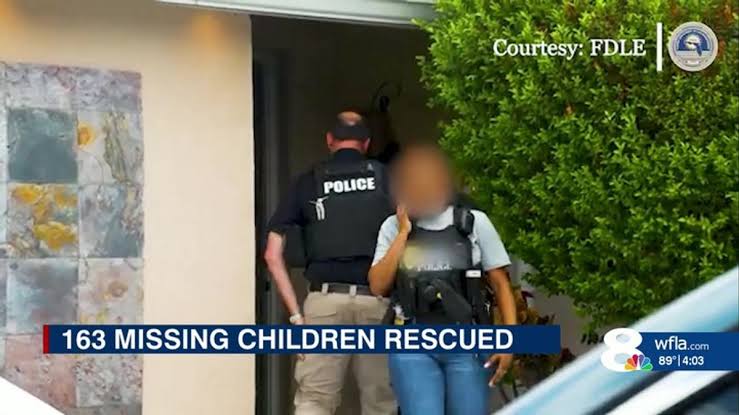
Such misinformation does more than confuse people.
It can damage ongoing investigations, falsely accuse individuals, expose children to unwanted attention and make it harder for the public to distinguish verified information from viral fiction.
The real story is serious enough.
Florida law enforcement located 163 children.
Officials say some had suffered abuse, neglect, exploitation or exposure to criminal activity.
Prosecutors are pursuing cases.
Investigators are continuing their work.
Children are receiving services.
And families are still searching for answers.
That should be the focus.
Because the most disturbing question is not simply how many children were found.
It is how many vulnerabilities allowed those children to disappear in the first place.
And whether the systems designed to protect them will be strong enough to prevent it from happening again.