THE DAUGHTER THEY CALLED A FAILURE – PART 5 — THE DAUGHTER WHO WALKED AWAY THE FINAL CHAPTER
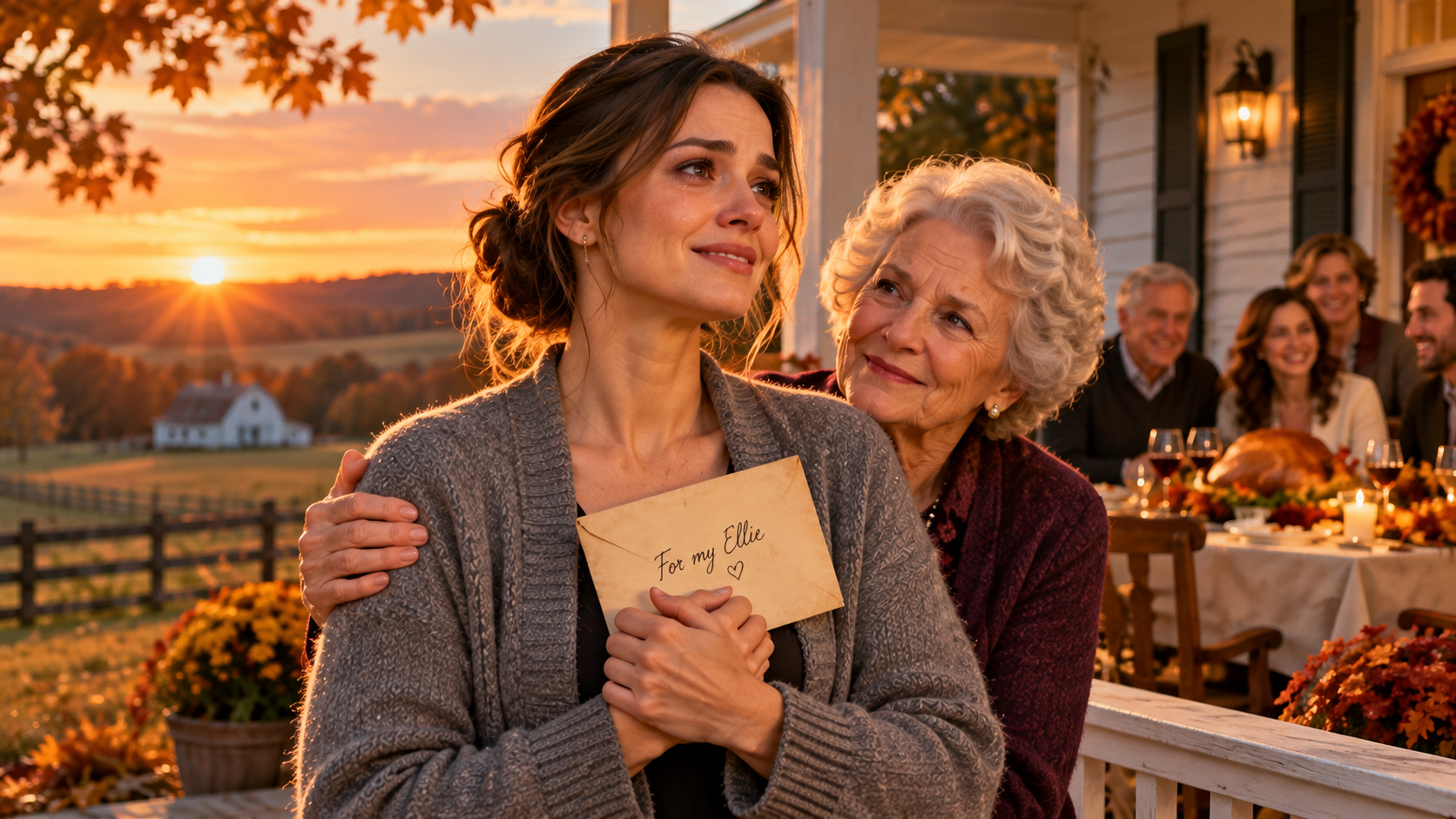
The first thing I noticed was the date.
Eleven years ago.
Three weeks before my grandfather passed away.
The second thing I noticed was my name.
ELLEN MARIE HOPKINS.
And beneath it, a description of something I had never known existed.
A house.
A trust.
And an inheritance my mother had kept secret for more than a decade.
I stood in the middle of the Thanksgiving dining room, holding the fragile documents while seventeen relatives watched me.
My grandmother’s hands were trembling.
My father looked confused.
And my mother looked like a woman who had just watched the past walk through the front door.
“Grandma,” I whispered, “what is this?”
Rose took a slow breath.
“Your grandfather wanted to make sure you always had somewhere to belong.”
I looked down again.
The property was a small farmhouse on twelve acres outside Willow Creek.
I knew that house.
I knew it better than almost any place on earth.
Grandpa used to take me there on summer weekends.
We picked apples in the orchard, painted the wooden fence, and sat on the porch while he told stories about the years before he met Grandma.
It was the one place where I never felt like the disappointing daughter.
The one place where nobody compared me to Naomi.
But after Grandpa passed away, Mom told me the property had been sold to cover expenses.
I hadn’t questioned her.
I was twenty-four, working long hours, studying at night, and trying to build a future.
Now I was staring at documents suggesting the house had never been sold.
“Mom,” I said.
She wouldn’t look at me.
“You told me Grandpa sold the farmhouse.”
Silence.
“Eleven years ago, you told me there was nothing left.”
My mother’s lips moved.
No words came out.
Grandma Rose spoke instead.
“Your grandfather arranged for the property to be placed in a trust for you. There were also investment accounts intended to help maintain it.”
I stared at her.
“Why didn’t you tell me?”
Her eyes filled.
“I believed your mother had delivered the letter. When I asked about it, she told me you knew and wanted your privacy.”
I turned toward Diane.
“Is that true?”
Mom suddenly stood.
“Your grandfather wasn’t thinking clearly toward the end!”
Grandma’s expression hardened.
“He knew exactly what he was doing.”
“Mother, he was ill!”
“He met with his attorney while he was still capable of making his own decisions. I was there.”
The room went silent.
I looked at the papers again.
The trust named a professional trustee, with instructions concerning the property and eventual distributions to me.
That didn’t tell me everything about its current legal status.
I would need the complete trust records and an attorney to understand what had happened.
But one thing was already clear.
My mother had known about something important that belonged in my life.
And she had chosen not to tell me.
“Why?” I asked.
Mom folded her arms.
“Ellen, you wouldn’t understand.”
I almost laughed.
After thirty-five years, those were still her favorite words.
You wouldn’t understand.
As if ignorance were my natural condition.
“Try me,” I said.
Her eyes flickered toward Naomi.
“Your grandfather was always too easy on you.”
I stared at her.
“What?”
“He was constantly encouraging you. Giving you money for books. Telling you that you could do anything. Meanwhile, Naomi was working herself to exhaustion to become a doctor.”
Naomi slowly lifted her head.
“Mom, don’t.”
But Diane continued.
“Your grandfather wanted to reward you for struggling. He thought you needed protecting.”
I felt my chest tighten.
“Protecting from what?”
Mom’s voice grew sharper.
“From a world that wasn’t going to applaud you just because you tried!”
Nobody moved.
Then Grandma Rose spoke.
“He didn’t leave Ellen that house because she was struggling.”
Diane turned.
“Mother—”
“He left it to her because she loved it.”
Grandma looked at me.
“Your grandfather said Naomi would build her own life wherever she wished, but Ellen was the one who understood what that place meant to him.”
My vision blurred.
I remembered the orchard.
The porch swing.
The old kitchen where Grandpa taught me to make pancakes.
And something else.
A conversation when I was nineteen.
I had come home crying after Mom told a neighbor that Naomi had a future in medicine while I was “still figuring things out.”
Grandpa found me sitting on the porch.
He handed me a cup of hot chocolate.
Then he said something I had never forgotten.
“Ellie, some people are so busy looking at the top of a tree that they forget to admire its roots.”
I hadn’t understood it then.
Now I did.
I covered my mouth.
Grandma placed one hand over mine.
“He believed in you long before anyone knew what you would become.”
For the first time that evening, I cried without trying to hide it.
Not because of the inheritance.
Because a man who had been gone for eleven years had still found a way to tell me I mattered.
My father rose slowly.
“Diane,” he whispered, “you told me Henry sold that house.”
Mom stared at him.
Walter continued.
“You told me the property was gone.”
“I was trying to do what was best for this family!”
“For whom?” he asked.
The question seemed to strike her harder than anything else.
“For whom, Diane?”
She looked around the room.
Nobody answered for her.
Then Naomi stood.
Her cream blazer was stained with tears.
Her perfect makeup was gone.
And the confident surgeon who had entered the house to applause now looked like someone carrying years of regret.
“Mom,” she said quietly, “you need to tell Ellen the truth.”
Diane shook her head.
“Naomi, stay out of this.”
“No.”
Everyone looked at my sister.
She swallowed.
“You made everything a competition.”
Mom’s face hardened.
“I gave you both every opportunity.”
“You gave me your approval,” Naomi replied. “And you made Ellen fight for it.”
I stared at her.
She continued.
“When I became a surgeon, you celebrated. When Ellen earned her degrees, you changed the subject. When I got promoted, you invited seventeen relatives. When Ellen got promoted, you didn’t even know.”
Mom looked away.
Naomi’s voice broke.
“And I let you do it because I liked being the daughter everyone admired.”
I felt a strange ache in my chest.
Naomi turned toward me.
“I’m sorry, Ellen.”
I didn’t speak.
“I knew what you had accomplished. I knew you were respected at Ashcom. And I let you sit through years of those jokes because I was afraid of losing my place.”
Tears rolled down her cheeks.
“I thought if everyone finally saw you, they might stop seeing me.”
I looked at the sister I had spent my whole life envying.
And for the first time, I understood that we had both been trapped.
I had been assigned the role of failure.
She had been assigned the role of perfection.
Neither of us had been allowed to simply exist.
“Naomi,” I whispered, “you never had to compete with me.”
She began crying harder.
“I know.”
“No,” I said. “I don’t think you did.”
She stepped toward me.
I stepped back.
Her expression crumpled.
But I needed her to understand something.
“I love you,” I said. “But you knew what Mom was doing. You watched it happen for years.”
“I know.”
“And when Richard Voss pressured you, you helped keep me in the dark.”
She nodded.
“I’m ashamed of that.”
“Then don’t ask me to pretend it’s fixed because you’ve finally admitted it.”
She lowered her eyes.
“I won’t.”
That was the first honest promise she’d made me all evening.
And somehow, it mattered.
I folded Grandpa’s letter carefully.
Then I looked at Grandma.
“Can I keep this?”
She smiled through her tears.
“It was always yours.”
I pressed the envelope against my chest.
“Thank you.”
Mom suddenly spoke.
“So that’s it?”
I turned toward her.
She looked furious.
“You’re going to walk out with an inheritance and make everyone think I’m a terrible mother?”
I stared at her.
The old version of me would have rushed to reassure her.
I would have explained that she wasn’t terrible.
That she had done her best.
That I understood.
That everything was fine.
But nothing was fine.
And I was tired of protecting her from the consequences of her own words.
“Mom,” I said quietly, “I didn’t make seventeen people believe I cleaned toilets.”
Her mouth tightened.
“You let them believe it.”
“Yes,” I answered. “Eventually, I stopped correcting you.”
“Then you share some responsibility.”
I nodded.
“You’re right about one thing. I should have stopped accepting the way you treated me a long time ago.”
She blinked.
I continued.
“But I didn’t invent those jokes. I didn’t slide money across the table. And I didn’t hide Grandpa’s letter.”
My father lowered his head.
Mom looked toward him.
“Walter, are you going to let her speak to me like this?”
He stared at her.
Then he said something I had waited thirty-five years to hear.
“Yes.”
The room froze.
Dad’s voice trembled.
“Because she’s telling the truth.”
Mom looked stunned.
He continued.
“I let this happen too. I laughed when I should have stopped you. I ignored Ellen because it was easier than challenging the way things worked in this house.”
His eyes filled.
“And tonight, I humiliated my daughter in front of our entire family.”
He reached for the folded fifty-dollar bill.
Then stopped.
For a moment, he seemed unable to touch it.
Finally, he picked it up.
“I can’t undo what I said.”
He looked at me.
“But I can promise I won’t say it again.”
I nodded.
I wasn’t ready to forgive him.
Not completely.
But I believed he finally understood.
And that was more than I had expected when I arrived with a dish of green beans.
I took my coat.
Grandma Rose looked worried.
“Sweetheart, where are you going?”
“Home.”
“Are you all right?”
I considered the question.
For years, I would have said yes.
I would have smiled.
I would have told everyone not to worry.
Instead, I told the truth.
“Not yet, Grandma.”
She nodded.
“That’s all right.”
I kissed her forehead.
Then I turned toward the door.
Nobody stopped me.
Not Mom.
Not Naomi.
Not Dad.
For the first time in my life, I left my parents’ house without apologizing for making everyone uncomfortable.
And when the front door closed behind me, something extraordinary happened.
I felt lighter.
Not happy.
Not victorious.
Just free.
***
The following Monday, I walked into Ashcom Regional Health Network headquarters at 7:15 a.m.
I wore a navy suit.
My hair was neatly pinned back.
And I carried a folder containing the documents Grandma had given me.
But the inheritance would have to wait.
There was another matter to handle first.
The irregular authorization.
The suspicious consulting contracts.
And Richard Voss.
I met with Margaret Ellis, our general counsel, along with outside legal counsel and members of the compliance team.
The executive review had been restructured so that anyone potentially involved in the disputed transactions would not participate in decisions about them.
Richard’s access to certain internal records had been restricted pending the investigation.
And I had been asked to provide a formal statement.
I told them everything I knew.
Including Naomi’s account of the conversations she’d had with Richard.
I turned over the relevant messages with her permission.
I described my documented recusal from her promotion process.
And I explained why I believed the signature on the authorization was not mine.
I didn’t exaggerate.
I didn’t accuse Richard of something I couldn’t prove.
I simply provided the facts.
Then I did what I’d always done.
I went back to work.
Because thousands of patients still needed our hospitals to function.
And my responsibilities didn’t disappear because someone had tried to compromise them.
Over the next several weeks, the independent review uncovered serious weaknesses in document access, authorization procedures, and vendor oversight.
The investigation identified transactions that required further examination.
Some had been routed through processes that bypassed ordinary controls.
Others lacked sufficient supporting documentation.
The disputed authorization bearing my name was determined not to be a valid approval from me.
The investigation did not establish that I had authorized the questionable expenditure.
That mattered.
But another finding mattered even more.
The report recommended significant changes to prevent anyone from exploiting the same weaknesses again.
Richard Voss stepped aside from his committee responsibilities while the findings were reviewed.
The board referred relevant matters for further examination by appropriate authorities.
I wasn’t told every detail.
Nor should I have been.
A proper investigation wasn’t supposed to become a personal revenge story.
My responsibility was to cooperate, protect the integrity of our operations, and make sure patient care remained the priority.
And that was exactly what I did.
Naomi cooperated too.
She provided her emails.
She answered difficult questions.
She acknowledged that she had failed to report concerning conversations when they first occurred.
There were consequences.
Her conduct underwent a separate review.
She continued working as a physician under the hospital’s ordinary clinical leadership structure while that process moved forward.
For the first time in her life, Naomi had to face a problem without Mom being able to praise it away.
And perhaps that was what finally allowed us to begin speaking honestly.
***
Three weeks after Thanksgiving, I received a letter from my father.
Not a text.
Not a phone call.
A handwritten letter.
He told me he had spent days thinking about all the times he had made me feel small.
He wrote about my graduation.
About the missed celebrations.
About the jokes.
And about the fifty-dollar bill.
One sentence stayed with me.
“I spent years confusing the daughter I understood with the daughter I valued.”
I read that line several times.
Then I put the letter away.
I didn’t call him immediately.
I needed time.
He respected that.
For once, my father didn’t demand forgiveness simply because he had apologized.
He let me decide when I was ready.
Mom was different.
Her first message accused me of turning the family against her.
Her second message said she had only been joking.
Her third asked whether I planned to embarrass her at Christmas too.
I didn’t respond.
Then, almost a month after Thanksgiving, she sent a different message.
“I found your graduation photos. I never realized how many ceremonies we missed.”
I stared at the screen for a long time.
It wasn’t an apology.
Not really.
But it was the first time my mother had acknowledged that something had been missing.
I wrote back.
“I need time, Mom. And if we’re going to have a relationship, the jokes and comparisons have to stop.”
She didn’t reply for two days.
Then she sent four words.
“I will try, Ellen.”
I wanted to believe her.
But I had learned that love without respect could still leave scars.
So I waited.
And watched.
***
The inheritance took longer to understand.
With Grandma’s help, I contacted the attorney who had handled Grandpa’s estate planning.
We obtained the trust records and confirmed the farmhouse had remained in the trust.
Its current status required legal clarification, including questions about the administration of the trust and why certain communications had never reached me.
The matter wasn’t resolved overnight.
There were records to review.
Questions to answer.
And difficult conversations ahead.
But eventually, after the trustee’s records were examined and the necessary legal steps completed, the property was transferred to me according to the trust’s terms.
The farmhouse.
The orchard.
The twelve acres.
The place where Grandpa had once told me that roots mattered more than applause.
On a cold Saturday morning in early spring, I drove there for the first time in eleven years.
Grandma came with me.
The house needed work.
The porch railing was loose.
The paint had faded.
Weeds had overtaken part of the garden.
But the old maple tree was still standing beside the driveway.
And the orchard was beginning to bloom.
Grandma stood on the porch while I unlocked the front door.
The house smelled of old wood and dust.
I stepped inside.
And suddenly, I was nineteen again.
I could almost hear Grandpa humming in the kitchen.
Almost see him standing beside the stove with a ridiculous apron tied around his waist.
I walked into the living room.
There, against the far wall, stood the old bookshelf he had built himself.
I ran my fingers over the wood.
Then Grandma handed me something.
A second envelope.
“This was kept with the trust records,” she said.
I looked at her.
“Another letter?”
She nodded.
“Read it.”
My hands trembled as I opened it.
Inside was a single handwritten page.
My grandfather’s familiar handwriting covered nearly every line.
I began reading.
“My dear Ellie,
If you’re reading this, I hope you’ve already discovered something I spent years trying to teach you.
Your worth has never depended on how impressive your life looks to other people.
I watched you work when nobody applauded.
I watched you study when you were tired.
I watched you help people who could never repay you.
And I watched you carry the weight of other people’s expectations without letting your heart turn bitter.
That is the person I am proud of.
Not the job you may hold one day.
Not the money you may earn.
Not the title written beside your name.
You.
If this old house becomes yours, I hope it reminds you that you have always belonged somewhere.
And if the day ever comes when you feel unwanted, come sit on the porch.
Remember that someone believed in you long before the world knew your name.
Love always,
Grandpa.”
I couldn’t finish the last sentence aloud.
Grandma wrapped her arms around me.
And I cried.
Not because I was hurt.
Not because I had been humiliated.
But because, for the first time in years, I felt the kind of love that never demanded proof.
***
By summer, I had restored the farmhouse.
Not into a mansion.
Not into something designed to impress strangers.
I kept the wooden porch.
The blue kitchen cabinets.
The old bookshelf.
Even the crooked wooden sign Grandpa had made for the orchard.
I began spending weekends there.
Sometimes Grandma joined me.
Sometimes Naomi came.
Our relationship was different now.
More honest.
Less automatic.
We talked about things we’d never dared to discuss before.
About childhood.
About jealousy.
About how our mother had shaped the way we saw ourselves and each other.
There were uncomfortable moments.
There were tears.
There were times I needed space.
But Naomi no longer pretended everything was fine.
And neither did I.
One afternoon, she helped me plant roses beside the porch.
She looked at the garden and smiled.
“Grandpa would have loved this.”
I nodded.
“He would.”
She hesitated.
“Ellen?”
“Yeah?”
“I’m proud of you.”
I looked at her.
She laughed nervously.
“Not because you’re COO. Not because of the house. Just because you’re my sister.”
I smiled.
For the first time, hearing those words from Naomi didn’t feel like winning a competition.
It felt like having a sister.
***
The next Thanksgiving, I didn’t go to my parents’ house.
Instead, I hosted dinner at the farmhouse.
Grandma came.
Naomi and Daniel came.
Aunt Ruth brought a pie.
Uncle Ford brought enough mashed potatoes to feed a football team.
My father arrived carrying a dish of green beans.
He had made them himself.
They were overcooked.
I loved them anyway.
Mom came too.
I had invited her after months of cautious conversations and small, consistent changes.
She hadn’t become a different person overnight.
Sometimes she still slipped into old habits.
Sometimes she needed reminding.
But she was trying.
And this time, when everyone gathered around the table, she didn’t introduce Naomi as the successful daughter.
She didn’t introduce me as the daughter who had finally made something of herself.
She simply said:
“I’m grateful both my girls are here.”
It wasn’t a perfect moment.
But it was real.
Later, when the turkey had been carved and the plates were full, Dad cleared his throat.
I looked up.
He reached into his jacket pocket.
For half a second, my heart stopped.
Then he pulled out a small wooden picture frame.
Inside was a photograph.
Me at twenty-three.
Standing outside my college graduation ceremony.
Wearing my cap and gown.
Smiling at the camera.
Alone.
I stared at it.
“I found this in an old box,” Dad said.
His voice was unsteady.
“I should have been there.”
I swallowed.
He continued.
“I can’t go back and change that day.”
He placed the frame gently beside my plate.
“But I wanted you to know that I see you now.”
My eyes filled.
“Thank you, Dad.”
He nodded.
And that was enough.
There was no dramatic applause.
No standing ovation.
No speech about how important I had become.
Just a father finally learning how to love his daughter without measuring her accomplishments.
After dinner, I stepped onto the porch.
The evening air smelled of fallen leaves and wood smoke.
Grandma joined me.
For a while, we watched the sunset without speaking.
Then she smiled.
“Do you remember last Thanksgiving?”
I laughed softly.
“How could I forget?”
She reached for my hand.
“Do you know what made me proudest that night?”
I looked at her.
“What?”
“Not when everyone found out what you did for a living.”
I smiled.
“Then what?”
“When you left.”
I turned toward her.
Grandma’s eyes were warm.
“You finally stopped asking people who refused to see you to tell you what you were worth.”
I felt tears gathering.
She squeezed my hand.
“And look at you now.”
I looked through the window.
At Naomi laughing with Daniel.
At Dad helping clear the table.
At Mom listening while Aunt Ruth told a story.
At the family I had once believed I needed to impress.
They were still imperfect.
So was I.
But things were different.
Because I was different.
I no longer needed their approval to know who I was.
I had spent years believing the greatest revenge would be watching my family discover my success.
I had imagined the surprise.
The embarrassment.
The apologies.
I thought the moment they learned my title would finally make me feel important.
But I was wrong.
The greatest victory wasn’t the promotion.
It wasn’t the inheritance.
It wasn’t the investigation that cleared my name.
It wasn’t even hearing my parents say they were proud of me.
It was realizing I had been worthy of respect all along.
Even at nineteen, cleaning hospital rooms.
Even at twenty-three, graduating without anyone cheering.
Even at thirty-five, sitting at a Thanksgiving table with fifty dollars beside the gravy boat.
I had always been enough.
I just hadn’t believed it.
Grandma leaned her head against my shoulder.
“Happy Thanksgiving, Ellie.”
I kissed her forehead.
“Happy Thanksgiving, Grandma.”
Inside, someone called us back for dessert.
Grandma started toward the door.
I stayed behind for one more moment.
The stars were appearing above the orchard.
The farmhouse lights glowed through the windows.
And somewhere in the quiet, I could almost hear Grandpa’s voice.
“Remember your roots, Ellie.”
I smiled.
“I will, Grandpa.”
Then I walked back inside.
Not as the daughter they called a failure.
Not as the executive they suddenly respected.
Not as the woman who had inherited a house.
But simply as Ellen.
And for the first time in thirty-five years, that was enough.
THE END.
Sometimes the people who refuse to recognize your worth are the very people whose approval you’ve spent your life chasing.
But your value doesn’t begin when someone finally notices it.
And you don’t have to become extraordinary to deserve ordinary kindness.
Because the most powerful moment in your life may not be when everyone finally sees who you are.
It may be the moment you stop needing them to.
THE DAUGHTER THEY CALLED A FAILURE
— A STORY ABOUT FAMILY, DIGNITY, BETRAYAL, AND FINDING YOUR WAY HOME.