THE DAUGHTER THEY CALLED A FAILURE – PART 4 — THE PRICE OF A FATHER’S JOKE
My name was at the bottom of the document.
My title was correct.
My employee identification number was correct.
Even the signature looked like mine.
But I had never signed it.
And the moment I saw the amount listed above my forged signature, I understood why someone had spent months trying to keep me in the dark.
$4.8 million.
Four million, eight hundred thousand dollars.
That was the amount supposedly authorized for a consulting and operational improvement program connected to the expansion of St. Matthew’s Medical Center.
A program I had never approved.
A company I had never heard of.
And an authorization carrying my name.
I stared at the screen until the words began to blur.
“Ellen?”
Grandma Rose’s voice brought me back to the dining room.
Seventeen relatives were still watching me.
The turkey was getting cold.
My father’s fifty-dollar bill still lay beside the gravy boat.
And my sister Naomi was crying so hard that her husband had moved his chair closer to hers.
“Ellen, what is it?” Grandma asked.
I locked my phone.
“Someone may have forged my signature.”
My father stood so abruptly that his chair scraped across the floor.
“What?”
I looked at him.
“There is an authorization document connected to a large hospital expenditure. It appears to carry my approval, but I didn’t sign it.”
Dad stared at me.
“How much money?”
I hesitated.
I knew better than to share every detail of a potentially confidential investigation with a dining room full of relatives.
“Enough that our legal department is taking it very seriously.”
Mom pressed a hand against her chest.
“Does this mean you could lose your job?”
I looked at her.
Of all the things she could have asked, that was the first one.
Not whether I was frightened.
Not whether someone had betrayed my trust.
Not whether I needed help.
Just whether I was about to lose the title she’d learned about less than an hour ago.
“I don’t know what it means yet,” I replied.
Naomi suddenly stood.
“I need to tell you something.”
I turned toward her.
She looked exhausted.
Her cream-colored blazer was wrinkled now, and mascara had gathered beneath her eyes.
The perfect daughter no longer looked perfect.
She looked terrified.
“Richard called me yesterday,” she whispered.
My stomach tightened.
“What did he say?”
“He asked whether you were coming to Thanksgiving.”
I stared at her.
“He asked about me?”
She nodded.
“He wanted to know if Mom and Dad still thought you were working in environmental services.”
Aunt Ruth gasped.
My mother’s face went white.
“Why would he care what we think?”
Naomi shook her head.
“I asked him that.”
“And?”
“He said it was important that Ellen not become suspicious before the annual executive review.”
I felt a cold sensation move through my body.
The annual executive review was scheduled for the following Monday.
It was the meeting where senior leadership would examine major operating expenditures, pending projects, and unresolved compliance issues.
I was supposed to present the St. Matthew’s expansion status.
And if I had walked into that meeting without knowing about the suspicious authorization, I might have been forced to explain a document I had never seen.
My name.
My signature.
My responsibility.
All attached to someone else’s decision.
“Naomi,” I said slowly, “did Richard tell you what he wanted me to do?”
She looked down.
“He said I should encourage you to take some time away from work.”
I stared at her.
“What?”
“He suggested I tell you that you seemed exhausted. That you needed a vacation. That maybe you should miss Monday’s meeting.”
I couldn’t believe what I was hearing.
For months, I had wondered why Naomi had suddenly become interested in my work-life balance.
Why she kept sending me articles about burnout.
Why she had repeatedly suggested that I take a long Thanksgiving weekend.
Now I knew.
“That’s why you kept calling me?”
Her eyes filled again.
“Yes.”
I felt something inside me break.
“You weren’t worried about me.”
“Ellen—”
“You were trying to keep me away from work.”
“At first, yes.”
“At first?”
She nodded miserably.
“Then I realized something was wrong. I started asking questions, and Richard became angry.”
“What questions?”
“About the consulting company.”
My pulse quickened.
“What did you find?”
She hesitated.
“Nothing I could prove. But one of the physicians told me the cardiac expansion team had never received some of the equipment and services described in the budget summaries.”
That was serious.
But it was still only an allegation.
And as much as I wanted answers, I knew the difference between suspicion and evidence.
“Did you report it?”
“No.”
I closed my eyes.
Of course she hadn’t.
“I was afraid,” Naomi whispered.
I looked at her.
“Naomi, people depend on those hospitals.”
“I know.”
“Patients. Families. Nurses working double shifts. Surgeons trying to get operating rooms and equipment.”
Her shoulders shook.
“I know, Ellen.”
“Then you should have spoken up.”
“I should have.”
For once, she didn’t argue.
And somehow that made everything hurt more.
I stepped away from the table.
“I need some air.”
Nobody stopped me.
Except Grandma.
She rose slowly and reached for my hand.
“Don’t go too far, sweetheart.”
I managed a small smile.
“I won’t.”
Then I walked out through the kitchen door.
The cold November air hit my face.
For the first time all evening, I could breathe.
The backyard looked exactly as it had when I was a little girl.
The same wooden fence.
The same old maple tree.
The same stone path my grandfather had built before he passed away.
I walked toward the wooden bench beneath the tree and sat down.
I had spent years building a life I was proud of.
Years working through college.
Years taking night classes.
Years proving that a young woman who started by cleaning hospital rooms could one day help lead an entire healthcare network.
And now someone had apparently decided that my history made me an easy target.
A woman whose own family didn’t understand her career.
A woman nobody at home would think to defend.
I pressed my palms against my eyes.
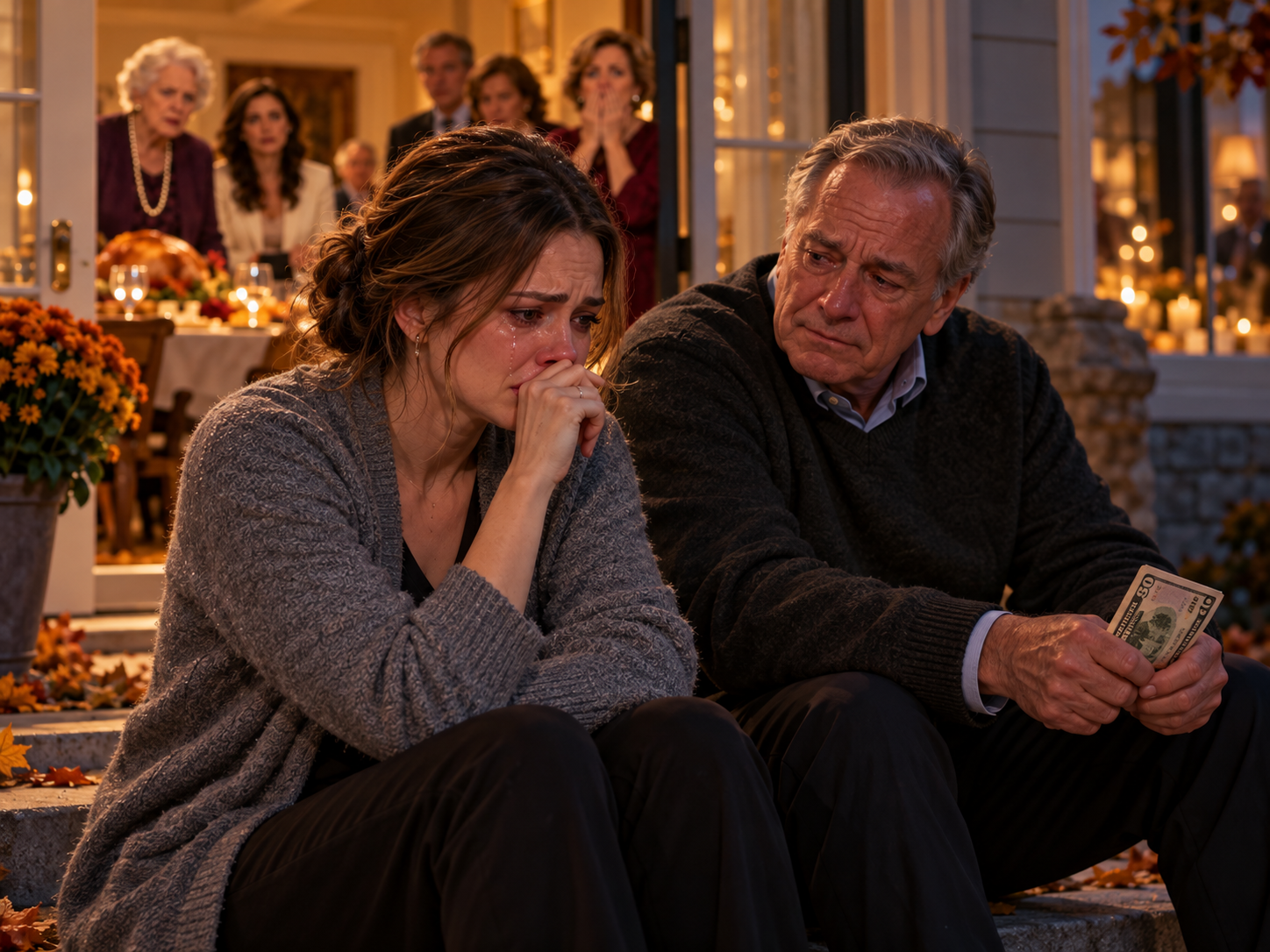
I didn’t cry when Mom humiliated me.
I didn’t cry when Dad offered me fifty dollars.
But sitting beneath that maple tree, I finally felt tears slipping down my cheeks.
Because success had never erased the little girl inside me who wanted her parents to be proud.
I heard the kitchen door open.
Footsteps moved across the patio.
Then stopped.
“Ellen?”
My father’s voice.
I wiped my face.
“What do you need, Dad?”
He didn’t answer immediately.
Then I heard the bench creak as he sat beside me.
For a while, neither of us spoke.
The house glowed warmly behind us.
Through the windows, I could see relatives moving around the dining room.
They looked like any ordinary American family enjoying Thanksgiving.
If someone had taken a photograph, nobody would have guessed what had happened at that table.
Finally, Dad spoke.
“I didn’t know.”
I stared at the ground.
“I know.”
“I didn’t know you were doing all those things.”
I let out a breath.
“That’s what everyone keeps saying.”
He rubbed his hands together.
“I suppose I deserve that.”
I didn’t answer.
He looked toward the house.
“Your mother always handled the family news. She told me what was going on with you girls.”
I turned toward him.
“Dad, I’m thirty-five years old.”
He frowned.
“I know how old you are.”
“Then why did you need Mom to tell you what I do?”
He looked away.
That question seemed to hurt him more than anything else I’d said.
“You’re my father,” I continued. “You could have asked me.”
He swallowed.
“I should have.”
“Yes.”
Another long silence.
Then he reached into his pocket.
He pulled out the fifty-dollar bill.
I stared at it.
For one terrible second, I thought he was going to offer it to me again.
Instead, he held it between his fingers.
“I thought I was being funny.”
I said nothing.
“I thought everyone knew I was joking.”
I looked at him.
“Dad, what’s funny about telling your daughter to go mop something?”
He couldn’t answer.
“Would you have said that to Naomi?”
His eyes dropped.
“No.”
“Why not?”
“Because she’s a surgeon.”
There it was.
The truth.
Small.
Simple.
Devastating.
I nodded slowly.
“Exactly.”
He looked up.
“Ellen, I didn’t mean—”
“You never do.”
The words came out sharper than I intended.
But I didn’t take them back.
“Mom never means it. You never mean it. Nobody ever means anything. And somehow I’m always the one who has to sit there and pretend it doesn’t hurt.”
Dad’s mouth trembled.
I had never seen him look so old.
“When I graduated with my master’s degree,” I continued, “I invited you and Mom.”
He closed his eyes.
“I remember.”
“Do you remember why you didn’t come?”
He said nothing.
“Naomi had been nominated for a hospital teaching award. You said you couldn’t miss her ceremony.”
He lowered his head.
I continued.
“When I became vice president, I called you. Do you remember what you said?”
“No.”
“You asked whether I had finally gotten an office instead of a supply closet.”
He winced.
“I didn’t know—”
“You didn’t ask.”
My voice cracked.
“You never asked.”
The tears came then.
Not quietly.
Not gracefully.
I cried the way I’d wanted to cry when I was nineteen and exhausted after cleaning hospital floors all night.
The way I’d wanted to cry when Mom introduced me as the daughter who hadn’t turned out quite right.
The way I’d wanted to cry every time I watched my parents celebrate Naomi while treating my achievements like a misunderstanding.
Dad reached toward me.
I moved away.
He stopped.
For once, he respected the boundary.
“I spent my entire life trying to become someone you’d be proud of,” I whispered.
His eyes filled.
“Ellen, I am proud of you.”
I shook my head.
“You’re proud now because someone told you I have an important title.”
He opened his mouth.
I continued before he could speak.
“But when you thought I cleaned hospital bathrooms, you weren’t proud.”
He stared at me.
“And that’s what hurts, Dad. Because if I were still cleaning bathrooms, I would deserve the same respect.”
He covered his face.
For several moments, neither of us spoke.
Then he began crying.
I had seen my father cry exactly twice in my life.
Once when Grandpa died.
Once when Naomi nearly lost a patient early in her residency.
Never because of me.
“I’m sorry,” he whispered.
I looked at him.
“I’m so sorry, Ellen.”
He lowered the fifty-dollar bill into his lap.
“I thought I was raising strong daughters. I didn’t realize I’d taught one of them that she had to earn my respect.”
I swallowed.
“I didn’t need you to think I was extraordinary.”
My voice trembled.
“I just needed you to think I mattered.”
Dad broke down.
And I sat beside him without reaching for his hand.
Because forgiveness isn’t something you owe someone simply because they finally understand the damage they’ve done.
After a while, he wiped his eyes.
“What can I do?”
I looked toward the house.
“Start by learning who I am.”
He nodded.
“And Dad?”
“Yes?”
“Don’t ever use someone’s job to humiliate them again.”
He looked down at the bill.
“I won’t.”
I wanted to believe him.
But I had learned that change was measured in actions, not promises.
My phone buzzed.
Margaret Ellis.
A text message.
ELLEN, PLEASE CALL WHEN YOU’RE SOMEWHERE PRIVATE. WE’VE CONFIRMED THE DOCUMENT WAS NOT PROCESSED THROUGH THE STANDARD APPROVAL WORKFLOW.
I stood immediately.
Dad looked alarmed.
“What’s wrong?”
“I need to make a call.”
He rose too.
“Do you need me?”
I looked at him.
For the first time that evening, he wasn’t offering money.
He wasn’t offering advice.
He was simply asking.
“Not right now.”
He nodded.
“I’ll be inside.”
I watched him walk toward the house.
The fifty-dollar bill was still in his hand.
Then I called Margaret.
She answered on the first ring.
“Ellen, are you alone?”
“Yes.”
“Good. Our document-control team confirmed an irregularity.”
“What kind?”
“The authorization entered the records system through a manual upload, not through the normal approval process.”
I closed my eyes.
“Can you identify who uploaded it?”
“We have an associated user account. Information security is validating the access logs and checking for any compromised credentials.”
“Whose account?”
She paused.
“An administrative account assigned to Richard Voss’s office.”
My pulse quickened.
But I forced myself to remain calm.
“That doesn’t prove Richard personally uploaded it.”
“Correct,” Margaret replied. “And I want to be clear that we’re not making that conclusion.”
I appreciated that.
In my career, I had seen reputations damaged by accusations that later proved incomplete.
I wasn’t going to repeat that mistake.
“What happens next?” I asked.
“Outside counsel and our compliance team will conduct an independent review. Relevant records are being preserved. We also need a formal statement from you regarding the signature.”
“You’ll have it.”
“There’s something else.”
I looked toward the house.
“What?”
“We identified a second document in the same collection.”
My stomach tightened.
“Another authorization?”
“No.”
“What is it?”
“A memorandum concerning the leadership structure at St. Matthew’s.”
I frowned.
“Why would that be included?”
“Because it appears to discuss two employees by name.”
“Who?”
Margaret hesitated.
“You and your sister.”
The cold suddenly felt sharper.
“What does it say?”
“One section proposes that your family relationship could be raised as a potential governance concern during the upcoming executive review.”
I stared into the darkness.
“Raised by whom?”
“The document doesn’t make that clear.”
“And what’s the proposed outcome?”
Margaret took a breath.
“Temporary removal of certain operational responsibilities pending a conflict-of-interest review.”
My heart pounded.
Someone had apparently prepared a route to question my authority.
And they were relying on the family connection that Naomi had been encouraged to conceal.
“Margaret, my relationship to Naomi was disclosed to human resources years ago.”
“We have that documentation,” she replied.
“And I recused myself from relevant promotion decisions.”
“We have that too.”
I felt a flicker of relief.
“Then why would anyone think this could work?”
Her answer was quiet.
“Because allegations can cause disruption even when they’re eventually disproven.”
I looked toward the dining room window.
Naomi was standing beside Mom.
For the first time that night, they weren’t talking.
They were simply staring at each other.
“Margaret,” I asked, “does the board chair know?”
“She’s been informed. The review will be handled independently, with any potentially involved individuals excluded from the process.”
“Good.”
“And Ellen?”
“Yes?”
“Please don’t discuss the documents with Richard or attempt to investigate them yourself. We need the evidence preserved.”
“I understand.”
She paused.
“One more question. Has anyone connected to Richard discussed your work responsibilities with your family recently?”
I looked at Naomi through the window.
“Possibly.”
“We’ll need to speak to anyone who has relevant information.”
“I know.”
When the call ended, I remained beneath the maple tree for another minute.
The legal team had evidence of serious irregularities.
But we didn’t yet know who was responsible.
We didn’t know whether the documents were connected.
And we certainly didn’t know whether someone was trying to frame me.
What I did know was that my sister had been drawn into something she didn’t fully understand.
And that I could no longer protect her from the consequences of keeping silent.
I returned to the house.
The dining room fell quiet when I entered.
Naomi stood immediately.
“Ellen?”
“We need to talk.”
Her face drained of color.
“What happened?”
“I spoke to Ashcom’s legal department.”
Daniel tightened his grip on her hand.
Naomi whispered, “Am I in trouble?”
“I don’t know.”
Her eyes filled.
“But they’re conducting an investigation, Naomi. If you have emails, messages, or documents involving Richard, you need to preserve them. Don’t delete anything.”
She nodded rapidly.
“I won’t.”
“And you need to tell them the truth.”
She looked down.
“I will.”
Mom suddenly rose.
“This has gone far enough. It’s Thanksgiving. Can’t we discuss this tomorrow?”
I turned toward her.
For thirty-five years, that sentence would have made me apologize.
I would have softened my voice.
I would have promised not to ruin the holiday.
But something had changed.
“No, Mom.”
She blinked.
“Excuse me?”
“No. We can’t pretend nothing happened just because the truth is uncomfortable.”
Her face hardened.
“You’re being dramatic.”
Grandma Rose stood.
“No, Diane. She’s finally being heard.”
Mom looked around the room.
Nobody defended her.
Not Aunt Ruth.
Not Uncle Ford.
Not even Dad.
He remained by the doorway, staring at the folded fifty-dollar bill in his hand.
Then he did something I never expected.
“Diane,” he said quietly, “we owe our daughter an apology.”
Mom turned toward him.
“Walter, don’t start.”
“I’m serious.”
“You don’t understand—”
“No,” he interrupted. “For years, I didn’t understand. And that was my failure.”
The room went still.
Dad walked toward me.
He placed the folded bill on the table.
Not in front of me.
Beside his own plate.
“I was wrong,” he said.
His voice shook.
“And I won’t make another joke at my daughter’s expense.”
Mom stared at him as if he were a stranger.
Then she turned to me.
Her eyes were wet.
But her voice was cold.
“So what do you want, Ellen? An apology? A standing ovation? Should we all clap because you’re important now?”
I felt the familiar sting.
But this time, I didn’t shrink.
“No, Mom.”
I picked up my coat from the back of my chair.
“I wanted a family that could love me even if I never became important.”
Nobody spoke.
I looked around the table.
At the relatives who had laughed.
At the sister who had stayed silent.
At the father who had finally understood.
And at the mother who still believed love was something to be awarded according to achievement.
“I’m going home.”
Grandma Rose reached for my hand.
“Wait.”
I turned.
She slowly stood, leaning on the table for support.
Then she looked at Diane.
“I’ve kept quiet about something for far too long.”
My mother froze.
“Mother, please.”
Grandma’s expression changed.
Suddenly, I saw fear in my mother’s eyes.
Real fear.
Not anger.
Not embarrassment.
Fear.
Grandma looked at me.
“Ellen, there’s something your grandfather wanted you to know before he passed.”
I stared at her.
“About what?”
She reached into the pocket of her cardigan.
And pulled out a small, yellowed envelope.
My name was written across the front.
In Grandpa’s handwriting.
I couldn’t breathe.
Grandpa had passed away eleven years earlier.
He had been the only person besides Grandma who consistently encouraged me to keep studying, keep working, and never feel ashamed of where I started.
I had spent years wishing I could tell him what I’d become.
Now his handwriting was in front of me.
“Grandma,” I whispered, “what is that?”
She looked toward my mother.
“I gave this to Diane years ago. Your grandfather asked her to deliver it when the time was right.”
Mom gripped the edge of the table.
“Mother, this isn’t necessary.”
Grandma ignored her.
“Your mother never gave it to you.”
I stared at Diane.
“Why?”
She wouldn’t meet my eyes.
Grandma placed the envelope in my hand.
“Read it, sweetheart.”
My fingers trembled.
The paper was fragile.
The ink slightly faded.
And beneath my name, Grandpa had written four words.
FOR WHEN YOU’RE READY.
I carefully opened the envelope.
Inside was a handwritten letter.
And one additional document.
At first, I didn’t understand what I was looking at.
Then I saw the heading.
THE LAST WILL AND TESTAMENT OF HENRY BENNETT.
My grandfather’s will.
I looked up.
“Grandma?”
She nodded sadly.
“Your grandfather left you something, Ellen.”
Mom suddenly stood.
“Mother, stop!”
Everyone turned.
Her voice cracked.
“Please. Not here.”
But Grandma Rose shook her head.
“You had eleven years to tell her, Diane.”
My heart began pounding.
“Tell me what?”
Grandma looked directly at me.
And spoke the words that made my mother sink into her chair.
“Your grandfather left you an inheritance your parents never told you about.”
I stared at the document.
Then at Mom.
Then back at Grandma.
“How much?”
Grandma’s eyes filled with tears.
“Enough to change your life.”
I looked down at the first page.
And when I saw what Grandpa had left me, I understood that the fifty-dollar bill on the Thanksgiving table was about to become the smallest amount of money discussed that evening.
Because the inheritance wasn’t just cash.
It was something far more personal.
And my mother had spent eleven years making sure I never knew it existed.
TO BE CONTINUED…
PART 5 — THE DAUGHTER WHO WALKED AWAY
THE FINAL CHAPTER