PART 2 — FULL ENDING: THE MAN WHO BOUGHT MY FREEDOM
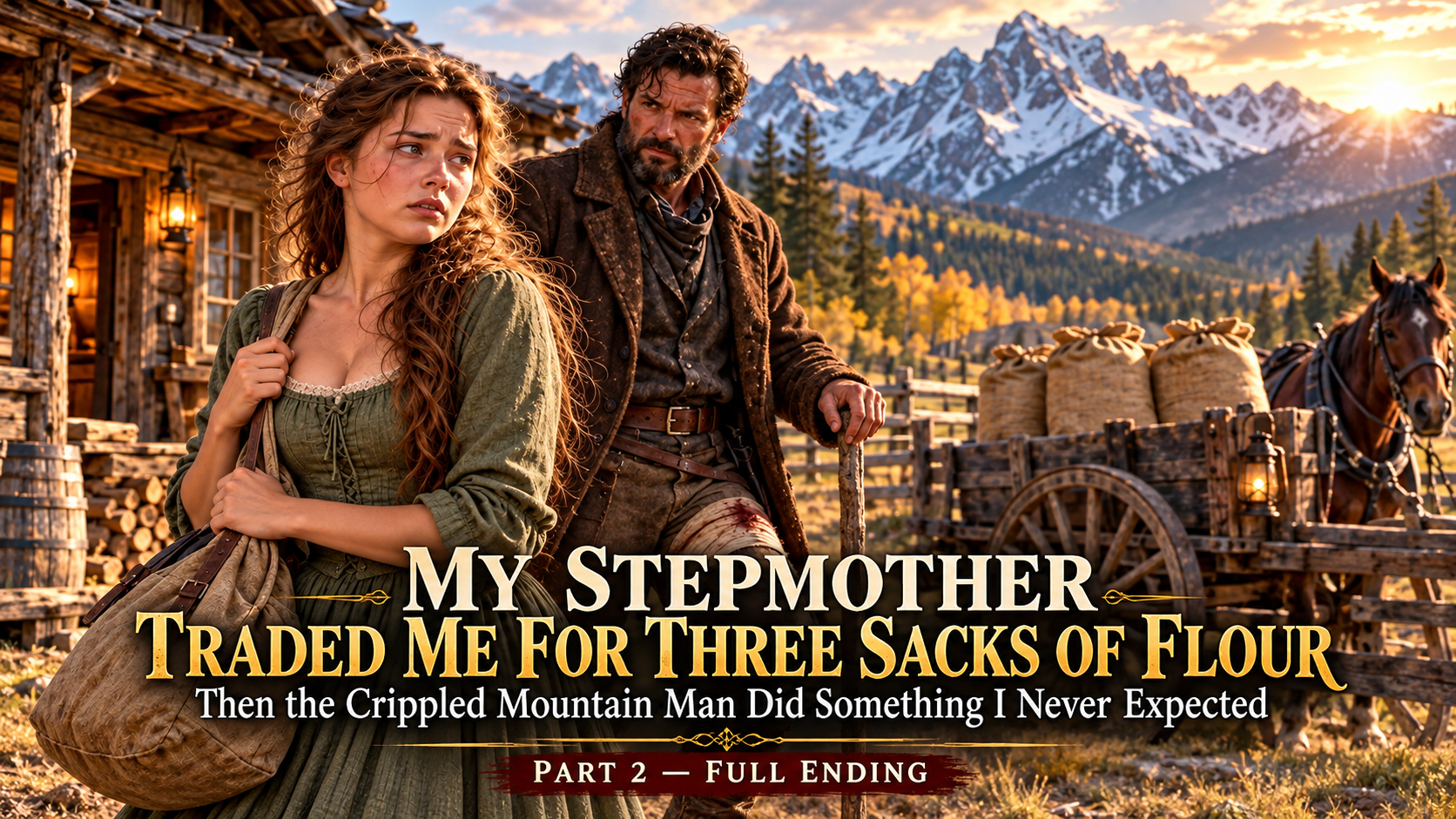
MY STEPMOTHER TRADED ME FOR THREE SACKS OF FLOUR—THEN THE CRIPPLED MOUNTAIN MAN DID SOMETHING I NEVER EXPECTED
The first thing Hollis Croft did after I stepped inside his mountain cabin was lock the door.
The second thing he did was place a small iron key on the table between us.
“That locks from the inside,” he said. “You can use it whenever you please.”
I stared at him, confused.
“And the bedroom is yours. I’ll sleep out here.”
I had spent the entire journey imagining what a man might demand from a woman he had purchased for three sacks of flour. Yet here he was, standing beside the stove, offering me the only bedroom in his house.
“What do you expect from me?” I asked.
He looked at me for a long moment.
“Nothing you don’t freely choose to give.”
That should have comforted me. Instead, it frightened me more. Kindness was unfamiliar territory, and I had learned that the gentlest promises sometimes concealed the cruelest bargains.
The cabin was warmer than I expected. A stone fireplace occupied one wall. There were shelves of preserved vegetables, neatly stacked firewood, a polished rifle above the mantel, and a table with two chairs.
Two chairs.
Something about that detail troubled me.
“Were you expecting someone?”
Hollis followed my gaze.
“I was hoping someone might come.”
He did not explain.
That night, I slept with my father’s knife beneath my pillow and the door locked from the inside.
At dawn, I woke to the sound of an ax striking wood.
Through the window, I saw Hollis standing beside the woodpile, balancing awkwardly on his damaged leg. Every swing seemed to cost him something. He paused frequently, gripping the chopping block until the pain passed.
I watched for several minutes before pulling on my boots.
“You’re going to hurt yourself,” I said when I reached him.
He glanced over his shoulder.
“Morning to you, too.”
“Give me the ax.”
His eyebrow lifted.
“You know how to split wood?”
“My father taught me before I was twelve.”
He handed it over without argument.
That was the first morning we worked together.
And it was the first time in years that a man had allowed me to prove I could do something without reminding me that I was a woman.
For the next three weeks, our lives settled into an uneasy rhythm.
Hollis tended the traps, repaired the roof, and cared for the horses. I cooked, cleaned, mended clothing, and helped with the firewood. He never ordered me to work. When I asked where something belonged, he answered. When I changed something, he usually left it changed.
Sometimes he watched me with an expression I couldn’t understand.
Once, while I was kneading bread, I caught him staring.
“What?”
He looked away.
“Nothing.”
“You’ve been staring for five minutes.”
“Just haven’t heard anyone singing in this house for a long time.”
I hadn’t realized I was singing.
That evening, he brought in a little wooden box he had found among his old belongings. Inside were six carefully carved hairpins, each shaped like a different mountain flower.
“Made these years ago,” he said. “They’re no use sitting in a drawer.”
I held one between my fingers.
“They’re beautiful.”
“You can have them.”
Nobody had given me anything beautiful since my father died.
I turned away before Hollis could see my tears.
But peace in the mountains was never as simple as it appeared.
One evening, while looking for clean linen, I opened a drawer beneath the kitchen cupboard and discovered a folded document tied with blue string.
My name was written across the front.
SARAH WHITMORE.
My hands went cold.
I unfolded the paper.
It was an agreement signed by Ruth Whitmore and Hollis Croft, witnessed by a man named Silas Borden.
Three sacks of flour. One plow. Twelve dollars for medicine.
In exchange, Ruth had surrendered all claim to my labor and residence.
At the bottom was a sentence that made my breath catch.
The young woman shall remain at the Croft property until the obligation is satisfied.
I read it three times.
Obligation.
What obligation?
How much did I owe?
And why had Hollis told me I was free to choose?
I was still holding the paper when the door opened.
Hollis stopped immediately.
His gaze moved from my face to the document.
“Where did you find that?”
“You said you expected nothing from me.”
“Sarah—”
“How long am I supposed to stay? A year? Five years? Until I die?”
He stepped forward, then stopped when I recoiled.
The hurt in his eyes was unmistakable.
“That paper isn’t what you think.”
“Then tell me what it is.”
He pulled out a chair and sat heavily, his injured leg stretched before him.
“I didn’t come to your house looking for a wife.”
My heart pounded.
“Then why did you come?”
He looked directly at me.
“Because your father saved my life.”
The room went silent.
My father had died four years earlier, when a spring flood swept away the bridge outside our valley. I remembered the funeral, the rain, and Ruth standing beside his grave with dry eyes.
“You knew my father?”
Hollis nodded.
“Daniel Whitmore found me after the pine fell. He wasn’t with the trapping party when they first discovered me, but he helped carry me down the mountain. He stayed beside me through the fever. When I couldn’t pay the doctor, he did.”
I lowered myself into the opposite chair.
“He never told me.”
“He wasn’t the kind of man who kept a tally of good deeds.”
Hollis reached into his coat and withdrew a worn leather pouch.
Inside was a silver pocket watch.
I recognized it immediately.
My father’s watch.
I had searched for it after his death, but Ruth told me he had lost it in the river.
“He gave me this when I tried to repay him,” Hollis said. “Told me to keep it until I met someone who needed a reminder that decent people still existed.”
I took the watch with trembling fingers.
The back was engraved with three tiny letters.
D. W. S.
Daniel Whitmore, Sarah.
My father had carved those letters himself on my thirteenth birthday.
I pressed the watch against my chest.
“Ruth wrote to me,” Hollis continued. “Said your family was starving. Said she needed supplies and that you wanted to leave the valley. I offered to bring you here for the winter, with wages and a place to stay.”
I looked down at the agreement.
“This doesn’t say wages.”
“No,” he replied grimly. “It doesn’t.”
He told me Ruth had changed the arrangement before he arrived. She insisted that the supplies were a bride price and threatened to send me to Silas Borden if Hollis refused.
“Borden?” I whispered.
Hollis’s jaw tightened.
“He’s been lending money against farms all across the valley. Your stepmother owes him more than she can repay.”
I remembered Borden. A narrow-faced man with yellow teeth and polished boots. He had visited Ruth several times after my father’s death.
He always looked at me too long.
“Why didn’t you tell me?”
“Because you already looked frightened enough. I thought I’d give you time to feel safe. Then I’d explain everything.”
“And the paper?”
“I kept it because it’s evidence of what Ruth and Borden tried to do. I should have told you it existed.”
He took a pencil from the mantel and placed it beside the agreement.
“You owe me nothing, Sarah. If you want to leave, I’ll take you wherever you choose. If you want to stay, I’ll pay you for your work. And if you want to burn that agreement, I’ll light the match.”
I looked at the man across from me.
For the first time, I understood that his silence had not been indifference.
It had been fear of saying the wrong thing to someone who had already been hurt too much.
“I want to stay,” I whispered.
Hollis’s shoulders relaxed.
“For the winter?”
I looked at the fire.
“For now.”
He nodded.
“For now is enough.”
Winter arrived early.
The first blizzard struck in November, swallowing the trail beneath four feet of snow. The wind howled against the cabin walls, and the horses huddled in their shelter.
We spent long evenings by the fireplace.
Hollis taught me to read maps and identify mountain tracks. I taught him how to bake bread without turning it into a weapon. He showed me the names of the stars. I read aloud from an old book of poetry I found beneath his bed.
He laughed more often.
And I began to realize that I was waiting for those rare moments when his serious face softened into a smile.
One night, while he was repairing a leather harness, I asked about his leg.
“Does it always hurt?”
His hands paused.
“Some days more than others.”
“Why don’t you use a walking stick?”
“Tried one. Didn’t like it.”
“Because it makes you look weak?”
He gave me a sharp look.
I met it without flinching.
Finally, he sighed.
“Maybe.”
The next morning, I found a length of mountain ash behind the woodshed. I spent three days shaping it with my father’s knife, smoothing the handle and carving a small eagle into the top.
When I gave it to Hollis, he stared at the walking stick as though I had placed a priceless treasure in his hands.
“I don’t need charity,” he said quietly.
“Good. Because this isn’t charity. It’s a tool. You wouldn’t refuse a hammer because you couldn’t drive a nail with your bare hand.”
He looked at me for a long time.
Then he laughed.
A real laugh, deep and surprised.
“Your father must have had his hands full with you.”
“He said I was the best trouble he’d ever known.”
Hollis stood, took the stick, and walked across the room.
For the first time, he didn’t have to drag his leg quite so painfully.
He stopped beside the window.
“Thank you, Sarah.”
There was something in his voice that made my chest ache.
By Christmas, I loved him.
I didn’t say it.
Neither did he.
But love had begun to fill the little cabin in ways neither of us could ignore.
It was in the extra blanket he warmed by the stove before I went to bed. It was in the way I saved the softest bread for him. It was in the quiet conversations after supper and the glances that lasted a moment longer than they should.
On Christmas Eve, Hollis gave me a small wooden chest.
Inside were twelve silver dollars, carefully wrapped in cloth.
“Your wages,” he said.
I stared at the money.
“That’s too much.”
“You’ve worked harder than anyone I’ve ever hired.”
Beneath the coins lay another paper.
A deed.
To a small parcel of land near the valley, purchased in my name.
I looked up, stunned.
“Hollis, what have you done?”
“Given you somewhere to go if you ever decide this mountain isn’t where you belong.”
My eyes filled with tears.
“Why would you do that?”
His voice became almost inaudible.
“Because I never want you to stay with me just because you have nowhere else to go.”
I crossed the room before I could lose my courage.
Then I kissed him.
He froze.
For one terrible second, I thought he would pull away.
Instead, he lifted one hand to my cheek.
“Sarah,” he whispered, “you don’t owe me that.”
“I know.”
“You don’t owe me anything.”
“I know.”
“Then why?”
I smiled through my tears.
“Because I wanted to.”
He kissed me back, gently, as though I were something precious rather than something purchased.
And for the first time in my life, I understood the difference.
But our happiness lasted only nine days.
On the morning of January third, a rider appeared through the snow.
He was half-frozen, slumped over his saddle, and barely conscious when Hollis carried him inside.
His name was Peter Bell, the blacksmith’s youngest son from our valley.
When he saw me, his eyes widened.
“Miss Sarah, thank God. I’ve been looking for you.”
Hollis helped him drink hot broth.
“What’s happened?”
Peter swallowed hard.
“Silas Borden is coming. He’s got a paper from the county office. Says Miss Sarah belongs to him under an unpaid debt agreement.”
The room seemed to tilt.
“What?”
Peter looked miserable.
“Your stepmother signed it. Says your father pledged your service against a loan before he died. Borden claims Croft took you without settling the debt.”
Hollis stood so quickly his chair struck the floor.
“Daniel Whitmore never borrowed a penny from Borden.”
“I know,” Peter said. “My father knows, too. But Borden has two hired men and a deputy who believes his paperwork.”
My hands began shaking.
“When are they coming?”
Peter looked toward the window.
“They were only a few hours behind me.”
Hollis turned to me.
“Get your coat.”
“Where are we going?”
“There’s an old mining shelter beyond the north ridge. You’ll be safe there until I can speak to the sheriff.”
I stepped back.
“No.”
“Sarah—”
“I am not running away again.”
His expression hardened with worry.
“Borden isn’t a man who listens to reason.”
“Then we’ll give him something else to listen to.”
I retrieved the agreement from the cupboard and laid it on the table beside my father’s watch.
“We have proof Ruth lied. We have Peter as a witness. And we have whatever my father left behind.”
Hollis stared at the watch.
Then something changed in his face.
“Your father’s papers,” he said slowly.
“What papers?”
“He told me once he kept records of every debt he paid. Said a man should always know what he owed and what he didn’t.”
I remembered a wooden box beneath the floorboards of our old kitchen.
My father had called it his rainy-day box.
After he died, Ruth claimed it was empty.
But I had never seen her open it.
“The box,” I whispered.
Hollis looked at me.
“What box?”
I told him.
And suddenly we had a plan.
When Borden arrived, the sun was already sinking behind the ridge.
Three riders approached the cabin. Borden rode in front, wrapped in an expensive black coat. Behind him came two rough-looking men carrying rifles.
A fourth rider followed at a distance.
Deputy Amos Reed.
Hollis stepped onto the porch with his walking stick in one hand and his rifle resting beside the door.
I stood behind him, holding my father’s watch.
Borden smiled when he saw me.
“There you are, girl. Your stepmother has been terribly worried.”
“Then she should have come herself,” I replied.
His smile thinned.
“You’ve caused quite a misunderstanding.”
“No,” I said. “You have.”
He pulled a folded document from his coat.
“This says Daniel Whitmore pledged his daughter’s service as security for a debt of two hundred dollars. With interest, that debt now stands at four hundred and eighty-six dollars.”
Hollis’s voice was cold.
“That’s a forgery.”
Borden shrugged.
“A court can decide that. Until then, the girl comes with me.”
“I’m nineteen,” I said. “I’m not a child, and I’m not property.”
The deputy shifted uneasily in his saddle.
Borden ignored me.
“Croft, you’ve always been a stubborn cripple. Don’t make this harder than it needs to be.”
Hollis didn’t move.
“Get off my land.”
One of Borden’s men reached toward his rifle.
Everything happened at once.
Hollis stepped in front of me. The hired man raised his weapon. Deputy Reed shouted for everyone to stop.
Then a shot cracked across the yard.
The bullet struck the porch railing, sending splinters into the air.
I screamed.
Hollis stumbled backward, his injured leg buckling beneath him.
For one horrible moment, I thought he had been hit.
He fell hard against the steps.
Borden’s men advanced.
And something inside me snapped.
I grabbed the rifle beside the door, raised it, and aimed directly at the man who had fired.
“Take one more step,” I said, my voice trembling, “and you’ll regret it.”
He stopped.
I had never pointed a rifle at another person before. My hands shook so badly I could barely hold it steady.
But I remembered my father teaching me to shoot tin cans in the meadow.
Breathe slowly.
Keep your eyes on the target.
Don’t let fear decide for you.
Deputy Reed dismounted and stepped between us.
“Enough! Put those weapons down!”
Borden’s face had turned red.
“Arrest her!”
The deputy looked at the shattered railing.
“Your man fired first.”
“He was protecting me!”
“From a woman standing on her own porch?”
I almost laughed.
But Hollis groaned beside me.
I lowered the rifle and knelt.
His face was pale, his injured leg twisted beneath him.
“Hollis?”
“I’m all right,” he whispered.
He wasn’t.
His breathing was shallow, and blood had begun soaking through his trouser leg where the old injury had reopened.
I turned toward the deputy.
“You see what they’ve done.”
Reed looked from Hollis to Borden.
Then he made a decision.
“Mr. Borden, you and your men will return to town. Any dispute over this young woman’s freedom belongs before a judge, not at the end of a rifle.”
Borden stared at him in disbelief.
“You’ll regret this.”
“Maybe,” Reed replied. “But I won’t regret stopping a shooting.”
Borden rode away with murder in his eyes.
And I knew he would return.
That night, Hollis developed a fever.
His leg swelled, and the reopened wound grew angry and red. He tried to hide the pain, but by midnight he was shaking uncontrollably.
Peter helped me heat water and prepare clean bandages.
I washed the wound as gently as I could.
Hollis gripped the edge of the bed until his knuckles turned white.
“You should leave,” he whispered.
I looked at him.
“What?”
“Take the deed. Take the money. Peter can get you to the valley.”
“I’m not leaving you.”
“Sarah, Borden won’t stop.”
“Neither will I.”
His eyes closed.
“I never should have brought you here.”
I leaned close enough that he could hear every word.
“You didn’t bring me here to hurt me. You brought me here because you believed I deserved something better.”
He opened his eyes.
“And you do.”
“Then let me decide what better means.”
For the first time, I saw tears in Hollis Croft’s eyes.
“I love you,” he whispered.
The words struck me harder than the gunshot.
I pressed my forehead against his.
“I love you, too.”
He tried to smile.
“Poor judgment on your part.”
I laughed through my tears.
“Terrible judgment. I’m keeping you anyway.”
But by morning, he could no longer stand.
We needed a doctor.
And the only doctor within fifty miles lived in the same town where Silas Borden controlled half the businesses.
Peter offered to ride for help.
I stopped him.
“No. You’re staying here with Hollis.”
He stared at me.
“Miss Sarah, the pass is dangerous.”
“I know the trail. Hollis taught me.”
I saddled the strongest horse, tucked my father’s knife into my boot, and wrapped the documents inside my coat.
Before leaving, I went to Hollis’s bedside.
His feverish eyes found mine.
“Where are you going?”
“To bring back a doctor. And to finish something that should have ended years ago.”
He caught my hand.
“Come back to me.”
I kissed his forehead.
“I will.”
The ride down the mountain nearly killed me.
Snow covered the trail, and the wind erased every familiar landmark. Twice, my horse slipped on ice. Once, I had to crawl across a narrow ledge while leading him by the reins.
By the time I reached the valley, darkness had fallen.
I went first to the blacksmith’s house.
Peter’s father, Thomas Bell, opened the door and stared at me as though he’d seen a ghost.
“Sarah Whitmore?”
“I need your help.”
Within an hour, Thomas had gathered three men who had known my father.
One was the retired county clerk, Mr. Ellery. Another was the minister who had buried Daniel Whitmore. The third was an elderly farmer named Josiah Pike.
I told them everything.
When I showed them Borden’s document, Mr. Ellery adjusted his spectacles.
“This signature is wrong,” he said immediately.
My heart leaped.
“You can prove it?”
“Your father always signed his middle initial. Daniel J. Whitmore. He was particular about it. This paper says Daniel Whitmore.”
Thomas leaned forward.
“And the date?”
Ellery examined it.
“April seventeenth, four years ago.”
Josiah Pike slammed his hand against the table.
“Impossible. Daniel was already dead.”
Silence fell.
I stared at them.
“What?”
The minister nodded slowly.
“Your father died on April ninth. I conducted the burial on the twelfth.”
For several seconds, nobody spoke.
Then Thomas said quietly, “Borden forged a dead man’s signature.”
I felt the room spin.
All those years, Ruth had told me my father left nothing but debts.
All those years, she had insisted I owed her everything for keeping me fed.
And now I was learning that the very debt used to control my life had been created after my father was buried.
“There’s something else,” I said.
I told them about the box beneath the kitchen floor.
Thomas stood.
“Then we’d better go find it.”
We reached my old house just before midnight.
Ruth opened the door wearing her best shawl.
When she saw me, her expression changed from surprise to fury.
“What are you doing here?”
“I came for my father’s papers.”
Her face went white.
“There are no papers.”
“Then you won’t mind if I look.”
She tried to slam the door, but Thomas caught it with one powerful hand.
“Ruth,” he said, “we’re not here to cause trouble. We’re here to find out why Silas Borden has a contract signed eight days after Daniel was buried.”
Her mouth opened.
Nothing came out.
Behind her, Emiline appeared in the hallway.
She looked healthier than I had seen her in years.
“Sarah?”
I barely glanced at her.
I walked straight into the kitchen, knelt beside the stove, and pried up the loose floorboard.
The wooden box was still there.
My hands trembled as I lifted it.
Inside were receipts, letters, and a folded deed bearing the county seal.
Mr. Ellery opened the first envelope.
His expression darkened.
“Good Lord.”
“What is it?” I whispered.
He held up a receipt.
“Your father paid off the farm mortgage in full two months before he died.”
Ruth made a small choking sound.
Ellery unfolded another paper.
“And this is his will.”
I could barely breathe.
He read aloud.
Daniel Whitmore had left the farmhouse, surrounding acreage, and remaining savings to his only daughter, Sarah Whitmore, to pass into her control upon her nineteenth birthday.
My nineteenth birthday had been six months earlier.
The house belonged to me.
The land belonged to me.
Ruth had sold my labor to a stranger while living in a home she had no legal right to claim as her own.
I looked at her.
“You knew.”
She began shaking her head.
“Sarah, listen—”
“You knew all along.”
“I raised you! I fed you! I kept this family together!”
“You made me sleep in the pantry while Emiline had my bedroom. You took my wages. You told me my father died owing money he never borrowed.”
Ruth’s eyes filled with angry tears.
“You have no idea what I sacrificed!”
I stepped closer.
“Then why did you sacrifice me?”
For once, Ruth had no answer.
Emiline began crying.
“Mother told me Sarah wanted to go,” she whispered. “She said Hollis Croft had offered her a good life.”
I turned toward her.
“You watched me leave with one bag.”
She lowered her head.
“I was afraid.”
“So was I.”
Those three words silenced the room.
I took the will, the deed, and the receipts.
Then I looked at Ruth one final time.
“You don’t get to decide my life anymore.”
By sunrise, the sheriff had been summoned.
Sheriff Nathaniel Briggs was an older man with a weathered face and a reputation for refusing bribes. When he examined the documents, he sent two deputies to bring Silas Borden to his office.
Borden arrived furious.
He became considerably less confident when Mr. Ellery laid the forged contract beside the burial record.
“This proves nothing,” Borden snapped.
“It proves the signature was dated after Daniel Whitmore died,” the sheriff replied.
“A clerical error.”
“Then perhaps you can explain why the witness signature belongs to a man who left the county six years ago.”
Borden stopped speaking.
The sheriff leaned back in his chair.
“I think we’d better have a longer conversation.”
But Borden had one final trick.
He looked at me and smiled.
“Even if the debt is false, the girl went willingly with Croft. Everybody saw it.”
I felt my stomach tighten.
“I didn’t know I had a choice.”
“You climbed onto his wagon.”
“Because Ruth told me I had been traded.”
Borden shrugged.
“Your word against hers.”
Then the sheriff opened a drawer.
“Not quite.”
He placed a letter on the desk.
It was the letter Ruth had sent Hollis, requesting supplies in exchange for allowing Sarah to leave the valley for paid work.
Hollis had given it to Deputy Reed after the confrontation.
The sheriff read the relevant passage aloud.
Sarah is eager to work and would be grateful for honest employment through the winter.
No mention of marriage.
No mention of a debt.
No mention of ownership.
Borden’s expression turned ugly.
“That mountain cripple thinks he can ruin me?”
I stood.
“His name is Hollis Croft. And he’s a better man than you will ever understand.”
Borden lunged toward the desk.
The deputies seized him before he could reach the papers.
For the first time, I saw fear replace arrogance in his eyes.
The sheriff ordered him held while the forgery and the attempted armed seizure were investigated.
Ruth was summoned to answer questions about the agreement and my father’s estate.
But I had no time to celebrate.
Hollis was still on the mountain.
And he was dying.
The doctor returned with me that afternoon, accompanied by Thomas Bell and two men carrying medical supplies.
We reached the cabin after dark.
Peter met us at the door.
One look at his face told me everything.
“He’s worse,” he whispered.
I pushed past him.
Hollis lay motionless beneath the blankets. His face was gray, his breathing shallow.
I dropped beside the bed.
“Hollis?”
Nothing.
I took his hand.
“Hollis, I’m here.”
His eyelids fluttered.
“Sarah?”
“Yes. I came back.”
He tried to smile.
“Knew you would.”
Then his eyes closed again.
The doctor worked for nearly three hours.
He cleaned the wound, treated the infection, and gave Hollis medicine to bring down the fever. At last, he stepped into the kitchen, where I waited with my hands clasped so tightly they hurt.
“Will he live?” I asked.
The doctor looked exhausted.
“I can’t promise you anything. The next two days will tell us.”
I sat beside Hollis for forty-eight hours.
I changed his bandages, cooled his forehead, and whispered stories about my father. I told him about the will, the forged contract, and the land that had always belonged to me.
I told him I had chosen him.
Not because Ruth had sent me.
Not because he had given me shelter.
But because he had shown me what love looked like when it asked for nothing in return.
On the second night, the fever finally broke.
I was half asleep when I felt his fingers move around mine.
“Sarah?”
I lifted my head.
His eyes were open.
Clear.
Alive.
“You’re awake,” I whispered.
“You look terrible.”
I burst into tears.
He smiled weakly.
“That wasn’t meant as an insult.”
I leaned forward and kissed him.
“You stubborn, impossible man.”
“Still poor judgment?”
“The worst.”
His hand rose slowly to my cheek.
“Then I hope you never come to your senses.”
I laughed and cried at the same time.
Outside, snow drifted gently past the window.
For the first time in days, I wasn’t afraid of morning.
Hollis recovered slowly.
The wound healed, but the damage to his leg remained. Some mornings he could barely stand. Other days, with the walking stick I had made, he managed to cross the yard and tend the horses.
I never asked him to become a different man.
He never asked me to become a smaller woman.
By spring, the snow began to melt.
News arrived from the valley that Borden had been indicted for forgery, fraud, and the armed confrontation at our cabin. Ruth faced a separate civil claim over my father’s estate. The court confirmed that the property had passed to me under Daniel Whitmore’s will.
I could have returned to the farmhouse.
I could have sold it and traveled east.
I could have built an entirely different life.
For the first time, those choices were truly mine.
One warm morning in May, I stood outside the cabin watching the clouds move across the mountains.
Hollis came up beside me, leaning on his walking stick.
“Thinking about the valley?” he asked.
“A little.”
“It’s your land. You should do whatever makes you happy.”
I turned toward him.
“What if I want to sell the farmhouse?”
“Then sell it.”
“What if I want to buy cattle?”
“Then we’ll need a bigger barn.”
“What if I want to stay here forever?”
He went very still.
“Sarah—”
“What if I want to marry you? Properly. In front of a minister, with witnesses and a ring?”
He stared at me.
Then he shook his head slowly.
“I was supposed to ask you that.”
“You’ve taken too long.”
He laughed, then reached into his coat.
From an inner pocket, he withdrew a small ring made of polished silver.
A tiny mountain flower had been engraved along the band.
“I’ve carried this for two months,” he admitted.
My mouth fell open.
“Two months?”
“Every time I tried to ask, I remembered the day you climbed onto my wagon. I didn’t want you to think you owed me a yes.”
I took his hand.
“Hollis Croft, I have never owed you my heart.”
His eyes shone.
“I know.”
“But I’m giving it to you anyway.”
He slipped the ring onto my finger.
And beneath the bright mountain sky, the man who had once believed his injured body made him unworthy of love asked me to become his wife.
I said yes before he finished the question.
We married six weeks later.
The ceremony took place in a meadow above the cabin, where wildflowers covered the hillside and the snow still crowned the distant peaks.
Thomas Bell stood beside Hollis. Peter carried the rings. The minister who had buried my father returned to speak the vows.
I wore a simple cream-colored dress sewn from fabric purchased with my own money.
My father’s silver watch hung from a ribbon around my neck.
When the minister asked who gave me in marriage, I answered for myself.
“I do.”
Hollis looked at me with such tenderness that I nearly forgot the words I had practiced.
When he promised to love and honor me, his voice broke.
When I promised to stand beside him through every winter and every spring, I meant every word.
After the ceremony, we stood together overlooking the valley.
“Do you regret it?” he asked quietly.
I looked at him.
“Regret what?”
“Coming up that mountain.”
I thought of the frightened nineteen-year-old girl who had climbed onto his wagon carrying everything she owned in one canvas bag.
I remembered Ruth counting the flour.
I remembered the cold, the silence, and the terrible belief that I had been exchanged for something worth more than myself.
Then I looked at the man beside me.
“I regret what Ruth did,” I said. “I regret the years I spent believing I was unwanted. But I will never regret choosing you.”
Hollis kissed my forehead.
“You saved me, Sarah.”
I shook my head.
“No. We helped each other find our way home.”
The years that followed were not always easy.
There were harsh winters, poor harvests, and mornings when Hollis’s leg hurt so badly he could barely rise from bed.
But we built something stronger than the difficulties that tested us.
We expanded the cabin, planted an orchard, and raised cattle on the lower slopes. I sold the farmhouse in the valley and used part of the money to purchase adjoining pastureland. We hired workers and paid them fairly.
And when a young woman arrived one autumn looking for employment after being turned away by her family, I gave her a warm meal, a room, and wages she could keep for herself.
I remembered what it meant to have no choices.
I was determined that nobody working in our home would feel that way.
Three years after our wedding, our daughter was born.
We named her Grace.
Hollis held her in his enormous hands as though she were made of sunlight.
He cried when she wrapped her tiny fingers around his thumb.
“She’s perfect,” he whispered.
I smiled.
“She has your eyes.”
“Poor child.”
I laughed.
“And your stubbornness.”
“Then we’re in trouble.”
When Grace was old enough to walk, she followed her father everywhere, toddling beside him with a little wooden stick he had carved to match his own.
Sometimes she imitated his uneven steps.
The first time she did it, I saw Hollis’s face tighten.
But Grace looked up at him and declared proudly, “I walk like Papa!”
He knelt carefully and gathered her into his arms.
“You walk like yourself, sweetheart,” he told her. “And that’s the finest way to walk.”
Years later, Grace would ask how her parents met.
She was seven then, sitting between us beside the fireplace while snow fell beyond the windows.
“Mama,” she asked, “is it true Grandma Ruth traded you for flour?”
I looked at Hollis.
He looked at me.
Then I drew our daughter onto my lap.
“Yes,” I said gently. “She did.”
Grace frowned.
“But people aren’t things you can trade.”
“No, darling. They aren’t.”
“Then why did she do it?”
I thought for a moment.
“Because some people forget that love is worth more than money. And some people never learn that every person deserves to choose their own life.”
Grace looked at her father.
“Did Papa buy you?”
Hollis reached for my hand.
“No,” he said softly. “I brought supplies to help her family, but I didn’t understand how badly she was being treated. Your mama chose to stay with me. And later, she chose to marry me.”
Grace considered this very seriously.
“So you didn’t buy Mama?”
He smiled.
“No, sweetheart. Your mama isn’t something anybody could own.”
Our daughter nodded, apparently satisfied.
Then she asked the question that made us both laugh.
“What happened to the flour?”
I leaned back against Hollis’s shoulder.
“I imagine somebody baked bread with it.”
Grace wrinkled her nose.
“That wasn’t a very good trade.”
Hollis kissed the top of her head.
“No, little bird. It wasn’t.”
That night, after Grace had fallen asleep, Hollis and I sat together beside the dying fire.
His hair had begun to turn silver at the temples. The lines around his eyes were deeper. His leg still troubled him, and sometimes the old injury forced him to rest when he would rather work.
But when he looked at me, I still saw the same pale gray eyes that had studied me from the wagon all those years ago.
“Penny for your thoughts,” he said.
I smiled.
“I was remembering the first night I came here.”
“You locked the bedroom door.”
“I had my father’s knife beneath the pillow.”
“I know.”
I stared at him.
“You knew?”
“Saw the handle when you opened your bag. Figured a sensible woman would want some protection from a strange mountain man.”
I laughed softly.
“Were you offended?”
“No. I was hoping that one day you wouldn’t need it.”
I leaned my head against his shoulder.
“I don’t.”
He wrapped an arm around me.
Outside, the mountains stood beneath the stars, silent and magnificent.
I thought about the three sacks of flour, the rusted plow, and the twelve dollars Ruth had accepted in exchange for sending me away.
For years, I had believed those things represented my worth.
But I had been wrong.
They represented the price Ruth was willing to accept for betraying me.
My worth had never been hers to measure.
Hollis had understood that before I did.
And the greatest gift he ever gave me was not the cabin, the land, the silver ring, or the beautiful life we built together.
It was the freedom to decide that I deserved all of them.
I turned toward him and kissed his cheek.
“What was that for?” he asked.
“For giving me the key that first night.”
He smiled.
“I thought you’d forgotten.”
“Never.”
Because the day my stepmother traded me for three sacks of flour, I believed my life had ended.
But the man waiting beside that wagon had never intended to own me.
He had intended to open a door.
And when I finally walked through it, I found something I had never dared to imagine.
A home.
A family.
A love freely given.
And a future that belonged entirely to me.
THE END.