The Woman Behind the Cattle — Part 2
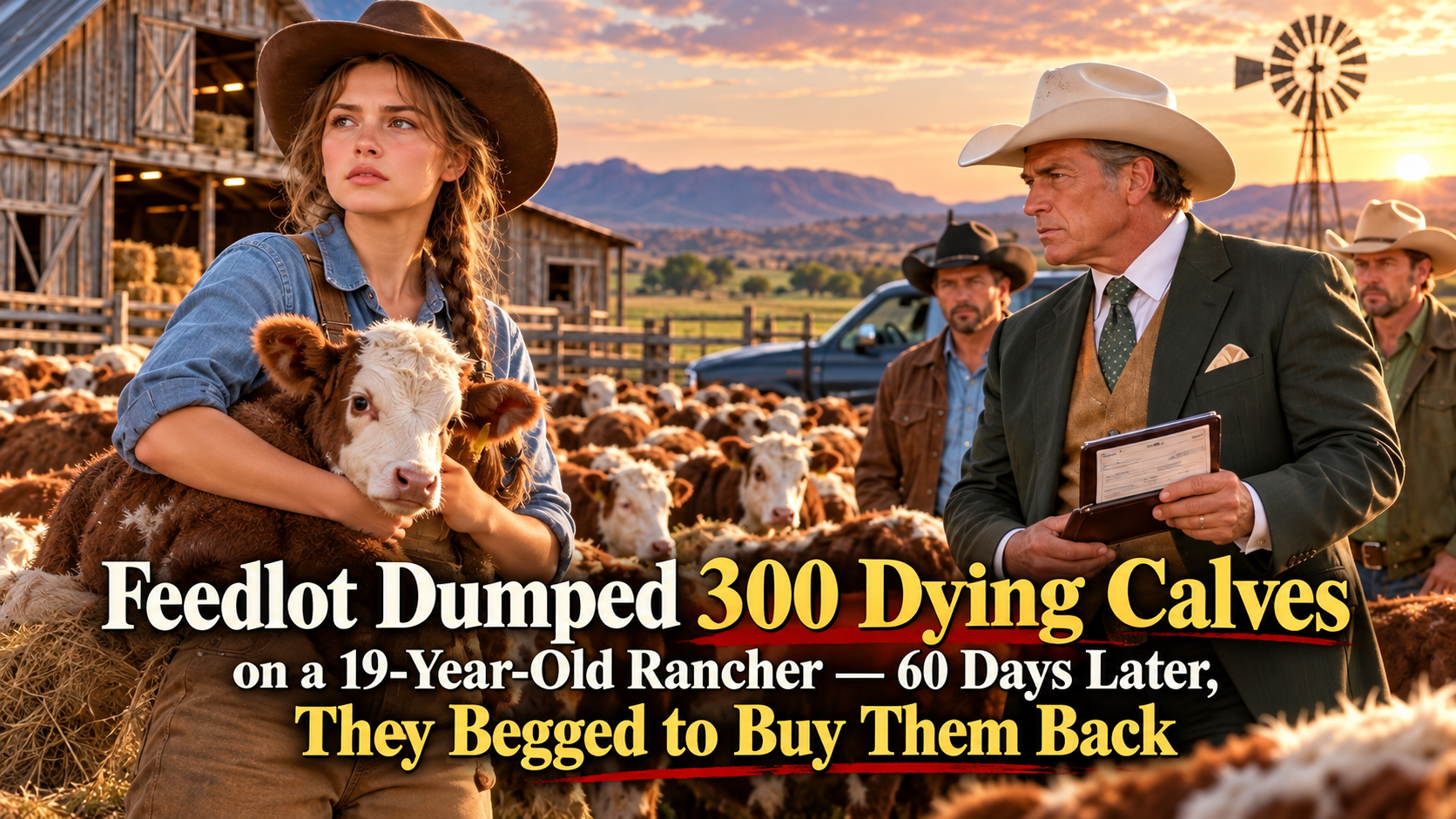
“Don’t scream, Emma.”
The stranger raised both hands.
He was an older man with silver hair, a weathered face, and a leather veterinary bag hanging from one shoulder.
“My name is Thomas Bell. Your grandfather sent me.”
Emma tightened her grip on the metal box.
“My grandfather is dead.”
“I know.”
“Then you’re seven months too late.”
Thomas looked toward the barn door.
“And Raymond Dorsey is seven years too early.”
Outside, the men were approaching.
Thomas pointed toward a narrow opening behind the hay bales.
“There’s an old drainage tunnel beneath this barn. Your grandfather built it after the flood of 1959.”
Emma stared at him.
“How do you know that?”
“Because I helped him.”
A flashlight beam crossed the wall.
Thomas grabbed the metal box and pushed it into Emma’s hands.
“Go. I’ll handle them.”
Before Emma could protest, he stepped into the center aisle.
“Evening, gentlemen.”
The two intruders stopped.
One immediately lowered his crowbar.
“Dr. Bell?”
Thomas folded his arms.
“Unless you’re here to deliver a calf, I suggest you explain why you’re trespassing.”
The men exchanged nervous glances.
Then they fled.
Thomas waited until their truck disappeared before turning toward Emma.
“Now,” he said, “we need to talk about Margaret.”
Inside the farmhouse, Emma made coffee while Thomas examined the documents.
He looked exhausted.
As though he had been carrying a secret for decades.
“Margaret Dorsey was Raymond’s younger sister,” he began.
“Everyone says she died.”
“Everyone was told she died.”
Emma stopped pouring.
Thomas continued.
“In 1971, Margaret was one of the finest cattle breeders in Kansas. She developed a Hereford line with exceptional maternal traits, sound feet, and unusually strong resistance to the respiratory problems that troubled many feedlot calves.”
“Those seventeen animals?”
“The descendants of her original foundation herd.”
Emma looked at the ledger.
“Why did my grandfather have them?”
“Because Margaret trusted him.”
Thomas explained that Margaret had married a ranch worker named Daniel Whitaker, a distant cousin of Emma’s grandfather.
Her wealthy family opposed the marriage.
Raymond believed the cattle breeding operation belonged under his control.
But Margaret refused.
She wanted a smaller breeding program built around animal welfare, careful records, and long-term ranch sustainability.
Raymond wanted volume.
Faster turnover.
Bigger contracts.
More money.
In 1972, Margaret disappeared from public life.
Her family announced that she had died after a sudden illness.
No funeral was held in Dodge City.
No grave was ever shown to the ranching community.
“Where did she go?” Emma whispered.
Thomas hesitated.
“That’s the question your grandfather spent years trying to answer.”
He opened the final document.
It was a signed agreement transferring seventeen foundation breeding rights into a protected trust.
The trustee was Emma’s grandfather.
The designated future successor was his legal heir.
Emma Whitaker.
Emma stared at her own name.
“I was only a child.”
“The trust was written to survive until you reached adulthood.”
“Then why didn’t Grandpa tell me?”
“Because he believed Raymond would destroy the records if he knew.”
Emma shook her head.
“That doesn’t explain why Raymond sold me the calves.”
Thomas leaned forward.
“Because he didn’t know they were in that shipment.”
For years, the original bloodline had been absorbed into commercial cattle operations.
Ear tags were replaced.
Records were altered.
Animals were transferred between feedlots.
The distinctive bloodline survived, but its history had been buried.
Then Raymond ordered three hundred underweight calves removed from his operation.
He believed he was disposing of a costly problem.
Instead, he had accidentally returned seventeen of the most valuable animals in Kansas to the one person legally entitled to protect them.
Emma’s hands trembled.
“How valuable?”
Thomas looked at her.
“Potentially enough to change the future of your ranch.”
The following morning, Emma drove to Dodge City with Thomas.
They visited the county records office.
The clerk searched through decades of property and agricultural documents.
At last, she produced a file marked:
MARGARET DORSEY — ESTATE DISPUTE, 1972.
Emma opened it.
Several pages were missing.
But one remained.
A sworn statement from a woman named Helen Price.
The statement alleged that Margaret had never willingly surrendered her breeding rights.
It also mentioned a private agreement involving Raymond Dorsey and a regional livestock investment company.
The company had later acquired a controlling interest in Dorsey Feedlot.
Emma read the final paragraph.
Then she looked at Thomas.
“Someone knew Margaret was alive after the family announced her death.”
Thomas nodded slowly.
“Yes.”
“Who?”
Before he could answer, the records clerk returned.
“Miss Whitaker, there’s a telephone call for you.”
Emma followed her into the back office.
She lifted the receiver.
“Hello?”
For several seconds, there was only static.
Then a woman’s voice spoke.
“Emma, listen carefully.”
Emma gripped the telephone.
“Who is this?”
“Your grandfather promised me you would be different from Raymond.”
Emma felt the room tilt.
The woman continued.
“Do not sell the seventeen calves. Do not trust the man who came to your barn. And whatever you do, do not let Raymond find the red ledger.”
Emma’s throat went dry.
“Are you Margaret?”
Silence.
Then the woman whispered:
“Ask Thomas Bell what really happened the night your grandfather lost his son.”
The line went dead.
Emma turned toward the doorway.
Thomas Bell was standing there.
And for the first time since meeting him, he looked terrified.