Part 2: The Four Children He Never Mentioned
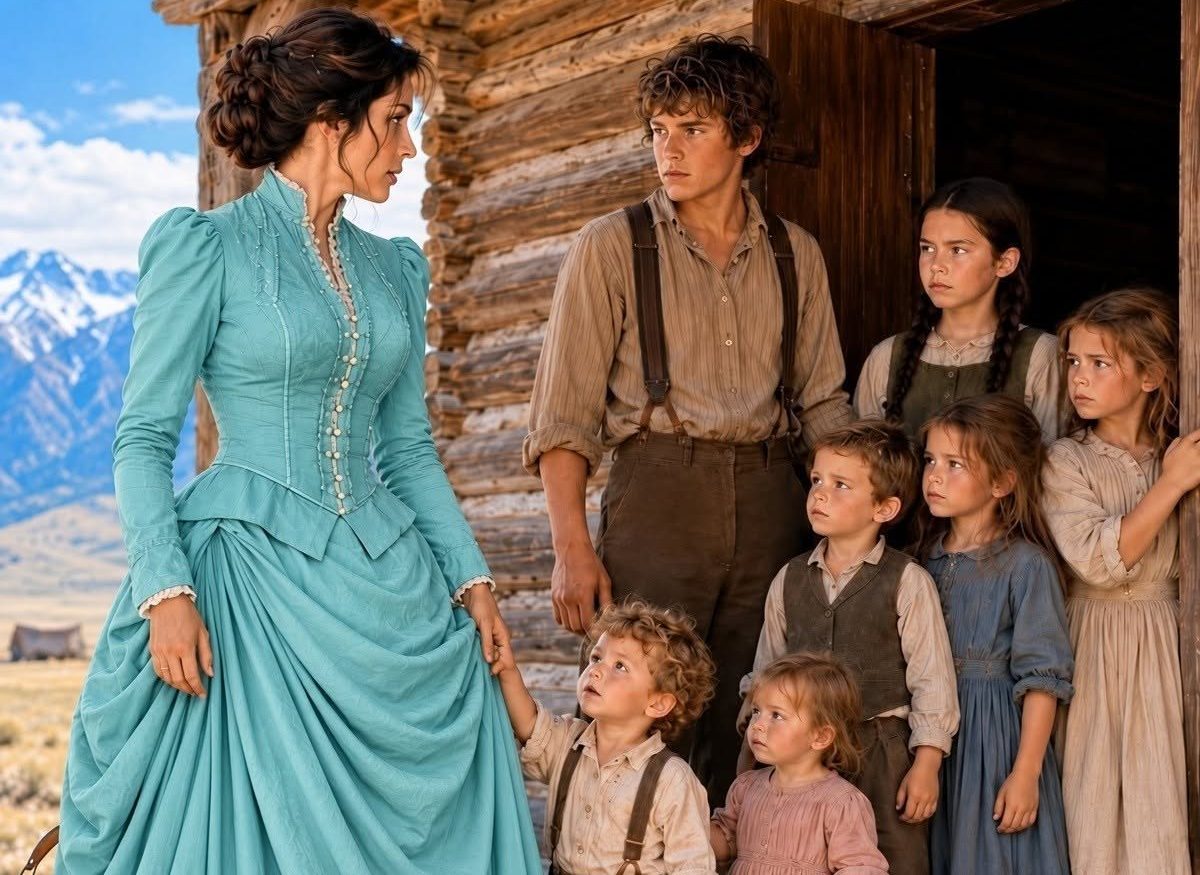
The Mail Order Bride Arrived to Find Seven Children and No Mountain Man. She Stayed Anyway.
By the time the first batch of biscuits came out of the iron pan, Norah Prescott had learned two things about the Hol household.
The children were starving.
And someone had taught them to be afraid of questions.
Seven children crowded around the kitchen table, their hands folded so tightly in their laps that Norah wondered whether they had been punished for reaching for food before.
Eli, the oldest, remained standing beside the door.
“Sit down,” Norah told him gently.
“I’m not hungry.”
His stomach growled loudly enough for everyone to hear.
Norah placed the largest biscuit on a chipped plate and pushed it toward him.
“Then you can keep me company while I eat.”
For the first time since she arrived, something almost resembling a smile crossed his face.
The children ate without speaking.
There was Ruthie, fourteen, with dark braids and the watchful eyes of someone who had forgotten how to be young. Twelve-year-old Jonah had a crooked finger that had healed badly. Nine-year-old Grace kept her little sister close. Six-year-old Millie was painfully thin, while four-year-old Tom seemed determined never to let go of Norah’s skirt.
And then there was the baby.
A little girl named Hope, barely eleven months old, who had been sleeping in a wooden crate lined with old blankets.
Norah counted them again.
Seven.
Yet Silas Hol’s letters had mentioned only three children.
She waited until the younger ones were occupied with their biscuits before turning toward Eli.
“Your father told me there were three of you.”
Eli stopped chewing.
Ruthie lowered her eyes.
For several seconds, the only sound was the wind rattling the shutters.
“That’s because only three of us are his,” Eli finally answered.
Norah looked around the table.
“Which three?”
“Me, Ruthie, and Jonah.”
Her gaze moved to the four younger children.
Grace pulled Millie closer.
Tom stopped eating.
“And the others?”
Eli’s expression hardened.
“They’re ours now.”
Norah did not understand.
Not yet.
But she understood enough to stop asking questions in front of frightened children.
That afternoon, she washed dishes, swept the floor, and discovered that the pantry contained barely enough food for another three days.
There was no fresh meat.
No milk.
No firewood stacked near the kitchen door.
And beneath a loose floorboard beside the stove, she found a small cloth pouch containing eleven silver coins.
She was still holding it when Eli appeared behind her.
“Put that back.”
His voice was sharp.
Norah turned.
“Is this your father’s money?”
“No.”
“Whose is it?”
“Mine.”
She carefully returned the pouch.
“Then it belongs to you.”
Eli stared at her as though she had spoken a language he had never heard.
“You’re not going to take it?”
“Why would I?”
He looked toward the window.
“Other people have.”
Before Norah could ask who, a horse whinnied outside.
Eli’s face changed instantly.
He crossed the kitchen in three strides and pulled the curtain shut.
“Everyone upstairs,” he ordered.
Ruthie grabbed Hope.
Grace took Millie’s hand.
Tom began to cry.
Norah stood still.
“Eli, what’s happening?”
“Don’t open the door.”
A heavy knock shook the wooden frame.
Then a man’s voice called from the porch.
“Hol! I know somebody’s in there!”
Eli reached for the shotgun hanging above the fireplace.
Norah caught his wrist.
“You’re sixteen years old.”
“And he’s not coming inside.”
The knocking came again.
“Open up, boy! I’ve got papers!”
Norah stepped toward the door.
Eli whispered urgently, “Please don’t.”
Something in his voice made her stop.
“Who is he?”
“Mr. Voss.”
“And what does he want?”
Eli swallowed.
“The children.”
Norah felt the room turn cold.
Before she could ask another question, the stranger outside spoke again.
“I know the new woman arrived today! Tell her she ought to know what kind of man she’s agreed to marry!”
Norah slowly opened the door.
A broad-shouldered man in a black coat stood on the porch, his horse tied to the railing. He had a narrow face, a polished silver watch chain, and the confident expression of someone accustomed to frightening people who could not fight back.
“Mrs. Hol, I presume?”
“Miss Prescott.”
His smile widened.
“Ah. So the wedding hasn’t happened.”
“Who are you?”
“Edgar Voss. I represent certain legal interests in Sweetwater Valley.”
He withdrew a folded paper from his coat.
“Silas Hol has disappeared while owing a considerable debt. The property will be seized unless payment is made.”
Norah glanced at the paper.
“How much?”
“Four hundred and eighty dollars.”
It was more money than she had earned in five years as a seamstress.
“And the children?”
Voss’s smile faded.
“That is a separate matter.”
“Then explain it.”
He looked over her shoulder toward the staircase.
“Four of those children have no legal claim to this household. Their mother is gone, their father cannot be located, and Mr. Hol has no lawful guardianship.”
Norah’s fingers tightened around the door.
“What happens to them?”
“They will be placed elsewhere.”
“Where?”
“That depends on who is willing to take them.”
Behind her, a floorboard creaked.
Tom was standing halfway down the stairs.
His small face had gone white.
“Are they taking us again?” he whispered.
Voss glanced at him without sympathy.
“That depends on whether people cooperate.”
Norah stepped into the doorway, blocking his view.
“You can leave your papers.”
“I’ll return in three days.”
“Then we have three days.”
Voss leaned closer.
“Miss Prescott, you came here expecting a husband. I suggest you take your trunks and leave before his troubles become yours.”
Norah looked him directly in the eyes.
“I haven’t decided what belongs to me yet.”
She shut the door.
For a long moment, nobody moved.
Then Eli lowered the shotgun.
“You should’ve gone with him,” he said quietly.
Norah turned.
“Why?”
“Because now he’ll come back.”
“He was coming back anyway.”
Eli looked away.
And Norah realized the boy was not merely afraid of losing the ranch.
He was afraid of losing someone.
That evening, after the younger children had fallen asleep, Eli finally told her the story.
Two winters earlier, his mother had died of fever.
His father had become a quiet, distant man who spent long weeks hunting and trapping in the mountains.
Then, the previous autumn, a woman named Abigail Mercer had arrived at the cabin with four children.
She had once been a friend of Eli’s mother.
She was frightened, exhausted, and running from something she refused to explain.
Silas had taken them in.
Three weeks later, Abigail disappeared.
“Just disappeared?” Norah asked.
Eli nodded.
“She went to town to meet somebody. Never came home.”
“Did your father search for her?”
“For months.”
“And the children’s father?”
Eli’s jaw tightened.
“That’s who she was hiding from.”
Norah looked toward the stairs.
“Voss?”
Eli shook his head.
“Not him. But he works for the man.”
“Who is the man?”
“I don’t know. Pa never told us his name.”
Norah sat back slowly.
“And where is Silas now?”
Eli stared at the cold fireplace.
“Three weeks ago, he found something in the mountains. Something he said could prove who those children really were.”
“What did he find?”
“A metal box.”
Norah leaned forward.
“Where is it?”
“He took it with him.”
“And then?”
“He rode out before sunrise. Said he’d return before you arrived.”
Eli’s voice broke.
“He promised.”
Norah looked at the boy who had spent three weeks keeping seven children alive, waiting for a father who might never come home.
She wanted to tell him everything would be all right.
But she would not make promises she could not keep.
Instead, she said, “Tomorrow, we’re going to find food. Then we’re going to find out whether Mr. Voss has any right to take this house.”
Eli looked at her.
“And after that?”
Norah glanced toward the stairs.
“After that, we’ll find your father.”
For the first time, Eli looked less like a frightened boy and more like someone who wanted to believe her.
But the night had one more secret waiting.
Shortly after midnight, Norah woke to a faint scratching sound beneath her bedroom window.
At first, she thought it was a branch.
Then she heard three soft taps.
She pulled on her shawl and approached the glass.
Outside, standing in the moonlight, was Ruthie.
The fourteen-year-old girl was barefoot, holding a small wooden box against her chest.
Norah hurried downstairs and opened the back door.
“Ruthie? What are you doing out here?”
The girl slipped inside, trembling.
“I couldn’t let Eli hear.”
“Hear what?”
Ruthie placed the box on the kitchen table.
Inside lay a folded letter, a woman’s gold wedding ring, and a photograph of four children standing beside a well-dressed couple.
Norah recognized Grace, Millie, Tom, and baby Hope.
But the man beside them was not Silas.
“Where did you get this?”
“Abigail gave it to me before she disappeared.”
Norah unfolded the letter.
The handwriting was hurried, almost desperate.
There were only four sentences.
“If anything happens to me, do not let Edgar Voss take my children. The man who claims to be their father is not who he says he is. Silas knows the truth, but the proof is hidden where nobody would think to look. Trust the woman who comes from Cincinnati.”
Norah read the final sentence twice.
Cincinnati.
Her hometown.
The place she had left nine days earlier.
A cold sensation crept up her spine.
“Ruthie,” she whispered, “how could Abigail have known about me?”
The girl looked terrified.
“Because she knew you were coming.”
Norah shook her head.
“That’s impossible. Silas didn’t write to me until January.”
Ruthie slowly reached into the wooden box and removed a second photograph.
It was older, faded at the corners.
Two young women stood outside a brick house, smiling into the sunlight.
One was Abigail Mercer.
The other was Norah’s mother.
Norah’s breath caught.
Her mother had passed away eleven years earlier.
She had never mentioned a woman named Abigail.
Norah turned the photograph over.
On the back, written in her mother’s unmistakable handwriting, were six words.
“If Norah comes, tell her everything.”
For several seconds, Norah could not speak.
Then Ruthie whispered something that made the entire journey from Cincinnati feel like a carefully arranged trap.
“Miss Prescott, Pa didn’t send for you because he needed a wife.”
Norah slowly raised her eyes.
Ruthie was crying now.
“He sent for you because Abigail said you were the only person who could save us.”
Outside, somewhere beyond the dark pine trees, a horse suddenly screamed.
Then came a single gunshot.
And from the upstairs bedroom, Eli shouted the words Norah had been waiting three weeks to hear.
“Pa’s home!”
But when Norah reached the porch, the rider collapsing from the saddle was not Silas Hol.
It was a wounded stranger carrying Silas’s hat.
And before losing consciousness, he grabbed Norah’s wrist and whispered:
“Don’t trust the boy. He knows where his father is.”
To be continued in Part 3…