PART 3: The Woman on the Helicopter
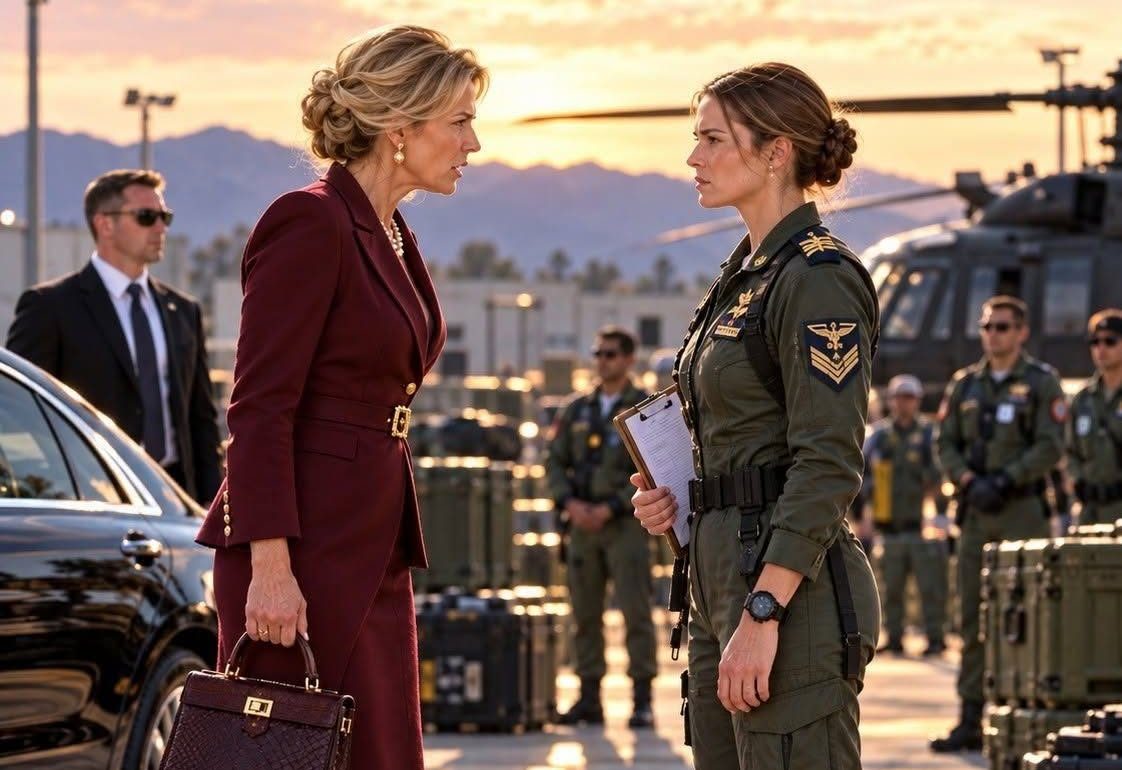
The helicopter was already fifteen feet above the runway when General Margaret Voss gave an order I would remember for the rest of my life.
“Bring that aircraft down. Now.”
Her voice cut through the radio static.
For three seconds, nothing happened.
Then the helicopter tilted slightly, hovered above the asphalt, and slowly began descending.
I stood beside Gate Six, staring at the photograph Colonel Bruce Harmon had placed in my hands.
Two women.
Identical faces.
Identical brown eyes.
Identical smiles.
One wore a pale blue nursing uniform.
The other wore a white summer dress and held a little girl in her arms.
Me.
I recognized the little girl immediately.
I was perhaps five years old.
My hair was tied into crooked pigtails, and I was holding a stuffed rabbit with one missing ear.
I remembered that rabbit.
I remembered the white dress.
I remembered the afternoon the photograph was taken.
But I did not remember two mothers.
“Who are they?” I asked.
Nobody answered.
I looked directly at Colonel Harmon.
“Sir, I asked you a question.”
He swallowed.
“The woman in the nursing uniform was Rebecca Conroy.”
I looked at the other woman.
“And her?”
His eyes moved toward Vivian.
“Her twin sister. Rachel.”
My mouth went dry.
“Rachel Conroy?”
“Yes.”
I looked down at the photograph again.
My entire childhood had suddenly become something I could no longer trust.
“Which one is my mother?”
Colonel Harmon closed his eyes.
General Voss stepped closer.
“Kate, there are things you deserve to hear from someone who was there.”
“Then tell me.”
She glanced toward the helicopter.
“First, we need to secure that aircraft.”
“No.”
My voice came out sharper than I intended.
“I have spent thirty-six years wondering why my mother disappeared. I have raised three children without knowing whether the woman who gave birth to me was alive. You don’t get to stand here and tell me to wait.”
For the first time, the four-star general had no immediate answer.
I pointed at the photograph.
“Which woman held me when I was sick? Which woman taught me to read? Which woman kissed me goodnight?”
General Voss looked at me with an expression I could not understand.
Then she said quietly:
“Both of them.”
I stopped breathing.
Behind us, the helicopter touched down.
Its rotors continued spinning.
Military police vehicles approached from the hangars, followed by a security SUV.
Major Ellis moved toward the aircraft with four armed personnel.
But I barely noticed.
“Explain,” I whispered.
General Voss took the photograph from my trembling hands.
“Rebecca and Rachel were identical twins. Rebecca worked as a civilian medical records specialist at an American military hospital in Germany. Rachel was a registered nurse working in the same medical complex.”
She paused.
“When you were born, Rebecca was unmarried and struggling financially. Rachel helped raise you. The sisters shared an apartment, childcare responsibilities, and nearly every part of their lives.”
I stared at her.
“Then why didn’t anyone tell me?”
“Because in 1998, something happened that destroyed their family.”
Vivian suddenly spoke.
“Margaret, you have no right to tell her everything.”
General Voss turned.
“You’re the last person who gets to decide what she knows.”
Vivian flinched.
Colonel Harmon stood motionless beside his SUV.
I had never seen a senior officer look so helpless.
“Twenty-eight years ago,” General Voss continued, “Rebecca discovered that medical shipments intended for American service members were being diverted through a private company.”
“By whom?”
Nobody answered.
I looked at Bruce Harmon.
His silence told me enough.
“You were involved.”
He lowered his eyes.
“I was a young captain assigned to logistics. I signed documents I should have questioned.”
“Did you know supplies were being stolen?”
“Not at first.”
“And later?”
His jaw tightened.
“Later, I knew something was wrong.”
I laughed.
Not because anything was funny.
Because the man standing before me commanded four thousand soldiers, and he still couldn’t say one simple sentence without hiding behind careful words.
“You knew,” I said.
He nodded.
“Yes.”
Vivian began crying again.
General Voss continued.
“Rebecca collected evidence. She intended to report the scheme to military investigators. Rachel helped her copy the records.”
“Then what happened?”
“Someone discovered what they were doing.”
A cold sensation moved down my spine.
“Who?”
General Voss looked toward Vivian.
The colonel’s wife shook her head.
“No. I didn’t know what they were planning. I only arranged the meeting.”
“What meeting?” I demanded.
Vivian pressed a hand against her mouth.
General Voss answered.
“Rebecca was told to come to a storage facility outside Frankfurt on September 18, 1998. She believed she was meeting an investigator who could protect her.”
“Was she?”
“No.”
I felt my heartbeat in my throat.
“She walked into a trap.”
Vivian whispered, “I never meant for anyone to get hurt.”
I turned toward her.
“You knew my mother?”
She nodded.
“You worked with her?”
Another nod.
“And you helped send her into a trap?”
Vivian couldn’t look at me.
I thought about her hand striking my face.
The contempt in her voice.
Military trash.
A cheap little disgrace wearing a uniform.
She hadn’t recognized me when she arrived at Gate Six.
But she had known my mother.
And somewhere inside the life she had built, she had carried the truth about my family for nearly three decades.
I stepped toward her.
Colonel Harmon immediately moved between us.
“Sergeant—”
“Get out of my way.”
He froze.
I was an enlisted sergeant speaking to a colonel with an anger I could barely control.
But I no longer cared.
“Your wife struck me while I was performing my duty. She ordered my soldiers to remove me. And now I’m finding out she helped destroy my family.”
My voice broke.
“Get out of my way, sir.”
General Voss raised one hand.
“Colonel Harmon, stand aside.”
He obeyed.
Vivian looked terrified.
I stopped two feet from her.
For one moment, I wanted to strike her.
I wanted her to feel the humiliation, the helplessness, and the years of unanswered questions.
But then I remembered my children.
Bree.
My twins.
The people who had watched me earn every stripe on my uniform.
I straightened my shoulders.
“I will not become you,” I said.
Vivian began sobbing.
And then the helicopter door opened.
A woman stepped down.
She was elderly, perhaps in her late sixties or early seventies, with silver hair pulled into a tight knot.
She wore a dark coat despite the August heat.
In her left hand was a red leather handbag.
My mother’s handbag.
My body recognized it before my mind did.
The same worn brass clasp.
The same narrow strap.
The same little scratch near the handle.
I remembered sitting on our apartment floor in Germany, playing with that clasp while my mother prepared dinner.
I remembered her telling me not to touch the important papers inside.
I remembered laughing.
And suddenly I was eight years old again.
The woman looked toward the gate.
Our eyes met.
She stopped walking.
The handbag slipped from her fingers.
Then she whispered a name.
“Katie Rose.”
My legs almost gave way.
I had heard those words twice in one afternoon.
First from Vivian.
Now from a woman who looked exactly like the mother I remembered.
She took one uncertain step toward me.
Then another.
“Sweetheart?”
I couldn’t speak.
Her face was older.
Her hair was different.
But the way her mouth trembled was familiar.
The way she held her right hand against her chest was familiar.
Even the slight tilt of her head made something inside me ache.
“My little girl,” she whispered.
I started moving.
Then General Voss stepped between us.
“Sergeant Conroy. Stop.”
I stared at her.
“What are you doing?”
“Do not approach her yet.”
“Why?”
The general’s expression hardened.
“Because we haven’t established who she is.”
The woman looked devastated.
“Margaret, please.”
General Voss turned toward her.
“State your name.”
The woman hesitated.
“Rebecca Conroy.”
Vivian made a strangled sound.
Colonel Harmon covered his face.
General Voss didn’t move.
“Your full legal name.”
“Rebecca Anne Conroy.”
“Date of birth?”
The woman answered.
“November 3, 1957.”
The general looked toward Major Ellis.
“Check the file.”
He opened a tablet.
After several seconds, his expression changed.
“General, the date matches Rebecca Conroy’s original medical employment record.”
The woman began crying.
“See? I told you.”
But General Voss wasn’t satisfied.
She removed the old photograph from her pocket.
“Which woman are you in this picture?”
The woman looked at it.
Then at me.
“I’m the one holding Katie.”
My heart lurched.
The woman in the white dress.
The woman I had believed was my mother.
General Voss lowered the photograph.
“That’s Rachel.”
The silence was unbearable.
The woman stared at her.
“No.”
“You’ve made a mistake.”
General Voss shook her head.
“Rebecca is the woman wearing the nursing uniform.”
The woman’s lips trembled.
Then she said something that made even the general go still.
“That’s what they wanted you to believe.”
Nobody spoke.
The woman looked directly at me.
“Katie, when you were six, you broke your wrist falling from the apple tree behind our apartment.”
I remembered.
She continued.
“You wouldn’t let the doctor touch you until I sang the song about the little blue bird.”
My chest tightened.
“You hated the yellow medicine. You called it dragon water.”
Tears blurred my vision.
“And every night, before you went to sleep, you asked me to leave the hallway light on because you thought shadows could climb through your window.”
I covered my mouth.
Nobody knew those things.
Not my foster parents.
Not my ex-husband.
Not even my children.
Only my mother.
“Mom?” I whispered.
The woman began to cry harder.
But General Voss remained between us.
“Sergeant, personal memories do not establish identity.”
I looked at her in disbelief.
“She knows everything.”
“Identical twins who raised the same child would share many memories.”
The truth struck me like another slap.
She was right.
And I hated her for being right.
The woman slowly raised both hands.
“Then test me. Take my fingerprints. Take my blood. I’ll do anything.”
General Voss studied her.
“Where have you been for twenty-eight years?”
The woman glanced at Vivian.
Then at Colonel Harmon.
Her expression changed.
Fear replaced grief.
“I’ve been trying to stay alive.”
Bruce Harmon stepped forward.
“Rebecca, if that’s really you—”
“Don’t come near me.”
Her voice was suddenly sharp.
He stopped.
“You signed the transfer order,” she said.
His face went pale.
“What transfer order?” I asked.
The woman looked at me.
“After the meeting outside Frankfurt, I was taken to a private medical facility. They said I had suffered a breakdown. They said I was dangerous. They said my daughter would be safer without me.”
My stomach turned.
“Who said that?”
She pointed at Bruce.
“He signed the paperwork.”
The colonel shook his head.
“I signed an administrative form. I was told you had been evaluated by medical personnel.”
“You never came to see me.”
“I didn’t know where they sent you.”
“You never asked.”
His silence was answer enough.
The woman turned toward Vivian.
“And she came to visit me.”
Vivian began shaking.
“No.”
“Three times,” the woman continued. “The first time, she told me Katie had been placed with relatives.”
I stared at Vivian.
“The second time, she said Katie was happy.”
Vivian whispered, “Please stop.”
“The third time, she told me my daughter was dead.”
The words hit me so hard that I couldn’t breathe.
My mother had been told I was dead.
And I had been told she had abandoned me.
For twenty-eight years, two people had lived with the same grief, believing the other had been lost forever.
I turned toward Vivian.
“Why?”
She couldn’t answer.
“Why would you do that to us?”
Her mouth opened.
Nothing came out.
Then Colonel Harmon spoke.
“Because Rebecca knew about the shipments.”
The woman looked at him with hatred.
“No, Bruce.”
He swallowed.
“She knew much more than that.”
General Voss turned sharply.
“What do you mean?”
Bruce took a step backward.
For the first time, he looked afraid of the general herself.
“Margaret, you need to understand. The diverted supplies were only part of it.”
The general’s eyes narrowed.
“Explain.”
“There was an off-books medical program. The shipments were going to a private research facility. Some were legitimate medical supplies. Others were experimental equipment.”
Major Ellis stopped typing.
General Voss went still.
“What facility?”
Bruce looked toward the helicopter.
“The one she escaped from.”
The woman with the red handbag shook her head.
“I didn’t escape.”
Everyone turned toward her.
She swallowed.
“They let me leave.”
General Voss frowned.
“Why?”
“Because three days ago, someone decided I was no longer useful.”
She reached into her coat.
Two security officers immediately moved forward.
“Hands where we can see them!”
She froze.
“Please. It’s only a document.”
General Voss nodded once.
“Slowly.”
The woman removed a folded envelope.
On the front was a military medical insignia that I didn’t recognize.
She handed it to Major Ellis.
He opened it.
Inside were several pages.
He scanned the first.
Then the second.
His expression changed so suddenly that General Voss stepped closer.
“What is it, Major?”
He looked at her.
“General, these appear to be archived identity records.”
“Whose?”
His eyes moved toward me.
“Sergeant Conroy’s.”
I felt the blood drain from my face.
“What?”
Major Ellis hesitated.
“General, the records list a different original birth certificate.”
I stared at him.
“My birth certificate?”
He nodded.
“The one currently in Sergeant Conroy’s personnel file appears to have been issued after the original was sealed.”
General Voss took the document.
She read it.
Then read it again.
Her face lost all expression.
“Bruce.”
The colonel closed his eyes.
“Tell me this isn’t what I think it is.”
He didn’t answer.
Vivian suddenly collapsed against the Mercedes.
I barely noticed.
“General,” I whispered. “What does it say?”
She looked at me.
And for the first time since arriving at Gate Six, General Margaret Voss seemed frightened of the truth.
“Kate, the records show that Rebecca and Rachel were both listed as your legal guardians at different times.”
“That doesn’t make sense.”
“No.”
She turned another page.
“One record identifies Rebecca as your biological mother.”
My heartbeat thundered.
“And the other?”
General Voss looked up.
“The other identifies Rachel.”
I stared at her.
“Which one is real?”
“We don’t know yet.”
I looked toward the silver-haired woman.
She was crying silently.
“Who are you?” I whispered.
She pressed a hand to her heart.
“I’m the woman who raised you.”
“That isn’t what I asked.”
Her face crumpled.
Then she said:
“Rebecca was your aunt.”
Everything stopped.
Even the helicopter seemed far away.
I stared at her.
“What?”
“My name is Rachel Conroy.”
My knees weakened.
“Then why did you say you were Rebecca?”
“Because for twenty-eight years, that’s the name they’ve forced me to use.”
General Voss took a slow breath.
“Where is Rebecca?”
Rachel looked toward Vivian.
Then Colonel Harmon.
And finally toward me.
“Rebecca disappeared the night I was taken.”
My voice was barely audible.
“Did she survive?”
Rachel’s eyes filled with tears.
“I don’t know.”
I looked at the photograph again.
Two women.
Two faces.
Two lives stolen.
And somehow my childhood had been divided between them.
Then Rachel reached into the lining of her red handbag.
She pulled out a small silver necklace.
A heart-shaped pendant.
I recognized it.
My mother had worn it every day.
She pressed a tiny catch on the side.
The pendant opened.
Inside was a miniature photograph of me as a newborn.
And behind it, folded so tightly it was almost invisible, was a strip of yellowed paper.
Rachel handed it to me.
“Rebecca gave me this before they separated us.”
My hands trembled as I unfolded it.
There were only two sentences.
“If anything happens to me, tell Katie the truth about her father. The man everyone calls Bruce Harmon is not who he claims to be.”
I looked up.
Colonel Harmon had gone completely white.
General Voss read the note over my shoulder.
Then she turned toward him.
“Bruce. What did Rebecca mean?”
He said nothing.
“Colonel, answer me.”
His lips moved.
Finally, he whispered:
“She wasn’t supposed to find out.”
I stared at him.
“Find out what?”
He looked directly into my eyes.
And suddenly I understood why he had stared at me when he arrived.
Why he had whispered my mother’s name.
Why he’d spent twenty-eight years keeping her disappearance buried.
But before he could speak, Rachel stepped forward.
“Don’t let him tell you another lie, Katie.”
She pointed toward the silver eagle on his uniform.
“The first time I saw that man, he wasn’t wearing the name Harmon.”
General Voss turned sharply.
“What name was he using?”
Rachel looked at Bruce.
Then answered.
“Daniel Mercer.”
Vivian screamed.
“No!”
General Voss reached for her radio.
“Major Ellis, contact the Criminal Investigation Division. Secure Colonel Harmon and preserve every document recovered today.”
Bruce didn’t resist.
He simply stared at Rachel.
Then he looked at me.
And whispered:
“Kate, I can explain.”
I held the note against my chest.
“Then start with my father.”
He lowered his head.
For several seconds, no one spoke.
Then he said:
“Your father was a military investigator named Thomas Conroy.”
I froze.
The surname.
The one I had carried my entire life.
The one I believed belonged to my mother.
“Where is he?”
Bruce looked toward General Voss.
And what he said next made her grip the radio so tightly her knuckles turned white.
“Thomas Conroy was assigned to investigate the missing medical supplies in 1998.”
He paused.
“Three days before Rebecca disappeared, he discovered the name of the officer who authorized the secret operation.”
General Voss demanded, “Who was it?”
Bruce looked at her.
“You.”
The entire airfield seemed to fall silent.
General Margaret Voss did not move.
Rachel slowly stepped backward.
Vivian began crying again.
And I stood between them, holding a photograph of two identical women, a letter written by a woman I had never truly known, and a truth that had just turned the only person defending me into a possible suspect.
Then General Voss spoke.
“Colonel Harmon, you have just made a very serious accusation.”
Bruce raised his head.
“I have the original authorization.”
He reached toward his jacket.
Major Ellis ordered him to stop.
Bruce froze.
“The document is in my vehicle,” he said.
The general’s expression remained unreadable.
“Major, secure it.”
But Rachel suddenly grabbed my hand.
Her fingers were ice cold.
“Katie,” she whispered, “listen to me carefully.”
I turned toward her.
“That document isn’t what matters.”
“Then what does?”
She looked past me toward the four-star general.
And whispered something that made my entire body go numb.
“Your father isn’t missing.”
I stared at her.
“Where is he?”
Rachel squeezed my hand.
“He’s been looking for you.”
My heart pounded.
“Where?”
She pointed toward the black armored truck that had arrived behind Vivian’s Mercedes.
“The driver.”
I turned.
Behind the windshield, a gray-haired man sat perfectly still.
He had been there the entire time.
Watching.
Waiting.
And when our eyes met, he slowly removed his sunglasses.
I saw my own eyes staring back at me.
END OF PART 3
PART 4: The Man Behind the Wheel
The stranger driving the general’s armored truck knew the lullaby my father used to sing and carried proof that could destroy a four-star military career. But when he finally stepped out, he didn’t reach for me.
He reached for his handcuffs.
And the first person he ordered arrested was General Margaret Voss.