Part 3: The Child in the Hidden Photograph
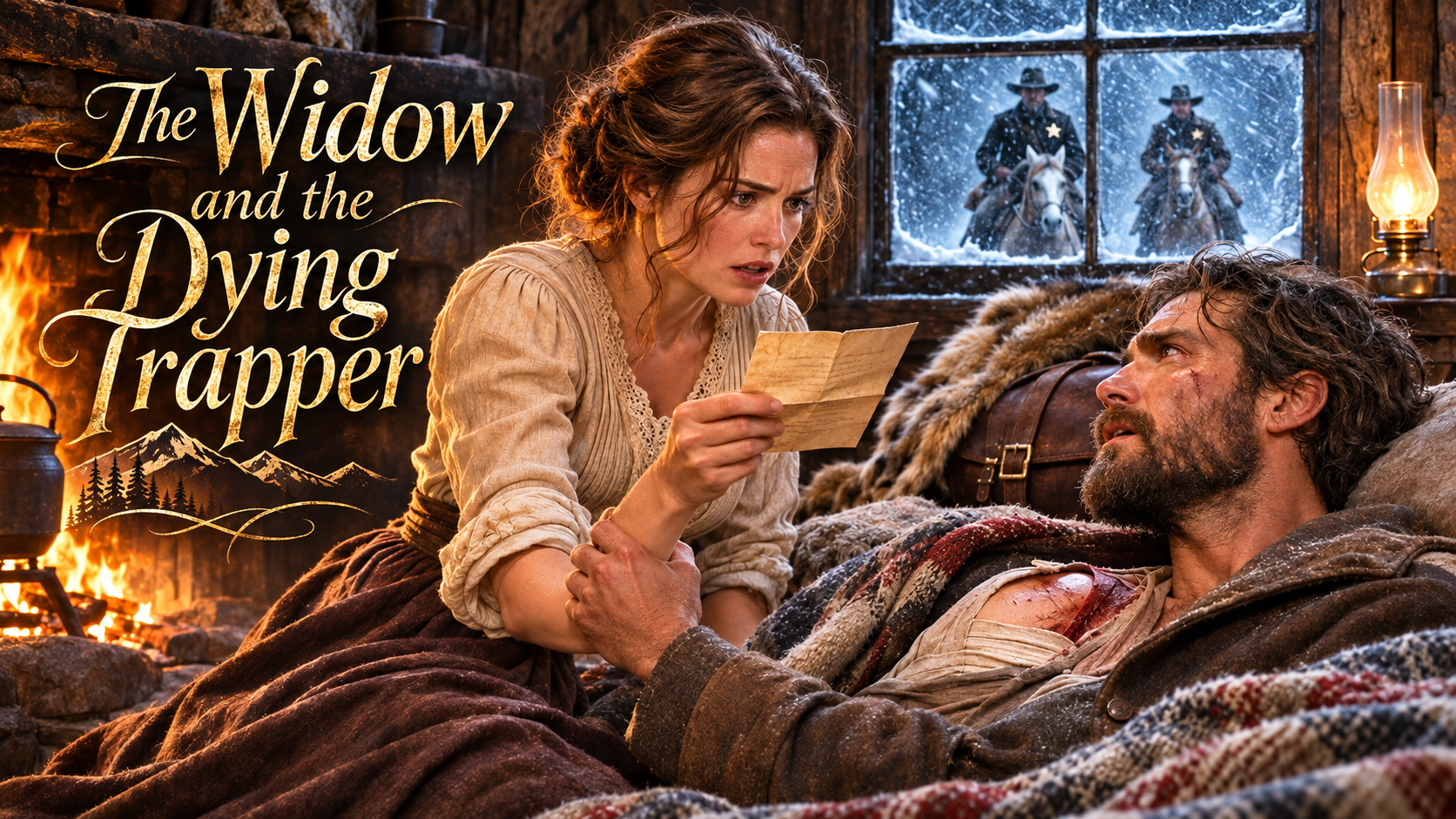
The sheriff had set Clara Whitmore’s cabin on fire. Inside, a wounded trapper was struggling to breathe, and the widow had just discovered a photograph suggesting her dead husband had another wife and a child.
But the most disturbing secret wasn’t the photograph.
It was the identity of the little girl.
Smoke slipped beneath the kitchen door.
Clara grabbed a blanket and threw it over Elias.
“Can you walk?”
“Not far.”
“Then you’ll crawl.”
Outside, the flames spread along the rear wall.
Clara knew the cabin better than anyone.
Thomas had built a narrow storage passage beneath the floorboards to keep supplies from freezing.
It connected the kitchen pantry to an old root cellar behind the house.
She had not opened it in years.
“Help me move this table.”
Elias pushed with his good arm.
Clara dragged the heavy wooden table aside and lifted a trapdoor.
Cold air rushed upward.
“Down.”
Elias hesitated.
“The box.”
Clara grabbed the iron box and pushed it into his hands.
“Move!”
They descended into darkness.
Above them, glass shattered.
A rifle fired.
Wood splintered near the fireplace.
Clara pulled the trapdoor closed.
For several moments, she heard nothing but Elias’s labored breathing and the roar of burning timber.
Then a man’s voice echoed through the cabin.
“Find the papers!”
Deputy Pike.
Another voice answered.
“Rourke said the woman doesn’t matter.”
Clara pressed a hand over her mouth.
The men were inside her home.
Searching.
Destroying.
See more Stories :
And somewhere above them, every memory she had made with Thomas was being consumed by fire.
Elias touched her shoulder.
“We have to go.”
They crawled through the narrow passage.
At its end, Clara pushed against a wooden hatch buried beneath frozen earth.
It refused to move.
She pushed again.
Nothing.
Smoke began drifting through the passage.
Elias braced his shoulder against the hatch.
He groaned as his wound reopened.
Together, they forced it upward.
Snow collapsed into the opening.
Clara climbed out first.
They emerged behind a fallen pine tree nearly forty yards from the cabin.
The fire illuminated the clearing.
Rourke stood beside the porch.
Pike carried a lantern.
A third man had joined them.
He was tall, clean-shaven, and dressed in an expensive black overcoat.
Clara had never seen him before.
Yet the moment Elias spotted him, his expression changed.
“That’s Nathaniel Voss.”
“Who?”
“The man who ordered Thomas killed.”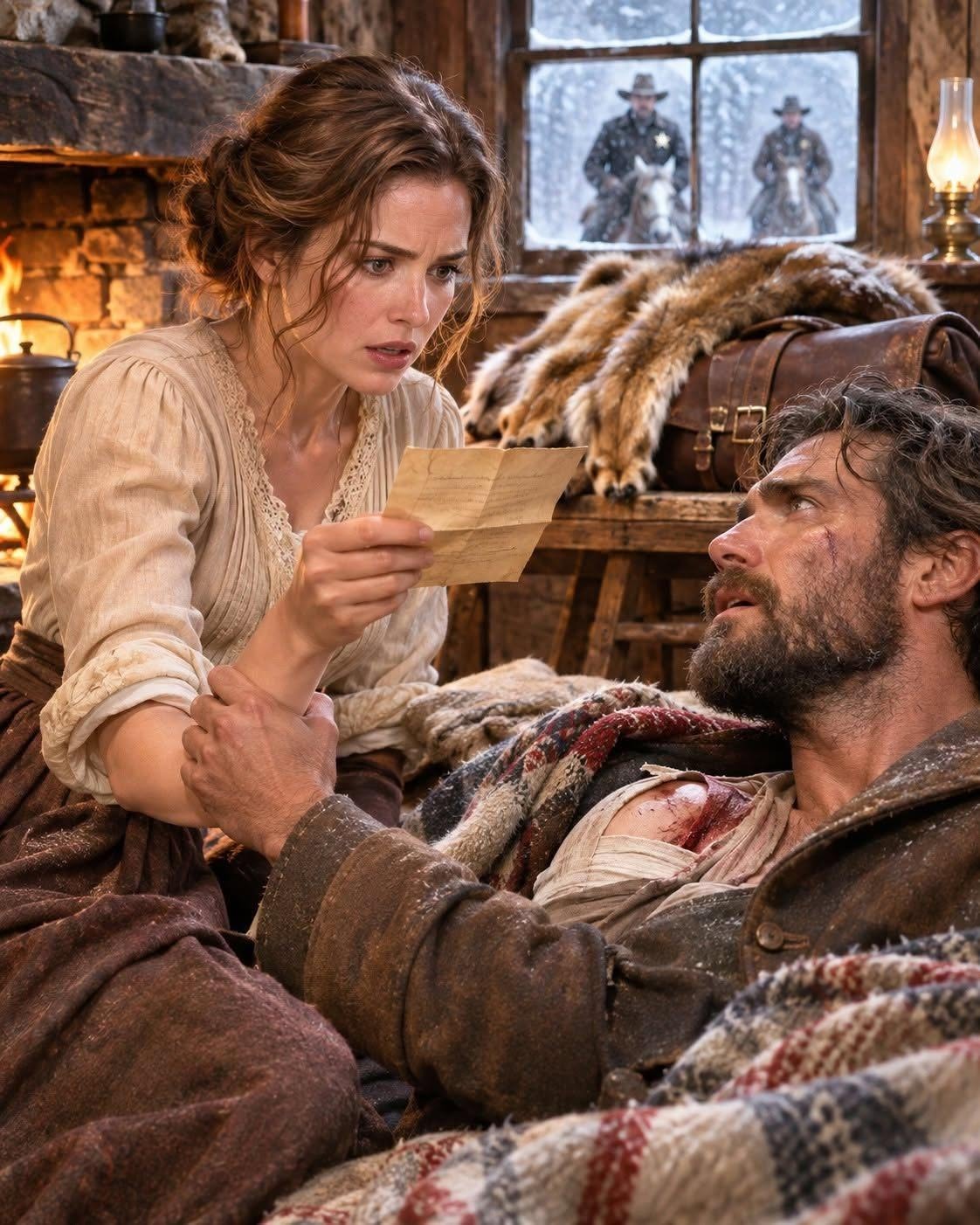
Clara stared at the stranger.
Voss looked toward the burning cabin with remarkable calm.
“Search the ashes,” he instructed.
Rourke lowered his rifle.
“And the woman?”
“She’ll be remembered as another unfortunate casualty of winter.”
Clara felt something inside her harden.
She had spent two years believing Thomas’s death was an accident.
Now these men were discussing her own disappearance as though it were a matter of paperwork.
Elias pulled her toward the trees.
They moved slowly through the snow.
Every step caused him pain.
By dawn, they reached an abandoned hunting shelter half a mile north.
Clara built a small fire beneath a stone chimney.
She cleaned and covered Elias’s wound as best she could.
Then she opened the iron box.
The photograph lay on top.
She studied the young woman holding the baby.
Her face looked strangely familiar.
“Tell me who she is.”
Elias stared at the flames.
“Her name was Margaret Bell.”
“Was?”
“She died twenty-nine years ago.”
Clara looked at the photograph again.
“Then why did Thomas write ‘my wife and daughter’?”
“Because he wanted whoever found it to believe that.”
Clara frowned.
“What?”
Elias swallowed.
“Thomas was protecting them.”
“From whom?”
“From Nathaniel Voss.”
Clara waited.
Elias continued.
See more Stories :
“Voss owned mining claims across three territories. He built his fortune by taking land from families who couldn’t defend themselves.”
“What does that have to do with Margaret?”
“Her father discovered what Voss was doing. He tried to expose him. Shortly afterward, his home burned down.”
Clara looked toward the distant smoke rising from her own cabin.
“Just like mine.”
Elias nodded.
“Margaret escaped with her baby. Thomas helped them.”
Clara examined the photograph more carefully.
The baby’s face was barely visible.
But around the child’s wrist was a small blue ribbon.
Clara looked down at the ribbon from the iron box.
It was the same color.
The same faded fabric.
“Why would Thomas keep this?”
Elias said nothing.
Clara noticed a tiny embroidered flower on one end.
Her hands began to tremble.
She had seen that flower before.
On an old blanket.
A blanket she had kept since childhood.
Her adoptive mother, Ruth Whitmore, had told her it was the only thing found with her when she was brought to the orphanage.
Clara stood abruptly.
“No.”
Elias watched her.
“Clara…”
“No.”
She backed away from the table.
“That baby…”
Elias lowered his head.
“Was you.”
The shelter seemed to grow silent.
Clara stared at him.
“My parents died of fever.”
“That’s what you were told.”
“My mother was a schoolteacher.”
“She was.”
“My father was a farmer.”
“He was also a surveyor who uncovered Voss’s earliest land fraud.”
Clara sank onto a wooden bench.
The photograph shook in her hands.
“Thomas knew?”
“Yes.”
“Before he married me?”
Elias hesitated.
“Before he ever met you.”
Clara’s eyes filled.
“Then why didn’t he tell me?”
“Because the people who wanted your parents silenced were still alive.”
She looked at the photograph.
Thomas had been standing beside Margaret and her baby.
But the photograph was almost thirty years old.
Thomas would have been a boy.
She examined his face.
The man beside Margaret had Thomas’s dark hair.
Thomas’s eyes.
Even Thomas’s crooked smile.
Yet something was wrong.
The man looked older than Thomas should have been.
Clara turned toward Elias.
“That’s not my husband.”
Elias closed his eyes.
“No.”
“Then who is he?”
“Thomas’s father.”
Clara stared at him.
“His name was Daniel Whitmore. He helped your mother escape.”
She looked at the handwritten words on the back.
My wife and daughter.
“Daniel wrote this?”
“No. Thomas did.”
“Why?”
“Because Daniel wasn’t simply helping Margaret.”
Elias leaned forward.
“He married her in secret after your father’s death. He promised to raise you as his own.”
Clara’s voice barely rose above a whisper.
“Then Thomas…”
See more Stories :
“Was Daniel’s son from his first marriage.”
She felt sick.
For one terrible moment, she wondered whether her marriage had been built upon an unforgivable deception.
Elias seemed to understand.
“You weren’t related by blood. Daniel married Margaret after you were born. Thomas grew up believing you had died in the fire.”
Clara looked toward the photograph again.
“How did Thomas find me?”
“Years later, he discovered the orphanage records had been altered. He followed the trail to Montana.”
“And married me without telling me?”
Elias lowered his eyes.
“That’s the part I never understood.”
Clara felt anger rising through her grief.
Thomas had known her childhood.
Her mother’s name.
The reason she had been abandoned.
And he had hidden everything.
She picked up the blue ribbon.
Then she noticed something stitched into its underside.
Tiny letters.
M.B.
Beneath them was a date.
October 17, 1859.
Clara turned the ribbon over.
A second line had been sewn into the fabric.
Not a name.
A number.
Forty-seven.
Elias stared at it.
“That’s impossible.”
“What is?”
“Forty-seven was the number of the original land claim.”
Clara frowned.
“Whose land?”
Elias looked at her.
“Yours.”
He explained that Margaret’s father had owned a vast stretch of mountain valley before Voss began acquiring surrounding properties.
The original deed had never been legally transferred.
If Clara could prove her identity, she might be the rightful owner of thousands of acres.
Land the railroad was now preparing to purchase.
Clara looked toward the distant smoke.
“How much is it worth?”
“Enough to ruin Nathaniel Voss.”
A horse neighed outside.
Both of them froze.
Someone was approaching the shelter.
Clara reached for her shotgun.
A voice called through the door.
“Clara Whitmore?”
It was a woman’s voice.
Old.
Frightened.
Familiar.
Clara’s heart stopped.
She knew that voice.
It belonged to Ruth Whitmore.
Her adoptive mother.
The woman Clara had buried fifteen years earlier.
And she was standing outside in the snow.