THE CHILD DOCTORS SAID WOULD NEVER WALK — NOW HE’S DEFYING THE IMPOSSIBLE
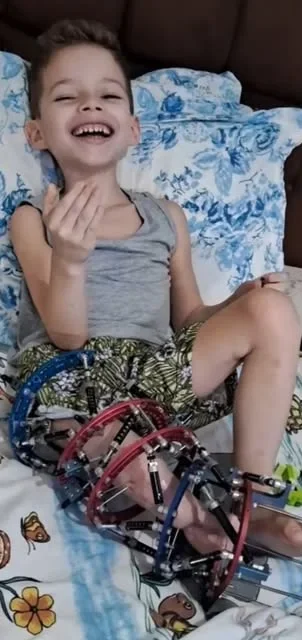
Before you meet him, you’ll hear the nickname first: “Cyborg.”
It sounds like something out of a comic book — a superhero name for a boy born with a rare bone condition. But once you see him walk, notice the light in his eyes, and hear the quiet determination in his voice, you understand why it fits.
Mateus earned that name.
A Diagnosis That Changed Everything
Mateus was born with congenital short femur associated with hemimelia, a condition so rare it affects only one in a million children.
One leg was shorter than the other. One hip was higher. Walking, running, balancing — all would be a struggle.
Doctors explained carefully: he would need multiple surgeries, years of physical therapy, and even then, his gait might never be considered “normal.”
What they couldn’t predict was his spirit.
The Birth of “Cyborg”
Mateus refused to see himself as limited.
After his first major surgery, he joked with nurses and parents:
“See? I’m half metal now. I’m getting stronger.”
The nickname stuck: Cyborg.
It became more than a joke. It became a symbol of courage, transformation, and resilience.
The Science Behind His Recovery
Mateus underwent bone-lengthening surgeries.
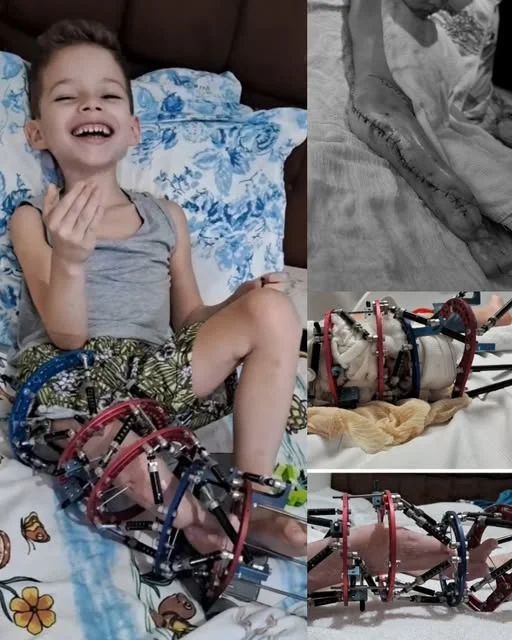
The process: surgeons break the bone, attach an external fixator, and slowly stretch the bone millimeter by millimeter. The body grows new bone to fill the gap.
It’s painful. Every day, screws are turned. Muscles stretch painfully. Physical therapy pushes limits.
Yet Mateus endures.
He has completed two full surgeries, gaining over 10 centimeters in the affected leg — nearly four inches.
Every centimeter represents months of hospital stays, nights of tears, and constant courage.
The Pause Before the Next Battle
After each surgery, the body needs time to recover. Bones must harden. Muscles adapt. Growth must catch up.
By 2027, Mateus’s legs are expected to be the same length. This means two or three more surgeries, each requiring hospitalization, rehab, and patience.
Most adults would find it overwhelming. Mateus treats it like a challenge:
“When the next one comes, I’ll be ready.”
The Power of Recovery
In the hospital, his name is written on the whiteboard, underlined twice, a smiley face beside it. Nurses call him “our little warrior.”
He high-fives everyone. He jokes with surgeons. He teaches other children that scars are proof of survival.
During therapy, a younger child cried from pain. Mateus rolled up his pant leg and showed his scars:
“See these? They hurt, too. But they made me faster.”
The child stopped crying.
Mateus has a gift: he turns fear into courage just by being himself.
Between Pain and Progress
The hardest part isn’t the surgery. It’s the waiting.
Waiting between stages. Waiting to see if the bone will hold. Waiting to run without limping.
At home, victories are celebrated: every centimeter gained, every step taken, every night without pain medication. The fridge is covered with drawings and X-rays. Above it all: “Strong like Cyborg.”
The Mindset of a Fighter
Mateus doesn’t see disability as limitation. He sees it as transformation.
He doesn’t call his leg “bad.” He calls it “the strong one” — rebuilt, resilient, brave.
He dreams of helping other kids: maybe as a physiotherapist or an engineer designing medical devices.
“I want to help other cyborgs,” he says with a wink.
Scars and metal aren’t weakness. They are strength.
A Future Rewritten
By adulthood, doctors expect his legs to be nearly identical. No more braces. No more surgeries.
His legacy goes beyond medicine.
He inspires children with similar conditions to believe in life after diagnosis. He shows family and doctors what perseverance really means built one millimeter at a time.
The Boy Who Redefined Strength
His mother laughs about the nickname:
“He gave it to himself. If his bones were strengthened with metal, he was part superhero.”
Every surgery made him more, not less. Every scar tells a story of pain and power.
Mateus isn’t just learning to walk evenly. He’s teaching the world: perfection is endurance, not symmetry.
Strength isn’t having two equal legs. Strength is standing tall no matter how many times you fall.
The human body may be fragile. But the human spirit is unbreakable.
The Legacy of “Cyborg”
By 2027, Mateus will face more months of pain, patience, and therapy. But if his story so far is any guide, he will face it as always: with courage and a smile that outshines the hospital lights.
When asked what he looks forward to most, he says simply:
“To run — really run — with both legs the same.”
When that day comes, the world will see what his family and doctors already know: he was never broken. He was becoming.
Sometimes heroes aren’t born in capes. Sometimes, they are built — one surgery, one scar, one miracle at a time.
Mateus, the boy they call Cyborg, is living proof.