Hubert Lizinkiewicz: Fighting for Life Before His First Birthday
- KimAnh
- December 15, 2025
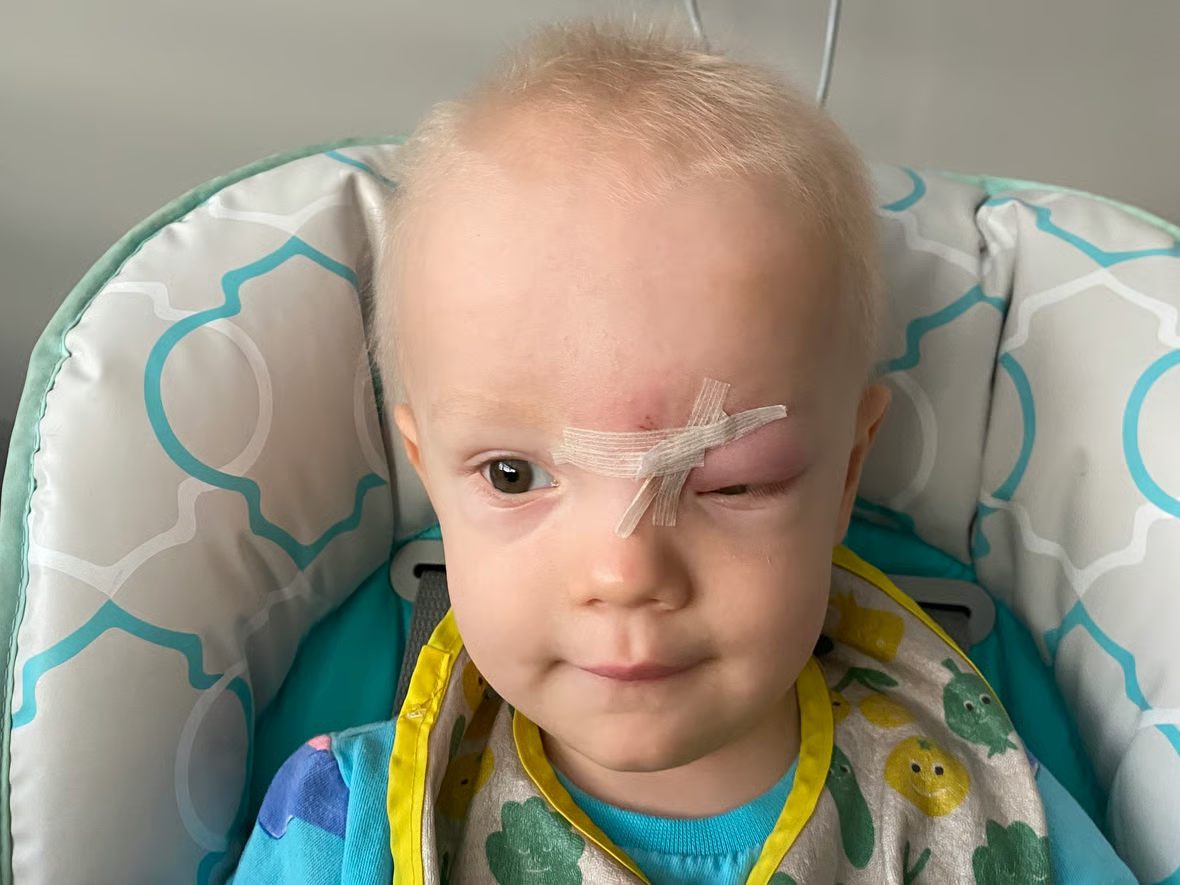
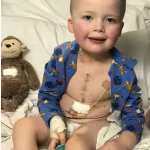
Hubert Lizinkiewicz—lovingly called Hubercik—is just 21 months old.
Yet in less than two years of life, he has endured more pain, fear, and resilience than many adults face in a lifetime.
Born in Biedrusko, in Poland’s Greater Poland region, Hubert was the youngest member of a warm, loving family. From the moment he arrived, he was surrounded by affection. His parents dreamed of ordinary things—first steps, first words, birthday candles, muddy shoes from the playground. They imagined a childhood filled with safety and laughter.
Those dreams shattered just weeks before Hubert’s first birthday.
A Small Sign That Changed Everything
It began with something that seemed harmless: a small bruise on Hubert’s eyelid. Like many parents, his mother and father assumed it was a minor bump from play. Toddlers fall. Bruises happen.
But the swelling didn’t fade.
Concern grew. They visited an eye specialist, expecting reassurance. Instead, the doctor’s expression changed. Blood tests were ordered. Then an ultrasound. Then advanced imaging.
What they discovered was devastating.
A massive tumor—measuring 7 by 8 centimeters—was growing in Hubert’s abdomen. Even worse, the cancer had already spread to his eye.
That same day, Hubert was admitted to the oncology ward.
The diagnosis soon followed: stage IV neuroblastoma, one of the most aggressive childhood cancers. Genetic testing revealed a positive N-MYC amplification, indicating a particularly fast-growing and dangerous form of the disease.
In a single moment, the family’s world collapsed.

A First Birthday in Isolation
Chemotherapy began immediately.
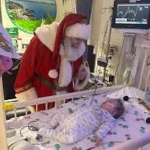
Instead of balloons and birthday cake, Hubert spent his first birthday in an isolation room, surrounded by IV lines, monitors, and medical staff. His tiny body, barely one year old, was already fighting for survival.
The months that followed became a blur.
MRI scans. CT scans. X-rays. Bone marrow biopsies. Eight initial cycles of chemotherapy slowly shrank the tumors. Hope flickered. But when doctors attempted to surgically remove the tumor from his eye, the procedure failed.
Four more cycles of chemotherapy followed.
Each treatment was brutal. Each pause between cycles carried fear. Through it all, Hubert endured quietly—too young to understand why his world was filled with needles instead of toys.
A Family Divided, Yet Unbroken
The emotional toll on the family was immense.
Only one parent was allowed to stay with Hubert in the oncology ward. At home, his older brother waited—missing his parents, confused by their absence, sensing the tension he could not yet understand.
The family lived in fragments, constantly separated by hospital rules and medical necessity.
Still, they held on.
Every small victory mattered. A good response to treatment. A smile. A moment of alertness. Each sign of strength became a reason to keep going.

A Life-Saving Surgery
Then came news that changed everything.
Doctors confirmed that the abdominal tumor could be removed.
The surgery was extremely risky. The tumor was wrapped around critical blood vessels, including the aorta. One mistake could be fatal. A specialized surgical team at the Medical University of Gdańsk took on the challenge.
The operation succeeded.
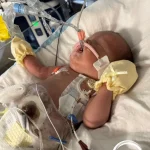
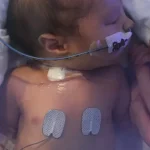
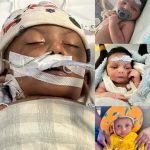
Hubert spent four days in intensive care, connected to machines, his tiny body covered in tubes and wires. His parents watched helplessly, terrified yet grateful. Their son had survived another impossible hurdle.
The Next Stage of the Fight
But the journey was far from over.
Hubert was transferred to a hospital in Poznań for the next phase: autologous stem cell transplantation, preceded by megachemotherapy designed to eliminate any remaining cancer cells.
This meant weeks of strict isolation. No visitors. No normal contact. His immune system would be virtually nonexistent.
Afterward, he would undergo six cycles of intravenous immunotherapy, each lasting ten consecutive days—months of relentless treatment for a child not yet two years old.

The Fear of Relapse
Even with aggressive treatment, neuroblastoma is notorious for returning.
Relapses are often more aggressive and harder to treat. Survival rates drop sharply. For Hubert’s parents, this reality was unbearable.
Then they learned about a groundbreaking option.
At Memorial Sloan Kettering Cancer Center in New York, children with neuroblastoma receive a specialized vaccine therapy designed to train the immune system to recognize and destroy cancer cells before relapse occurs.
This therapy offers something priceless: prevention.
But it comes at an enormous cost.
The treatment spans three years, involves repeated hospital visits, vaccinations, and constant monitoring—and is not covered by Poland’s healthcare system.
A Family Asking for Help
Hubert’s parents are not wealthy. They are ordinary people placed in an extraordinary nightmare.
They have already given everything—time, energy, sleep, savings—to keep their son alive. Now they are asking for help, not for comfort, but for a future.
“Hubert is a brave little boy who wants to live,” his father Tomasz says.
“His smile gives us strength. We will do everything we can to give him a healthy, happy childhood.”
Every donation brings Hubert closer to the vaccine that could protect him from relapse. Every act of kindness becomes a step toward a life outside hospital walls.
Why Hubert’s Story Matters
Hubert Lizinkiewicz is more than a diagnosis.
He is a child who laughs despite pain.
A baby who fights without understanding fear.
A symbol of courage in its purest form.
His story reminds us how fragile life is—and how powerful compassion can be.
Sometimes, saving a life does not require miracles. It requires people choosing to care.
Every second matters.
Every donation counts.
Every heartbeat of this brave little boy deserves the chance to keep going.
Together, we can help ensure that Hubert doesn’t just survive—but truly lives.