The Face History Couldn’t Erase Remembering Aron Löwi and the Humanity the World Tried to Forget
An Ordinary Life Before the Darkness
In the small, quiet town of Zator, Poland, lived a Jewish merchant named Aron Löwi. He was sixty-two years old, an age shaped by decades of work, family, and quiet routines. Aron was not a symbol. He was not a statistic. He was a husband who shared meals at a family table, a father who worried about the future, a neighbor known by name, a member of a community woven together by faith, labor, and shared history.
Like millions of others before the war, Aron lived an ordinary life — and that ordinariness mattered. He had dreams, responsibilities, and a place in the world. He belonged somewhere. He was someone.
But history would not allow that to last.
March 5, 1942: The Day a Name Was Taken
On March 5, 1942, Aron Löwi’s life was violently interrupted. That day marked the beginning of a journey designed not just to imprison him, but to erase him.
Like countless Jewish men during World War II, Aron was rounded up and transported to a wartime detention site under Nazi control. From the moment he arrived, the system began its work. It did not begin with violence alone, but with something colder — the systematic stripping away of identity.
Aron Löwi ceased to exist as a man.
He became Prisoner #26406.
That number replaced his name in official records, on his uniform, and in the eyes of those who controlled his fate. It was not a label of organization — it was a weapon of dehumanization. A way to reduce a human life into something manageable, disposable, and forgettable.
The Uniform That Told a Lie
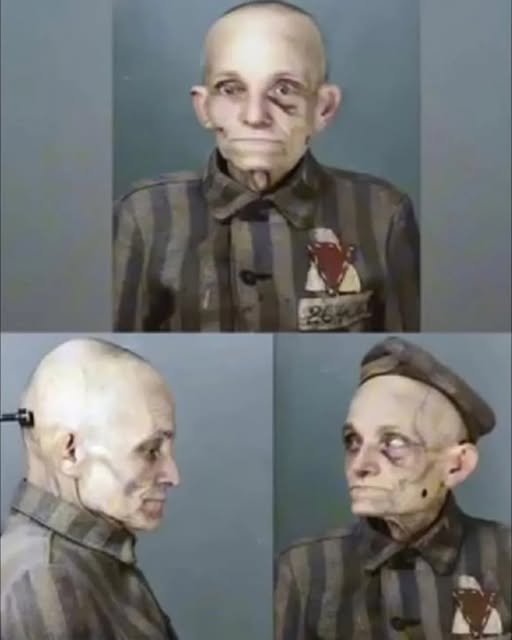
The photographs taken of Aron during his detention are haunting. They show a man already worn down by cruelty, his face marked by exhaustion and despair. His body, thin and fragile, is wrapped in the infamous striped uniform — a garment designed not for warmth or protection, but for humiliation.
The uniform carried symbols meant to define him — not as a person, but as a category.
Each mark denied his individuality and replaced it with stigma.
-
The yellow star on his chest identified him as Jewish.
-
The red triangle marked political prisoners.
-
The green triangle was used for those labeled “criminals.”
-
The pink triangle identified men persecuted for their love.
-
The black triangle marked those deemed “asocial” — the marginalized, the unwanted.
Each symbol told a different story, yet all spoke the same language of cruelty.
These were not mere identifiers. They were tools of degradation, designed to teach prisoners that they were no longer individuals, but problems to be managed, erased, or destroyed.
To the regime, Aron Löwi was no longer a father or a husband. He was no longer a man with a past. He was a number wearing symbols meant to justify his suffering.
Five Days That Contained a Lifetime of Pain
Aron’s time in the camp lasted only five days — from March 5 to March 10, 1942.
Five days.
In ordinary life, five days pass almost unnoticed. But within the machinery of Nazi brutality, those days were filled with hunger, fear, exhaustion, and unimaginable cruelty.
What happened during those five days was never fully recorded. There are no detailed accounts of his final moments. No testimony describing his last breath. No grave marked with his name.
His suffering unfolded in silence.
Like so many others, Aron disappeared into the shadows of history — another life extinguished without ceremony, without justice, without witnesses.
What Could Not Be Taken
And yet, there is something the system failed to destroy.
His memory.
The photographs that remain preserve more than his image — they preserve his humanity. In his eyes, we see a man who lived, who loved, who endured. His number may be visible, but it does not define him.
The Nazis tried to erase Aron Löwi’s name. History refused to let them succeed.
Today, we say his name aloud.
We remember that he was not born a prisoner. He was not born a symbol. He was a human being whose life mattered.
More Than a Photograph, More Than a Statistic
The photograph of Aron Löwi is not just a historical artifact. It is a moral document.
It confronts us with a truth that numbers alone cannot express — that every victim of genocide was a world unto themselves. Each had relationships, memories, hopes, and fears.
Aron was a father. A husband. A son.
He was not “Prisoner #26406.”
He was a man whose life was stolen by a regime that sought not only to kill bodies, but to annihilate dignity, identity, and memory.
Remembering One Is Remembering All
To remember Aron Löwi is to remember the countless others who were reduced to numbers, to triangles, to stars sewn onto cloth.
Remembering one name is an act of resistance.
It is a refusal to allow history to flatten human lives into statistics. It is a declaration that suffering must be acknowledged, that lives erased by violence still matter.
When we remember Aron, we remember them all.
A Legacy of Witness, Not Silence
Aron Löwi’s legacy is not one of disappearance, but of testimony.
His story reminds us why remembrance matters — not as a ritual of the past, but as a responsibility of the present. His suffering speaks to the urgency of compassion, of vigilance, and of defending human dignity wherever it is threatened.
Every time his name is spoken, we honor those who were denied the chance to be remembered.
The Face History Couldn’t Erase
History tried to erase Aron Löwi.
It failed.
As long as his face is seen, his name spoken, and his story told, he remains more than a victim. He remains a human being whose life mattered — and still matters.
In remembering Aron Löwi, we carry forward the voices of those who were silenced, ensuring that the past is not forgotten and that humanity is never reduced to numbers again.