He Lost All Four Limbs in War—Then a Single Moment of Hope Changed Everything
There was a moment, years after the explosion, when John Peck decided he was done.
After losing both arms and both legs in Afghanistan, after waking up in hospitals more times than he could count, after learning what it meant to depend on others for nearly every basic need, the weight of survival became unbearable. Life no longer felt like something he was living. It felt like something he was enduring.
One morning at Walter Reed National Military Medical Center, John looked at a staircase and made a plan to end his life. At just twenty-five years old, the future felt empty—stripped of independence, dignity, and the possibility of love. He believed the best part of his life had already happened, and that everything ahead would only be loss.
Then something unexpected happened.
The Moment That Stopped Everything
From his hospital window, John noticed another patient outside. The man was also a double amputee. He was holding his young daughter’s hand while hugging his wife. It was an ordinary moment, quiet and unremarkable by most standards.
But for John, it cracked something open.
If that man could still have joy—still have love, still have a family—then maybe life after loss was not impossible. Maybe the story did not have to end at survival.
That single glimpse changed the direction of his life. John stepped away from the stairs. He chose to stay.
A Life Already Marked by War
John Peck had already endured more than most people ever will. In 2007, he suffered a traumatic brain injury during an explosion in Iraq. Recovery was long and difficult, but when many would have stepped away, John reenlisted.
In 2009, he deployed to Afghanistan.
On May 24, 2010, while searching homes for weapons in Helmand province, John stepped on an improvised explosive device. The blast hurled him through the air, instantly severing both legs and his right arm. Doctors worked desperately to save his left arm, but the damage was too severe. It was later amputated below the elbow.
When John finally woke up after months of sedation, it was his mother—a former Army nurse—who had to tell him the truth.
Anger, Then Darkness
Anger came first. Anger at the war. At fate. At a body that no longer felt like his own.
Depression followed close behind.
John felt isolated and invisible, convinced no one would ever want him, convinced his life had peaked before it truly began. He struggled with the idea of being dependent, with the fear that he would always be a burden. Physical therapy and psychological counseling were offered, but at first, he resisted.
Hope felt unrealistic. Trust felt dangerous.
But after that moment at the window, something shifted. John said yes—to therapy, to help, to the idea that rebuilding might be possible.
Slowly, painfully, he began to work not only on strength, but on self-worth.
Learning to Live Again
Recovery was not linear. It was frustrating and humbling. Tasks that once required no thought now demanded intense focus. Progress came in inches, not leaps.
But with time, John began to reconnect with himself. He learned to laugh again. To engage. To imagine a future that was not defined solely by loss.
And then he did something that terrified him.
He reentered the world.
Choosing Vulnerability
John created an online dating profile. It felt risky, almost foolish. He wondered who could possibly look past the wheelchair, the amputations, the trauma.
Most didn’t.
Messages went unanswered. Silence confirmed every fear he had about being unwanted. About being alone forever.
Then one message arrived—from a woman named Jessica Parker.
Jessica noticed his humor first. His honesty. The way he refused to hide who he was or pretend to be someone else. She reached out without expectation, just curiosity.
When John saw her message, he assumed it had to be a joke. A beautiful woman wanting to talk to him didn’t fit the story he told himself. Still, he replied.
They met for drinks.
They talked all night.
What began as curiosity turned into connection. Connection turned into love.
Love Without Conditions
Their relationship grew naturally, deeply, without pretense. Jessica moved in. She became his partner in every sense—laughing with him, supporting him, seeing him not as broken, but as whole.
For the first time since the explosion, John felt chosen.
And quietly, he held onto a dream he had never said out loud. He wanted to hold her hand on their wedding day. Not with prosthetics.
With real arms.
A Rare and Risky Hope
In August 2016, that dream became reality.
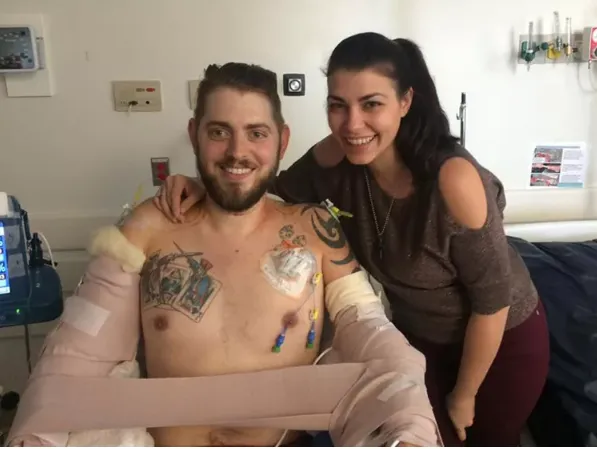
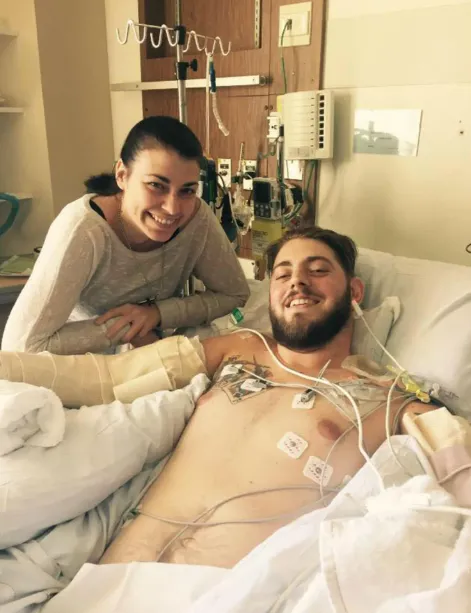
John underwent a 14-hour double arm transplant at Brigham and Women’s Hospital in Boston. The surgery was performed by a team of more than 60 medical professionals. He became one of only a handful of veterans—and fewer than one hundred people worldwide—to receive such a transplant.
The hospital donated the cost of the surgery. But the greatest gift came from a donor family who chose generosity in the midst of unimaginable grief.
When John woke up, the first face he saw was Jessica’s.
Carrying Someone Else’s Gift
John speaks often about the unknown young man whose arms now give him a future. He does not forget the cost of that gift. Every movement, every returning sensation, carries the weight of gratitude.
Recovery is slow. Nerves awaken gradually. Tasks like brushing teeth or buttoning a shirt require patience, repetition, and determination. But for John, every challenge is worth it.
Because now, effort leads somewhere.
A Proposal Full of Meaning
Not long after surgery, on his birthday, John asked Jessica to marry him in a way only he could. Knowing her love for penguins, he proposed at an aquarium, offering her a stone with the ring—a symbol of permanence and devotion.
She said yes without hesitation.
They plan to marry when his arms are fully functional—when he can walk down the aisle on prosthetic legs and take her hand with his own.
What His Story Really Means
Looking back, John knows how close he came to losing everything. He also knows how one moment of hope, one act of love, and one decision to keep going altered the course of his life.
Today, he is grateful—not simply to be alive, but to be living with purpose, connection, and dignity.
His story is not about what was taken by war.
It is about what was found afterward.
It is about the power of a single moment to interrupt despair. About love that sees possibility where someone else sees endings. And about the quiet, stubborn choice to stay when leaving feels easier.
John Peck did not get his old life back.
He built a new one—piece by piece, with courage, hope, and love.