Leviathan of the Jurassic: The Two-Metre Skull That Emerged from England’s Cliffs
- SaoMai
- March 3, 2026
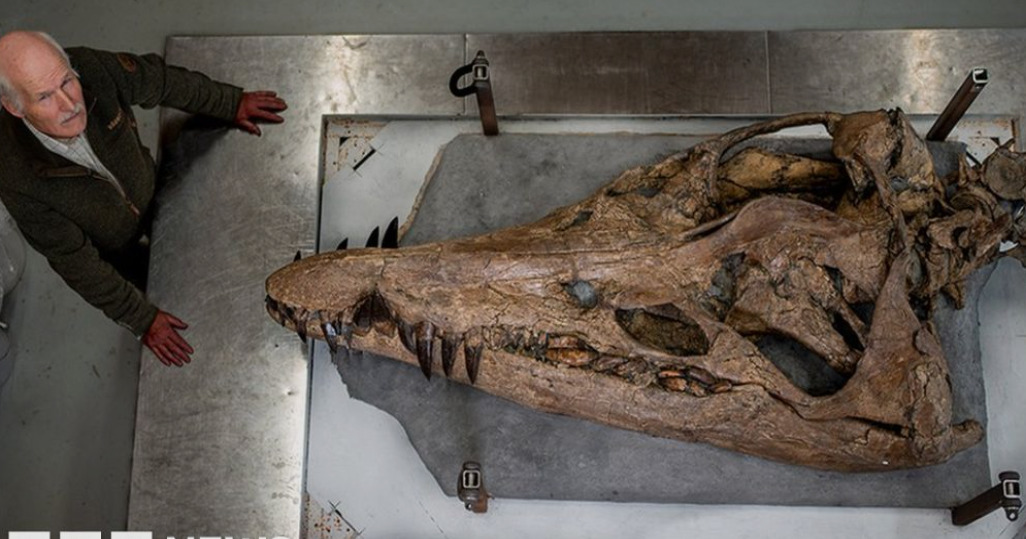
Imagine strolling beneath the windswept cliffs of southern England and locking eyes with a predator that once dominated ancient oceans. That astonishing encounter became reality on the legendary Jurassic Coast, where a 150-million-year-old pliosaur skull was discovered embedded in the rock — one of the most spectacular marine reptile finds in decades.
The fossil was unearthed along the Dorset coastline, part of a UNESCO World Heritage Site that preserves an almost continuous record of life spanning 185 million years. The skull belongs to a pliosaur, a fearsome group of short-necked marine reptiles that ruled the seas during the Late Jurassic. Unlike their long-necked relatives, the plesiosaurs, pliosaurs were built for power and speed. 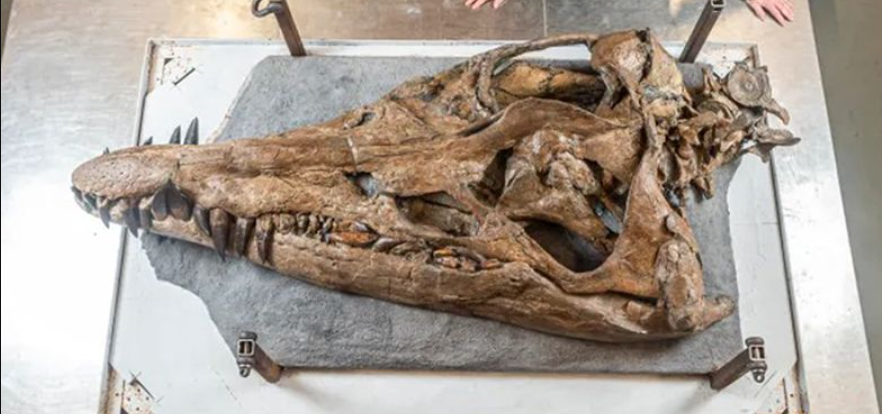 They possessed enormous heads, muscular jaws, and streamlined bodies designed for explosive bursts through prehistoric waters.
What makes this specimen truly breathtaking is both its size and its condition. Measuring around two metres in length — longer than most adults are tall — the skull is remarkably complete. Marine reptile fossils are often fragmented or crushed by immense geological pressure over millions of years. Yet this skull preserves intricate anatomical details: clearly defined eye sockets, intact jaw structures, and approximately 130 razor-sharp, conical teeth. The front teeth project forward like curved daggers, perfectly shaped for seizing slippery prey.
Such dentition reveals a predator of formidable capability. With interlocking teeth and immense bite force, this pliosaur likely hunted large fish, squid, and even other marine reptiles. Based on the skull’s proportions, researchers estimate the full animal measured between 10 and 12 metres in length. Forward-facing eyes suggest strong depth perception — a crucial advantage for a hunter relying on ambush tactics in the warm, shallow seas that once covered what is now Britain.
 The discovery adds another extraordinary chapter to the fossil legacy of Dorset. The cliffs of the Jurassic Coast have yielded countless insights into ancient marine ecosystems, but such a complete and massive pliosaur skull provides rare clarity into skull mechanics, feeding strategies, and evolutionary relationships among apex marine predators.
Even more chilling is the evidence left behind by these giants. Bite marks attributed to pliosaurs have been found on the bones of other marine reptiles, indicating violent encounters — and possibly cannibalism — in Jurassic waters. These were not merely large animals; they were dominant forces in their ecosystems.
Standing before this colossal skull today, one cannot help but imagine the moment it surged upward from the depths, jaws open, ruling an ocean world long vanished yet astonishingly preserved in stone.