The Miraculous Journey of Baby Ellie: Surviving Heart Surgery and Multiple Complications Against All Odds
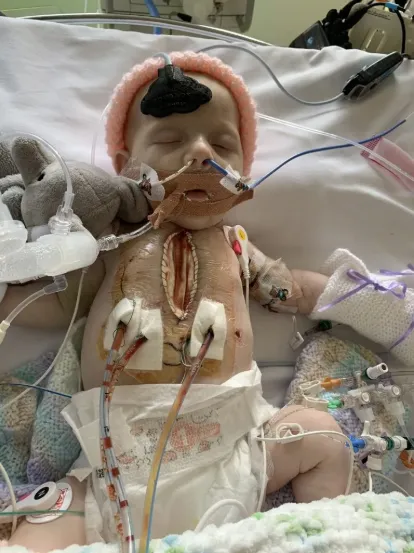
A baby girl who defied the odds after a life-threatening heart condition
The remarkable survival story of a baby girl named Ellie is inspiring families and medical professionals alike after she overcame a series of life-threatening medical challenges during the first weeks of her life.
Ellie was diagnosed before birth with a rare and serious heart defect known as Transposition of the Great Arteries (TGA). The condition, discovered during her mother’s 20-week pregnancy scan, meant that the major arteries connected to her heart were reversed, preventing oxygenated blood from circulating properly through her body.
For Ellie’s parents, the diagnosis was devastating. But the early detection also gave doctors the chance to prepare a detailed treatment plan before she was even born.
A critical surgery just days after birth
At 39 weeks of pregnancy, doctors induced labor to prepare Ellie for the medical care she would need immediately after birth. The newborn responded well to the initial treatments and was scheduled for a life-saving arterial switch surgery on her fifth day of life.
However, just before the procedure, doctors discovered an additional complication: an intramural coronary artery, a rare anatomical abnormality that significantly reduced her chances of survival during surgery.
Despite the risks, the surgical team decided to proceed.
After hours in the operating room, the delicate procedure was completed successfully, giving Ellie’s parents a moment of cautious hope. She was then transferred to the Pediatric Intensive Care Unit (PICU), where doctors closely monitored her fragile condition.
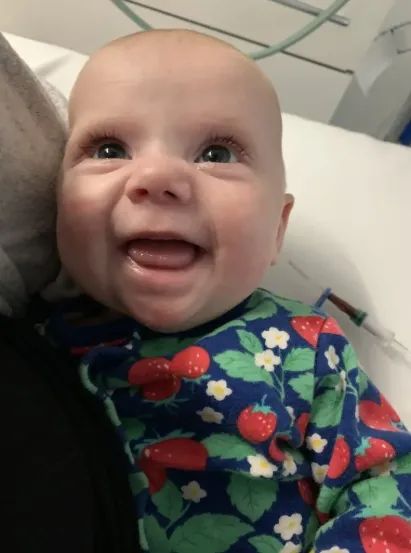
Complications threaten her fragile recovery
Although the surgery had been successful, Ellie’s recovery was far from easy.
Doctors soon discovered that she was suffering from pulmonary hypertension and chylothorax, conditions that required intensive treatment including sedation, nitric oxide therapy, and total parenteral nutrition.
After eight days of careful monitoring in the PICU, Ellie was stable enough to be moved to the cardiac ward. For her parents, it felt like the first small victory after days filled with fear.
But the relief was short-lived.
Just one week later, as Ellie’s mother attempted to breastfeed her for the first time, the baby suddenly went into cardiac arrest.
A race against time
Fortunately, an anesthetist present at the time immediately intubated Ellie, helping stabilize her breathing and circulation.
She was rushed to the cardiac catheterization laboratory for emergency intervention.
During the procedure, Ellie suffered another cardiac arrest, forcing doctors to place her on ECMO (Extracorporeal Membrane Oxygenation), a life-support system that temporarily takes over the function of the heart and lungs.
For Ellie’s parents, the following days were filled with unimaginable fear and uncertainty.
Doctors soon determined that Ellie would need another extremely delicate procedure: a coronary artery bypass graft (CABG).
This operation involved using the left internal mammary artery to bypass a blocked artery that was smaller than a strand of hair—an incredibly rare and technically challenging procedure in newborns.
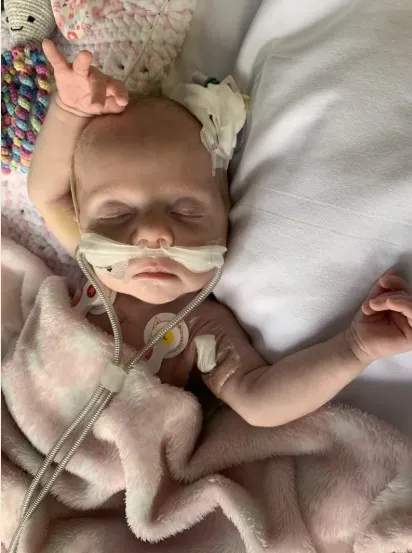
A tiny miracle begins to emerge
Against all odds, the surgery was successful.
After five days on ECMO, Ellie passed the critical low-flow test, indicating that her heart was capable of functioning independently again.
Her ventricles regained full activity, and one of the surgeons described her as nothing short of a “miracle.”
For the first time in weeks, Ellie’s parents felt a glimmer of real hope.
But Ellie’s journey was not finished yet.
More challenges test her strength
Shortly after recovering from heart surgery, Ellie was diagnosed with necrotizing enterocolitis (NEC), a severe intestinal disease that can be life-threatening in newborns.
She required an emergency abdominal surgery while her chest was still open from the previous heart operation—an incredibly frightening moment for her family and medical team.
Even after the surgery, Ellie continued to face complications.
Doctors treated several additional issues during her stay in the PICU, including:
-
A collapsed lung requiring bronchoscopy
-
Recurring chylothorax
-
Diaphragmatic palsy that required fluoroscopy assessment
Through it all, a dedicated team of doctors and nurses carefully monitored her condition and adjusted treatments to keep her stable.
Twelve weeks of courage and determination
Eventually, Ellie was transferred back to the cardiac ward.
However, feeding remained difficult because of complications from her intestinal surgery. She required weeks of nutritional support through intravenous feeding while doctors waited for the right moment to perform an early stoma closure.
Just one week before the procedure, Ellie developed a sudden fever and an elevated heart rate.
Medical staff quickly identified the source of the problem: an infection in her Hickman line, a long-term intravenous catheter.
The line was removed immediately, and targeted antibiotic treatment successfully controlled the infection.
Following a successful stoma closure surgery, Ellie began to recover more quickly.
Five days later, after nearly twelve weeks in the hospital, she was finally strong enough to go home.
A story that changed a family forever
Ellie’s incredible journey has profoundly changed her family’s perspective on life.
The experience taught them to cherish every moment, show kindness to others, and raise awareness about congenital heart disease (CHD).
They now advocate for better support and understanding for families who are navigating the complex challenges of caring for children with heart defects.
A powerful reminder of resilience and hope
Ellie’s story highlights the extraordinary resilience of newborns facing severe medical conditions.
Her survival was made possible through a combination of advanced medical technology, highly skilled surgeons, and the unwavering love and determination of her parents.
Each stage of her recovery—from ECMO support to multiple surgeries—demonstrates how modern medicine and human perseverance can transform a potentially fatal diagnosis into a story of survival and hope.
Today, Ellie’s journey stands as a powerful reminder that even the smallest fighters can overcome the greatest challenges.
And sometimes, against all odds, miracles really do happen.