Rex’s Journey: The Baby Who Survived a Life-Threatening Heart Defect Before His First Birthday
A joyful beginning that quickly turned into concern
For Ruth, pregnancy had been smooth and uneventful. Like many first-time mothers, she eagerly awaited the arrival of her baby boy, imagining the joyful moment she would finally meet him.
That moment came in the early hours of September 8, 2013, when Ruth’s water broke unexpectedly. Doctors soon noticed the presence of meconium, a sign that can sometimes indicate fetal distress. As a precaution, Ruth was quickly taken to the hospital.
Labor initially progressed quickly, but complications soon appeared. Baby Rex began showing signs of distress during delivery, forcing doctors to make a rapid decision to perform an emergency Caesarean section.
At 11:48 a.m., Rex was born.
At first glance, everything seemed fine. The newborn looked healthy, and his parents felt overwhelming relief after the stressful delivery. For a brief moment, it appeared their son’s arrival had ended safely.
However, within hours, doctors began noticing troubling signs.
Subtle symptoms raise early alarms
While recovering in the post-operative ward, nurses observed that Rex’s skin had a slightly purple tint, and his breathing appeared irregular. Although these symptoms were subtle, medical staff recognized they could indicate an underlying problem.
To ensure his safety, Rex was transferred to the Special Care Baby Unit (SCBU) for closer monitoring.
Initially, doctors suspected meconium aspiration, a condition that occurs when a baby inhales meconium-stained fluid during birth. In many cases, the condition can be treated with supportive care and resolves within a few days.
Rex’s parents were reassured that his stay might only be temporary.
By September 10, doctors reported encouraging news: Rex was improving and could potentially go home within a few days.
But just hours later, everything changed.
A shocking diagnosis
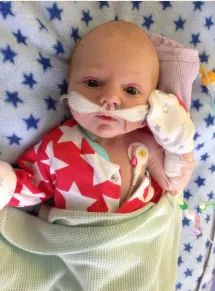
During a routine examination, doctors detected a loud heart murmur while listening to Rex’s chest. Although some murmurs can be harmless, this one immediately raised serious concerns.
Doctors ordered an echocardiogram, a specialized ultrasound used to examine the structure and function of the heart.
The results were devastating.
Rex had multiple congenital heart defects, including:
-
Coarctation of the Aorta – a dangerous narrowing of the body’s main artery
-
Bicuspid Aortic Valve – a heart valve abnormality affecting blood flow
-
Ventricular Septal Defect (VSD) – a large hole between the heart’s lower chambers
In addition, doctors discovered extra tissue in the left ventricle, further complicating his already fragile heart structure.
Together, these conditions created a life-threatening situation that required immediate treatment by pediatric heart specialists.
Rex’s parents were suddenly faced with a terrifying reality: their newborn son needed urgent heart surgery to survive.
A race to a specialist hospital
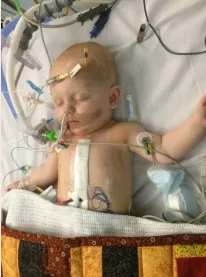
To receive the specialized care he required, Rex was sedated and transferred by ambulance to the Paediatric Intensive Care Unit (PICU) at Southampton General Hospital.
For Ruth and her family, the experience was overwhelming.
Just days earlier, they had been celebrating the birth of their son. Now, they were watching doctors prepare him for life-saving heart surgery.
The emotional shock was immense.
But the medical team moved quickly, knowing that time was critical.
A delicate operation at just eight days old
At only eight days old, Rex underwent his first major heart surgery.
The procedure focused on repairing the Coarctation of the Aorta, widening the narrowed artery so that blood could flow normally through his body.
Surgeons also placed a pulmonary artery band, a small surgical band designed to regulate blood flow to Rex’s lungs. This temporary measure helped reduce strain on his heart while doctors prepared for future corrective surgery.
Operating on a newborn heart is one of the most delicate challenges in pediatric medicine.
Every movement requires extreme precision, and the margin for error is incredibly small.
Thankfully, the operation was successful.
After several days of intensive monitoring and recovery in the hospital, Rex’s condition stabilized enough for him to finally return home on September 28, 2013.
For his parents, it was an emotional milestone—but they knew the journey was far from over.
Preparing for the second surgery
Although Rex had survived his first operation, his heart defect still required further repair.
Doctors scheduled a second major surgery for April 9, 2014, when Rex was several months older and strong enough for a more complex procedure.
During this surgery, surgeons:
-
Closed the large ventricular septal defect (VSD)
-
Removed the pulmonary artery band that had been placed during the first operation
Once again, Rex returned to the Paediatric Intensive Care Unit following surgery so doctors could carefully monitor his recovery.
For Ruth and her family, the wait during surgery was agonizing.
But once again, Rex proved to be a fighter.
A remarkable recovery
Following the second surgery, Rex gradually regained strength at home.
Doctors closely monitored him for complications, but with each passing week he continued to improve.
Simple milestones became moments of celebration:
-
breathing comfortably on his own
-
feeding successfully
-
gaining weight
-
growing stronger every day
These small victories meant everything to his parents.
They were reminders that Rex’s difficult start in life had not defined his future.
A thriving child today
Today, Rex is a happy and energetic three-year-old who loves playing and spending time with his family.
Looking at him now, it is difficult to imagine the life-threatening heart condition he once faced as a newborn.
His story highlights the incredible progress made in pediatric cardiac surgery, where early detection and specialized treatment can transform what was once a fatal diagnosis into a story of survival.

The importance of early detection
Rex’s journey underscores a critical message for parents and healthcare providers alike: early diagnosis can save lives.
The careful observations of nurses, the quick decision to perform an echocardiogram, and the coordinated efforts of pediatric cardiologists and surgeons were all essential in saving Rex’s life.
Without these steps, his condition might not have been discovered in time.
A story of hope and resilience
For Ruth, Rex’s early months were filled with fear, uncertainty, and sleepless nights.
Yet they were also filled with gratitude—for the doctors, nurses, and specialists who worked tirelessly to save her son.
Today, Rex’s story serves as a powerful reminder that even the most fragile hearts can overcome extraordinary challenges.
Through medical expertise, parental love, and remarkable resilience, a baby once fighting for survival has grown into a child full of life.
And for his family, every laugh, every step, and every moment is a miracle.