Billy’s Journey: How Early Detection Saved a Baby Born With a Rare Heart Defect
A life-changing diagnosis during pregnancy
For Rebecca, her pregnancy initially seemed normal. Like many expectant mothers, she looked forward to her 20-week ultrasound scan, excited to see her baby and confirm that everything was progressing well.
However, the appointment quickly turned into a moment that would change everything.
During the scan, doctors discovered that Rebecca’s unborn baby, Billy, had Transposition of the Great Arteries (TGA)—a rare congenital heart defect that affects about 1 in 10,000 babies.
TGA is a serious condition in which the two main arteries that carry blood away from the heart are reversed. Without urgent medical treatment after birth, the condition can prevent oxygen-rich blood from circulating properly throughout the body.
The diagnosis immediately triggered a referral to the cardiology specialists at John Radcliffe Hospital in Oxford, where further examinations confirmed the condition.
From that point forward, Rebecca’s pregnancy became very different from what she had imagined.
Pregnancy filled with hope and anxiety
Following the diagnosis, Rebecca began attending regular specialist appointments and detailed scans to monitor Billy’s condition.
While these check-ups ensured that doctors were prepared for his birth, they also meant that the excitement of pregnancy was often overshadowed by worry.
Instead of simply preparing for a newborn, Rebecca and her partner had to prepare for the reality that their baby would require major heart surgery soon after birth.
Despite the fear, the medical team carefully developed a plan to ensure Billy would receive immediate care when he arrived.
Early detection would prove to be the key factor that ultimately saved his life.

Billy’s early arrival
Billy arrived slightly earlier than expected on May 9, 2016, at 7:30 a.m., just one day before Rebecca was scheduled to be induced.
His birth was both joyful and frightening.
Rebecca was able to hold him briefly, but only for a moment.
Almost immediately, doctors took Billy away so they could stabilize him and begin life-saving medication to support his heart function. For Rebecca, the experience was overwhelming—she had just given birth, yet her newborn was already fighting for his life.
Within hours, Billy was under the care of specialists who were preparing him for the difficult days ahead.
A difficult first week
The first week of Billy’s life introduced his parents to a world no family expects to face.
They had to learn emergency responses, including how to react if Billy experienced apnea, a condition where breathing temporarily stops. These were skills they had never imagined needing for their newborn child.
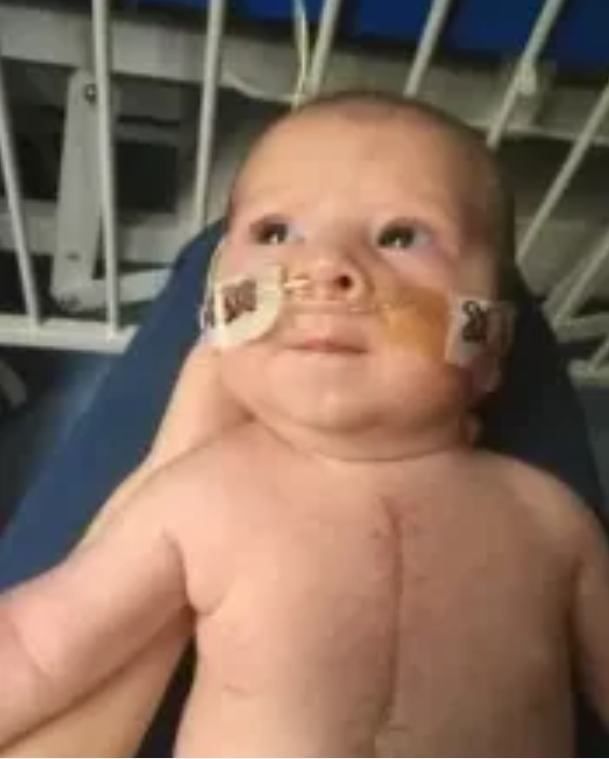
At just seven days old, Billy was scheduled to undergo open-heart surgery to correct the TGA.
Doctors initially expected the procedure to take about four to five hours.
But things did not go as planned.
A surgery that lasted 13 hours
During the operation, complications arose that dramatically extended the procedure.
Instead of a few hours, the surgery lasted 13 hours.
At two separate points, Billy’s heart failed to restart after doctors removed him from the heart-lung bypass machine. Surgeons had to resuscitate him twice to restore his heartbeat.
The situation was critical.
Doctors prepared Billy’s parents for the worst, explaining that their son might not survive the night.
For Rebecca and her partner, the news was devastating.
Yet in a remarkable turn of events, Billy stabilized two hours later.
He was transferred to the Paediatric Intensive Care Unit (PICU) with an ECMO machine nearby as a precaution, ensuring that doctors could support his heart and lungs if necessary.

The painful days of recovery
Billy’s recovery was far from easy.
Due to severe swelling after surgery, doctors had to leave his chest open for seven days, a necessary but extremely difficult sight for his parents.
Each visit to the intensive care unit was emotionally painful.
Rebecca could only watch as her tiny son fought through the aftermath of a life-saving but traumatic operation.
Finally, on the ninth day, she was able to hold him again for the first time since surgery.
The moment was overwhelming—a mixture of relief, gratitude, and disbelief that her son had survived such an ordeal.
Learning to feed and grow
Even after Billy’s heart stabilized, new challenges appeared.
Because he had been tube-fed since birth, Billy had not developed the natural ability to suck or swallow. This meant breastfeeding was not possible, and he had to gradually learn how to drink from a bottle.
Feeding became a slow and careful process that required patience and training.
However, day by day, Billy began to grow stronger.
Small milestones—such as finishing a bottle or gaining weight—became major achievements for his parents.
After 31 days in the hospital, Billy was finally discharged.
For the first time, his parents could begin life at home with their son.
A thriving toddler today
Today, Billy is a happy and energetic two-year-old who loves exploring the world around him.
Although he still attends regular cardiology check-ups and sees specialists to monitor his development, his progress has been remarkable.
Looking at him now, it is hard to imagine the life-threatening challenges he faced during his first weeks of life.
Why early detection mattered
Billy’s story highlights the critical importance of prenatal diagnosis.
Only about one-third of TGA cases are detected during pregnancy, which means many babies are born without doctors knowing about the condition in advance.
In Billy’s case, his mother believes that recent training provided to ultrasound technicians just a week before her scan helped ensure the defect was identified early.
Without that early detection, Billy might have been sent home after birth without the urgent treatment he needed.
That delay could have had devastating consequences.
A message of hope for families
Billy’s journey shows how early diagnosis, specialized medical care, and determined parents can transform a potentially fatal condition into a story of survival.
From prenatal detection to neonatal care and complex heart surgery, a coordinated team of doctors, nurses, and specialists worked together to give Billy a chance at life.
For Rebecca, the experience also revealed the emotional strength required of parents raising a “heart baby.”
Navigating hospital corridors, learning emergency medical skills, and enduring weeks of uncertainty demanded courage she never expected to need.
Yet through it all, Billy continued to fight.
A tiny heart with incredible strength
Today, Billy’s laughter and curiosity are reminders of just how far he has come.
His story continues to inspire other families facing similar diagnoses and highlights the importance of awareness about congenital heart defects.
Rebecca now shares a simple message with other parents whose babies face serious heart conditions:
Stay strong, trust the doctors, and believe in your child’s strength.
Because sometimes, even the smallest hearts can overcome the biggest challenges.