
The Woman Who Chose Forgiveness: The Extraordinary Story of Ameneh Bahrami
- SaoMai
- May 4, 2026
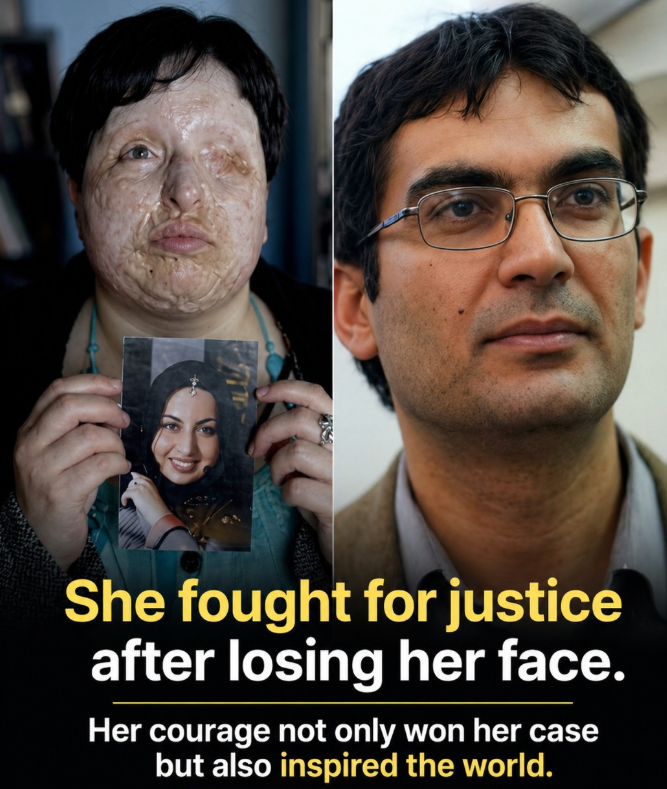
The Woman Who Chose Forgiveness: The Extraordinary Story of Ameneh Bahrami
In 2004, Ameneh Bahrami was a young woman living in Tehran, Iran, building her future and pursuing her education. Her life, however, was violently altered in a single moment that would change everything she knew about safety, identity, and survival.
After she rejected a marriage proposal from a fellow student, Majid Movahedi, his behavior reportedly became obsessive and increasingly hostile. One day, as Ameneh was walking home from work, he approached her without warning and threw sulfuric acid directly into her face.
The attack caused devastating injuries. Ameneh lost her eyesight completely and suffered severe burns that required extensive medical intervention. In the years that followed, she underwent approximately 19 reconstructive surgeries in an attempt to repair the damage. Her physical recovery was long, painful, and uncertain, but the emotional impact of the attack was equally profound.
 Despite the trauma, Ameneh refused to disappear into silence. Instead, she chose to pursue justice through Iran’s legal system. Her case was tried under the principle of qisas, a form of retributive justice often described as “an eye for an eye,” where victims of serious crimes may request that the same punishment be applied to the offender.
After years of legal proceedings and public attention, an Iranian court ruled in her favor. She was granted the legal right to carry out an acid attack on her attacker in the same manner she had suffered.
In July 2011, the sentence was prepared to be executed in a hospital setting in Tehran. Reports described a highly controlled environment: medical staff present, the attacker restrained on a bed, and acid prepared in accordance with the court’s ruling. At that moment, Majid Movahedi reportedly begged for mercy, fully aware of what was about to happen.
Ameneh Bahrami, who had lived in darkness for seven years because of him, stood only steps away from fulfilling the court’s decision.
Then, something unexpected happened.
She stopped.
At the final moment, Ameneh declared that she would not proceed. Despite having the full legal right to carry out the sentence, she chose forgiveness instead of revenge.
“I forgive him,” she said.
Her decision stunned those present and resonated around the world. In later interviews, Ameneh explained that she did not want another human being to experience the same suffering she had endured. She acknowledged that revenge would not restore her sight or undo the past. Instead, she believed forgiveness offered her a different kind of freedom—emotional release from the weight of hatred.
Ameneh Bahrami’s story has since become a powerful symbol of resilience, moral strength, and the complex nature of justice. It raises difficult questions about punishment, healing, and the limits of retribution.
But above all, it remains remembered for one extraordinary choice: in a moment defined by darkness, she chose mercy.