Iran HIT US Warship… US Navy Revenge Was INSTANT and BRUTAL! – Family Stories
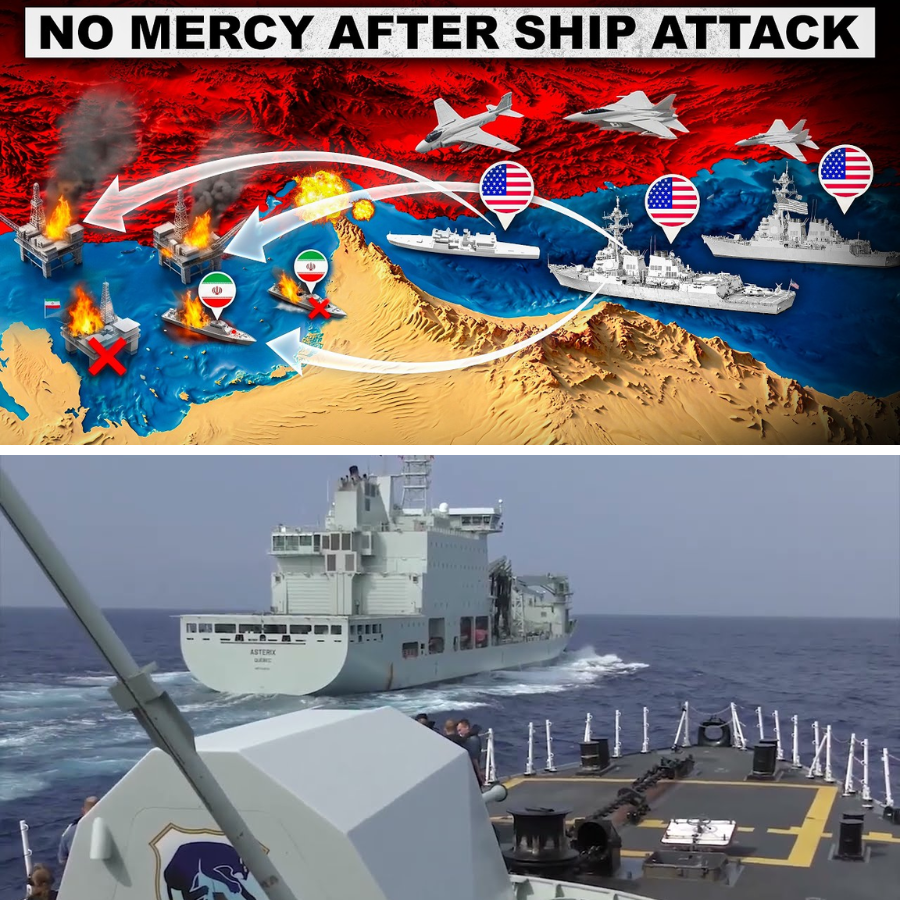
In the mid-1980s, the world’s attention was fixed on a grinding, bloody conflict between Iraq and Iran—two nations locked in a war that had already consumed hundreds of thousands of lives. But beneath the headlines of trench warfare and missile exchanges, another conflict was unfolding quietly at sea. It would become one of the most dangerous maritime confrontations since World War II.
The Strait of Hormuz—a narrow waterway connecting the Persian Gulf to the open ocean—had become the economic choke point of the modern world. Roughly 60% of global oil shipments passed through its waters at the time. Whoever controlled or disrupted it could influence global energy prices overnight.
By 1984, both Iran and Iraq had realized that battlefield victories on land were increasingly out of reach. Instead, they turned to economic warfare. Iraq targeted Iranian oil infrastructure. Iran responded by striking oil tankers—particularly those linked to Kuwait, which had become a logistical lifeline for Iraqi exports.
This escalation marked the beginning of what would later be known as the Tanker War, a brutal campaign of maritime harassment, missile strikes, and naval mines that would eventually draw in the United States Navy.
The violence at sea rapidly expanded beyond the original belligerents. By 1986, more than 200 commercial vessels—many of them neutral—had been attacked or damaged in the Persian Gulf. Insurance rates for shipping skyrocketed. Oil prices surged globally.
Kuwait, heavily reliant on uninterrupted maritime exports, found itself in an increasingly precarious position. Facing repeated attacks, it sought protection from outside powers. In a controversial diplomatic maneuver, Kuwaiti officials reached out to both the Soviet Union and the United States for naval assistance.
Washington’s response was driven less by regional politics than by global strategy. The idea of Soviet warships operating freely in the Persian Gulf was unacceptable to U.S. planners during the Cold War. The result was a deal that would reshape naval operations in the region.
Kuwait agreed to reflag its oil tankers under the American flag. These vessels would now be treated as U.S.-protected shipping.
Thus began Operation Earnest Will.
Launched in 1987, Operation Earnest Will became the largest naval convoy operation undertaken by the United States since World War II.
At its core, the mission was simple: escort reflagged Kuwaiti tankers safely through the Strait of Hormuz and the Persian Gulf using U.S. naval power.
But in execution, it was far more complex—and far more dangerous.
Convoys were assembled with layers of protection: destroyers, frigates, cruisers, mine countermeasure vessels, Coast Guard cutters, and aerial surveillance support. Among the most notable warships deployed were:
The centerpiece of the convoy system was the massive tanker Bridgeton, a reflagged Kuwaiti supertanker stretching over 1,000 feet in length.
On paper, it appeared to be one of the most heavily protected civilian maritime operations in modern history.
In reality, the convoy’s first major test would expose a critical vulnerability: naval mines.
On July 24, 1987, the convoy encountered its first major shock.
Unknown to U.S. intelligence at the time, Iranian forces had secretly deployed a field of naval mines along the convoy’s route. These were Soviet-designed contact mines—simple but devastating weapons that detonated upon impact with a ship’s hull.
As the convoy passed through calm waters, the unthinkable happened.
The Bridgeton struck a mine.
The explosion tore a massive hole in the tanker’s hull, yet due to its enormous size, the ship did not sink. Instead, it continued moving—damaged but afloat.
The psychological impact, however, was immediate and severe.
U.S. escorts, realizing the convoy had unknowingly sailed into a minefield, fell back behind the tanker. In a now-famous tactical decision, the warships effectively used the damaged civilian vessel as a makeshift minesweeper, following in its wake to avoid detonation.
The image of American warships trailing behind a crippled oil tanker became an international symbol of the risks unfolding in the Gulf.
As the conflict intensified, Iran expanded its arsenal to include anti-ship missiles, including Chinese-made Silkworm missiles.
In 1987, one such missile struck the Sea Isle City, a reflagged Kuwaiti tanker under U.S. protection. The attack injured multiple crew members, including the ship’s captain, who was permanently blinded.
The United States now faced a direct challenge: American-flagged vessels were being attacked.
Washington’s response came in phases. First, Operation Nimble Archer targeted Iranian offshore oil platforms used for military coordination. U.S. destroyers opened fire on the installations after evacuation warnings were issued, destroying key infrastructure used for naval attacks.
But the escalation did not end there. Instead, it set the stage for a far more decisive confrontation.
On April 14, 1988, the guided-missile frigate USS Samuel B. Roberts struck a naval mine while operating in the central Persian Gulf.
The explosion was catastrophic.
Yet what happened next would become one of the most studied examples of naval damage control in modern history.
The crew, trained extensively for emergency response, executed rapid containment procedures. Bulkheads were reinforced with makeshift supports. Structural cables were tightened across the ship’s frame to prevent it from breaking apart.
Against all odds, the USS Samuel B. Roberts survived and was later towed to safety.
But the attack had crossed a line.
Washington interpreted the mining of a U.S. Navy vessel as a direct act of war.
Just four days later, on April 18, 1988, the United States launched Operation Praying Mantis.
It would become the largest naval surface engagement for the U.S. since World War II.
The operation was divided into coordinated surface action groups supported by carrier-based aircraft from the USS Enterprise.
The U.S. issued evacuation warnings before striking key installations. Once warnings expired, naval gunfire and airstrikes began.
At the Sassan and Sirri oil platforms, U.S. forces destroyed Iranian positions using sustained 5-inch gunfire followed by demolition charges deployed by Marine and Navy SEAL units.
The most decisive phase of Operation Praying Mantis came when Iranian naval units attempted to respond.
One Iranian fast-attack vessel launched a missile toward U.S. ships. It failed to reach its target. In response, U.S. forces launched a coordinated missile strike that destroyed the vessel.
Shortly afterward, Iranian fighter jets attempted to engage U.S. ships. They were intercepted by surface-to-air missile systems, forcing immediate withdrawal.
The most significant engagement occurred when the Iranian frigate Sahand engaged U.S. aircraft. It was struck repeatedly by Harpoon missiles, laser-guided bombs, and conventional ordnance until it was rendered inoperable and ultimately destroyed.
Its sister ship, Sabalan, suffered similar damage and was forced out of combat.
In less than eight hours, U.S. forces had effectively neutralized a significant portion of Iran’s operational naval fleet in the region.
The consequences of Operation Praying Mantis were immediate and far-reaching.
Iranian naval activity in the Persian Gulf dropped sharply. Attacks on commercial shipping decreased dramatically in the months that followed.
More importantly, the operation demonstrated a new doctrine of U.S. naval warfare:
Three months later, Iran agreed to a UN-brokered ceasefire in its war with Iraq, ending an eight-year conflict that had devastated the region.
Iranian leadership described the decision as “more bitter than drinking poison,” underscoring the scale of exhaustion and loss.
Operation Earnest Will officially concluded in late 1988, having escorted more than 250 merchant vessels through hostile waters. Only one convoy suffered a successful attack during the entire operation.
The USS Samuel B. Roberts, nearly lost in the conflict, was repaired and returned to service. It remained active for decades, becoming a symbol of naval resilience.
Today, military analysts view the Tanker War and Operation Praying Mantis as a turning point in modern naval doctrine. The engagements demonstrated:
The conflict in the Persian Gulf during the 1980s was not just a regional war—it was a global confrontation over energy, trade routes, and military deterrence.
What began as attacks on oil tankers evolved into one of the most decisive demonstrations of naval power in modern history.
In the narrow waters of the Strait of Hormuz, a simple truth was reinforced at enormous cost:
Control of the sea is control of the world’s lifelines.
And when those lifelines were threatened, the response was swift, overwhelming, and irreversible.