A Parent’s Worst Nightmare Turned Miracle: Finn’s Fight Against Congenital Heart Defects
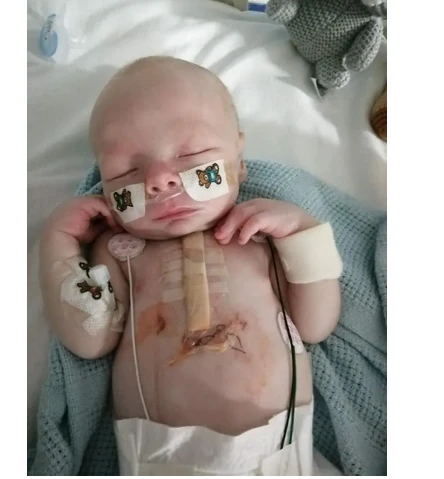
In what began as a long-awaited moment of joy, Jessica and her husband Craig soon found themselves facing every parent’s deepest fear. Their pregnancy—after more than a year of trying—had finally begun. But what followed at a routine scan would transform excitement into uncertainty, and eventually into a life-or-death battle for their newborn son, Finn.
What unfolded was not just a medical journey, but an emotional test of resilience, hope, and the fragile line between tragedy and miracle.
A long-awaited pregnancy filled with hope
After more than twelve months of trying to conceive, Jessica and Craig were overjoyed to finally see a positive pregnancy test. Early scans at eight weeks brought relief and happiness as they heard their baby’s heartbeat for the first time.
Everything appeared normal. The pregnancy was smooth, with no warning signs or complications. Like many expectant parents, they moved forward with cautious optimism, counting down to each milestone—especially the 20-week scan, often considered the most routine and reassuring check of fetal development.
They expected another moment of celebration.
Instead, they walked into uncertainty.
The 20-week scan that changed everything
During the mid-pregnancy scan, the atmosphere in the room gradually shifted. What began as routine guidance from the sonographer turned into silence, repositioning, and repeated attempts to capture clearer images.
Then came the moment no parent is prepared for: the sonographer leaving the room to seek a second opinion.
Jessica immediately sensed something was wrong.
When the specialist returned, the explanation was cautious but devastating. Their unborn baby had a ventricular septal defect (VSD), commonly known as a hole in the heart. But further concerns quickly followed—signs of a narrowed aortic arch, potentially indicating a more complex and serious heart condition.
The uncertainty was overwhelming. Doctors could not yet provide a full prognosis, but the message was clear: their baby would likely need surgery after birth—and possibly more than one.
They were told to prepare for the worst, while still hoping for the best.
Searching for answers in the darkest moment
In the days that followed, Jessica and Craig turned to research, desperately trying to understand what their child might face. They found support through medical resources and charities such as Tiny Tickers, which helps families affected by congenital heart defects.
What they discovered brought both fear and comfort. The condition was serious—but treatable in many cases. Early diagnosis, they learned, could significantly improve outcomes.
That knowledge did not remove the fear, but it replaced helplessness with direction.
They were no longer just waiting—they were preparing.
Specialist care and careful monitoring
The couple was referred to a fetal cardiac specialist in Birmingham, where detailed scans confirmed the seriousness of the condition. Finn’s heart would require close monitoring throughout the pregnancy, and doctors prepared the couple for the possibility of immediate intervention after birth.
The diagnosis evolved into a clearer picture: Coarctation of the Aorta, a narrowing of the major artery leaving the heart.
Surgery would be necessary. Possibly open-heart surgery within days of birth.
While terrifying, the medical clarity gave Jessica and Craig something they had been missing: understanding. With each appointment, they became more prepared for the journey ahead.
Birth under a shadow of urgency
At 39 weeks, Jessica was induced. On July 31, 2019, baby Finn was born.
For a brief moment, there was normality—skin-to-skin contact, a first cuddle, the overwhelming love of meeting their son. But within minutes, that moment gave way to medical urgency.
Finn was immediately taken to the neonatal unit for monitoring and stabilization.
Jessica and Craig had been warned this moment would come. They had toured the unit, learned the sounds of the machines, and prepared themselves as much as any parent could.
But nothing fully prepares you for separation from a newborn seconds after birth.
A fragile start in intensive care
Finn was transferred to Birmingham Children’s Hospital, where an echocardiogram confirmed the diagnosis. The narrowing of his aorta required surgical repair.
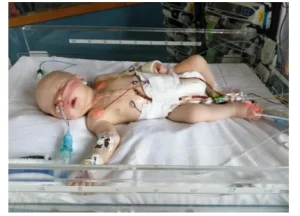
At just ten days old, Finn underwent open-heart surgery.
Jessica and Craig walked with him to the operating theatre, holding his tiny hand for as long as they could before letting him go. Then came the wait—hours that felt stretched beyond time itself.
When the call finally came, it brought relief: the surgery had been successful.
Recovery that defied expectations
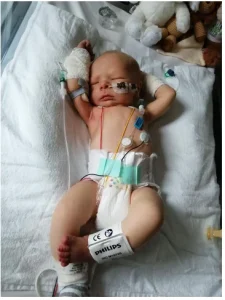
What followed surprised even his medical team. Finn’s recovery was remarkably strong. Within hours of surgery, he was breathing more stably, moving, and showing early signs of resilience.
By the next day, many of his support lines had been removed. Pain management was minimal. He began feeding soon after.
Each milestone felt like a victory—not just medically, but emotionally.
Jessica and Craig watched as their son, once surrounded by machines and uncertainty, began to resemble the healthy baby they had once only hoped for.
A moment that changed perspective forever
A week after Finn’s surgery, another family arrived at the hospital with a baby facing the same condition—but diagnosed too late for planned intervention. Their journey was far more urgent, far more uncertain.
For Jessica and Craig, it was a sobering reminder of how different outcomes can be, even with the same diagnosis.
Timing, access to care, and early detection had made all the difference.
Life after the crisis
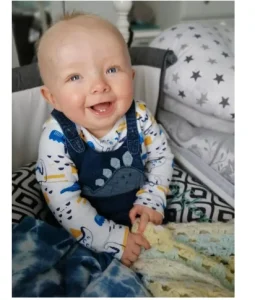
Today, Finn is a thriving, energetic young child—a living testament to early diagnosis and modern cardiac care. His journey, though beginning in fear, became a story of survival and resilience.
For Jessica and Craig, the experience reshaped everything they believed about pregnancy, parenting, and medical awareness.
They now advocate for awareness around congenital heart defects, encouraging parents to trust their instincts and seek early screening when something feels wrong.
A message of awareness and hope
Congenital heart defects affect thousands of families each year, often without warning. But Finn’s story highlights a critical truth: early detection saves lives.
Through medical support, specialized care, and timely intervention, children born with serious heart conditions can go on to live full, healthy lives.
Jessica and Craig’s journey is not just a personal story—it is a reminder that behind every scan, every diagnosis, and every hospital monitor, there is a family holding onto hope.
And sometimes, that hope is enough to create a miracle.