Almost a Third of the Congressional Black Caucus at Risk of Losing Seats
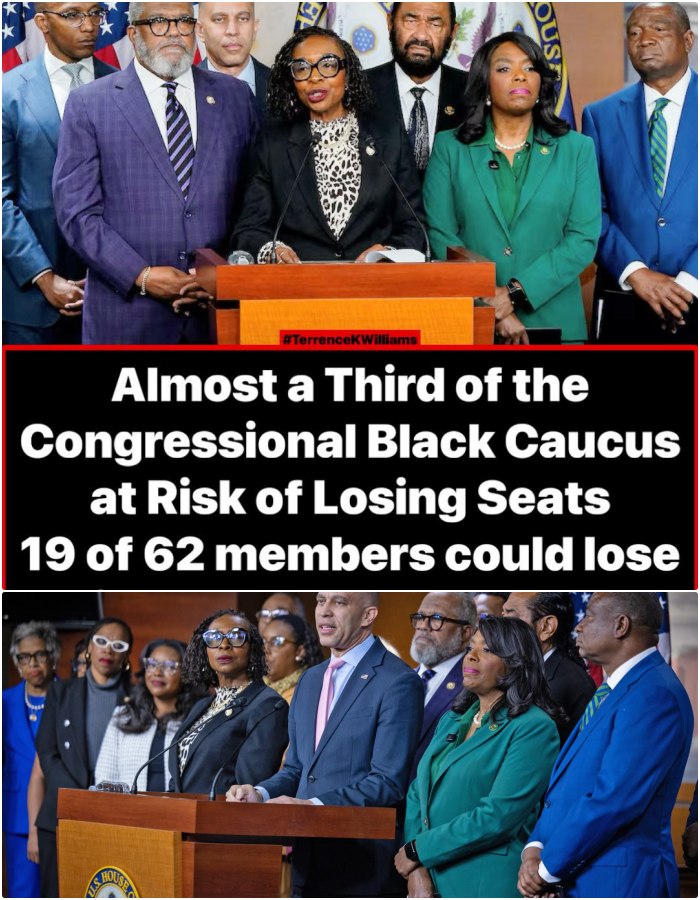
Almost a Third of the Congressional Black Caucus at Risk of Losing Seats
19 of 62 members could lose their seats through the 2028 election cycle following the redraw of congressional maps.
In a significant development for U.S. congressional politics, nearly one-third of the Congressional Black Caucus (CBC) faces the prospect of diminished influence as Republican-led state legislatures in the South push forward with new congressional maps. According to reports, as many as 19 of the caucus’s 62 members could see their seats endangered or eliminated in the coming redistricting battles, potentially reshaping Black representation in the House of Representatives.
This shift comes less than two weeks after the Supreme Court’s April 29, 2026, ruling in Louisiana v. Callais, which limited the use of race as a predominant factor in drawing electoral districts. The 6-3 decision struck down a Louisiana congressional map that had created an additional majority-Black district to comply with Section 2 of the Voting Rights Act. The Court determined that the map constituted an unconstitutional racial gerrymander, emphasizing that states must not prioritize race over traditional districting principles like compactness and respect for political boundaries.
Impact on Southern States and Key Members
Republicans, who control legislatures in several Southern states, have moved quickly to redraw maps in places like Louisiana, South Carolina, Tennessee, and others. These efforts are expected to produce more Republican-friendly districts, potentially diluting the voting strength of Black communities that have historically supported Democratic candidates.
Prominent members at risk include:
- Rep. Jim Clyburn (D-SC), a longtime leader and one of the most influential Democrats in the House.
- Rep. Emmanuel Cleaver (D-MO), whose district was among the early targets.
- Other Black Democrats in states such as Georgia, Texas, and North Carolina.
CBC Chair Rep. Yvette Clarke (D-NY) described the situation as a “five-alarm fire,” warning that up to 19 members could be affected in a worst-case scenario. While the exact outcomes remain fluid as maps are finalized and legal challenges unfold, Democrats view this as a coordinated effort to roll back gains in minority representation.
Background and Broader Context
The Congressional Black Caucus, founded in 1971, has grown significantly thanks in part to the Voting Rights Act of 1965, which helped combat racial discrimination in voting and redistricting. The recent Supreme Court decision has been criticized by Democrats and civil rights advocates as weakening protections under Section 2 of the Act, making it harder to challenge maps that dilute minority voting power.
Supporters of the ruling argue it promotes color-blind districting and prevents the manipulation of maps for racial quotas. Critics, however, contend it opens the door for partisan gerrymandering that disproportionately affects Black voters and representatives.
House Minority Leader Hakeem Jeffries and other Democrats have vowed to fight the changes through litigation and political mobilization. Some CBC members have drawn parallels to earlier eras of limited Black political power, with Rep. Cleaver stating that the efforts feel like an attempt to “send us back to Reconstruction.”