Rudy Santos — The Man Known as “Octoman”
Rudy Santos — The Man Known as “Octoman”
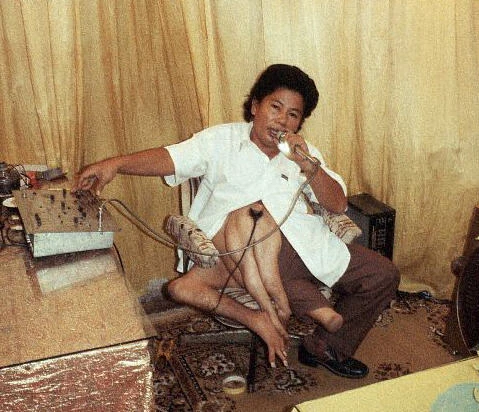
Rudy Santos lived with one of the rarest medical conditions ever documented: parasitic twinning.
Born in the Philippines in 1953, he carried additional limbs and partial body structures from an underdeveloped twin attached to his torso.
The condition made everyday life physically demanding and often placed him at the center of public attention.
From a young age, Rudy faced challenges that few people could imagine.
Simple activities could be difficult, and social stigma often accompanied his unusual appearance.
Yet despite these obstacles, he worked to build a life for himself under difficult circumstances.
As he grew older, he became known to audiences as “Octoman.”
He appeared in traveling exhibitions and sideshows, using those performances as a way to earn income and help support his family.
While many viewed him as a curiosity, the reality was that he was a man doing what he could to survive and provide for those he loved.
Medical specialists later evaluated the possibility of surgically removing the parasitic twin.
However, such a procedure would have involved significant risks and complex medical considerations.
After decades of living with the condition, Rudy made a personal decision not to pursue the operation.
He reportedly explained that the attached structures had been part of him for so long that he no longer viewed them as separate from his identity.
His decision highlighted an important truth: medical conditions are not only physical experiences but also deeply personal ones.
Questions of treatment, identity, and quality of life often involve factors that only the individual can truly understand.
Rudy’s life remains one of the most unusual and extensively discussed cases of parasitic twinning in modern medical history.
Researchers and physicians have studied his condition as a rare example of human developmental biology.
Yet beyond the medical interest lies a much more human story.
He was not simply a case study or a sideshow attraction.
He was a person who navigated extraordinary circumstances with resilience and determination.
His story continues to encourage reflection on dignity, acceptance, and the complex ways people define themselves.