THE DAUGHTER WHO NEEDED A MARRIAGE LICENSE FOR PARENTS WHO HAD ALREADY SAID I DO
**PART 1: **
The woman at the county clerk’s office asked if she could buy a marriage license for someone who was already gone.
Not renew one.
Not replace one.
Buy one.
I was working window three at the Jefferson County Clerk’s Office in northern Alabama, where the lights buzzed, the printer jammed every other Tuesday, and most people came in already irritated because government buildings have a way of making everyone feel late.
She came in just before lunch.
Mid-fifties, maybe. Gray hair twisted into a clip, black blouse, sensible shoes, and a purse hugged tight against her ribs like it was holding her together. She had a manila folder in one hand and a small plastic bag from CVS in the other.
The lobby was full that day. A young couple in matching college sweatshirts was filling out marriage paperwork at the table by the vending machine. A contractor needed a permit copy. A man kept complaining because he had parked at a meter and “the city was robbing him one quarter at a time.”
The woman waited until her number was called.
Then she stepped up to my window and whispered, “I need a marriage license.”
“Sure,” I said. “Both applicants present?”
Her face changed.
Just enough.
“No.”
I looked at the form in front of me.
“We do need both parties to sign.”
“I know.”
She opened the manila folder and slid out an old photograph.
A young couple standing in front of a courthouse. The man wore a brown suit with sleeves a little too short. The woman wore a cream dress and held a bouquet that looked like it had been bought from a grocery store bucket.
On the back, in faded ink, someone had written:
June 14, 1974. We did it anyway.
The woman touched the edge of the picture.
“That’s my parents,” she said. “Roy and Annette.”
I nodded.
“They were married?”
“For forty-nine years.”
She swallowed.
“Daddy passed last month.”
I softened my voice.
“I’m sorry.”
She nodded the way people do when they are tired of that sentence but still grateful someone said it.
“I’m trying to settle everything. Insurance, house deed, bank stuff. My mother has dementia, so I’m doing most of it.”
She opened the folder again and pulled out another paper.
A search request.
No marriage certificate found.
My stomach sank a little.
She kept talking fast now, like if she slowed down, the tears would catch her.
“They always said they got married at the courthouse. Same building. This building, actually. Mama said her father told her not to marry a mechanic with no savings, so they came here on their lunch break and did it anyway.”
She gave a tiny smile.
“Daddy used to say he had five dollars, a borrowed tie, and the prettiest woman in Alabama mad enough to marry him.”
I smiled too.
Then she looked at the paper.
“But there’s no record.”
I looked carefully through the file.
It happens sometimes. Old records get misfiled. Names misspelled. Flood damage. Human error. A whole life can be real and still missing from a drawer.
“What name would it be under?”
“Annette Louise Harper and Roy Dean Whitcomb.”
I searched.
Nothing.
I tried Whitcom. Whitcombe. Roy D. Harper by mistake. Ann L. Harper.
Nothing.
The woman watched my face and understood before I said it.
“We don’t see it in the system,” I told her gently.
Her mouth tightened.
“I need it for the pension paperwork.”
“I understand.”
“No,” she said, and then stopped herself.
She looked down at the photo.
“I mean, yes, I need it for paperwork. But that’s not why I came today.”
The young couple at the vending-machine table laughed over something on their form. The bride-to-be held up her left hand and wiggled her ring. Her fiancé kissed her knuckles.
The woman at my window saw them.
Her eyes filled.
“Today would’ve been their fiftieth anniversary,” she said.
The lobby noise seemed to lower around us.
“She still remembers him today,” the woman whispered. “Most days she asks where her mother is. Sometimes she thinks I’m the neighbor. But this morning, she woke up and said, ‘Roy’s taking me to the courthouse. I need my cream dress.’”
She opened the CVS bag.
Inside was a small corsage.
White carnations. A little baby’s breath. Plastic pearl pin.
“I bought this on the way here,” she said. “I thought if I could bring her back something official, something with their names on it, maybe she could hold it before the day disappeared.”
She looked at me through the glass.
“So I know you can’t sell me a license. I know he can’t sign. I know rules are rules.”
Her voice broke.
“But is there anything here that can say they were real?”
I looked at the counter between us.
That thin strip of government wood where people came to prove they existed.
Births. Deaths. deeds. marriages. names changed, names corrected, names searched for until someone had to say, “I’m sorry, we don’t have it.”
There are rules in county offices.
More rules than chairs.
But sometimes the thing a person needs is not exactly illegal or impossible.
It is just not on the form.
I told her to wait a minute.
Then I went to the back room.
**PART 2: THE FIFTY-YEAR MARRIAGE THAT WAS FINALLY FOUND**
Our records room smelled like dust, toner, and old cardboard. I pulled the marriage index books from 1974. Real books. Heavy. Green covers. Yellowed pages. Names typed in uneven columns.
I searched Harper.
Nothing.
I searched Whitcomb.
Nothing.
Then I remembered the photo.
We did it anyway.
People who run off on a lunch break sometimes do not go where they said they went.
I checked the neighboring county index online.
Nothing.
Then I checked by date instead of name.
June 14, 1974.
There it was.
Not Whitcomb.
Whitman.
Roy Dean Whitman and Annette Louise Harper.
A clerk in 1974 had typed the name wrong.
One wrong name.
Fifty years of marriage hiding behind one wrong name.
I printed the old index page and carried it back to the window.
The woman stood up when she saw me.
“I found something,” I said.
Her hand went to her mouth.
I pointed to the line.
“Roy Dean Whitman. Annette Louise Harper. June 14, 1974.”
She stared at it.
“That’s him,” she whispered. “That’s my daddy.”
“We’ll need to request a correction. It may take some paperwork. But this is enough to start.”
She pressed one hand flat on the counter.
For a second, she looked like the building itself had given her father back.
Then she said, “Can my mother see it today?”
I looked at the printout.
Plain paper. Crooked toner. Nothing beautiful.
But it had their names.
Almost.
I said, “Give me ten minutes.”
I made a certified copy request. I printed the index. I typed a letter on county letterhead explaining that a marriage record had been located with a clerical surname error and that correction paperwork was pending. I stamped it with the clerk’s received stamp.
It was not a marriage certificate.
But it was official enough to feel like the county had finally stopped losing them.
Then I did something I probably was not supposed to do.
I took one of our blank decorative certificate sheets from the public ceremony folder. The kind we give couples after courthouse weddings, not legally binding, just pretty.
At the top, I typed:
In Honor of Fifty Years
Then:
Roy Dean Whitcomb
and
Annette Louise Harper Whitcomb
Married June 14, 1974
Still Recorded Where It Matters Most
I did not stamp that one.
I did not pretend it was legal.
I just slid it into a folder with the official documents.
The woman opened it at the counter.
Her face crumpled.
“I can’t pay extra for this.”
“You’re not.”
“I don’t want you getting in trouble.”
“I won’t.”
That was not necessarily true.
But it was close enough for kindness.
She held the paper like it might fly away.
“My mother won’t understand all of it,” she said.
“Maybe she’ll understand enough.”
She nodded.
Then she picked up the corsage, the photo, and the folder and walked out of the courthouse.
I thought that was the end of it.
But at 3:40 that afternoon, she came back.
This time, she was pushing a wheelchair.
In it sat a tiny woman in a cream cardigan with white carnations pinned to her chest.
Her hair had been curled. Lipstick slightly crooked. Hands folded over a purse in her lap.
The daughter leaned close to my window.
“This is my mother,” she said. “Annette.”
The old woman looked around the lobby.
Her eyes drifted over the chairs, the vending machine, the faded county seal on the wall.
Then she smiled.
“Roy’s parking the car,” she said.
The daughter closed her eyes.
I came around from behind the counter.
Technically, I should not have left my station.
Technically, I had fifteen people waiting.
But every person in that lobby went still, including the man with the parking-meter complaint.
The daughter opened the folder and placed the decorative certificate in her mother’s lap.
Annette looked at it for a long time.
Her finger found Roy’s name.
“Roy Dean,” she said softly.
Then she looked up at her daughter.
“I told Daddy I’d marry him anyway.”
The daughter laughed and cried at the same time.
“Yes, Mama. You did.”
Annette touched the corsage.
“He bought me flowers?”
Her daughter nodded.
“He always did.”
The old woman looked toward the front doors.
“Is he late?”
Nobody moved.
I crouched in front of her chair.
“Mrs. Whitcomb,” I said gently, “I think he wanted you to have this first.”
She looked at me, really looked, for one clear second.
Then she smiled like a young woman in an old photograph.
“That sounds like him,” she said.
The young couple in college sweatshirts had stopped filling out their marriage form. The bride-to-be wiped her eyes with the sleeve of her hoodie. Her fiancé stood there holding the pen like he had forgotten what it was for.
Annette looked at them.
“You getting married?”
The girl nodded.
“Today.”
Annette patted the certificate in her lap.
“Do it anyway,” she said.
The whole lobby laughed softly.
Not because it was funny.
Because it was beautiful.
Before they left, the daughter asked if I could take a picture.
So I did.
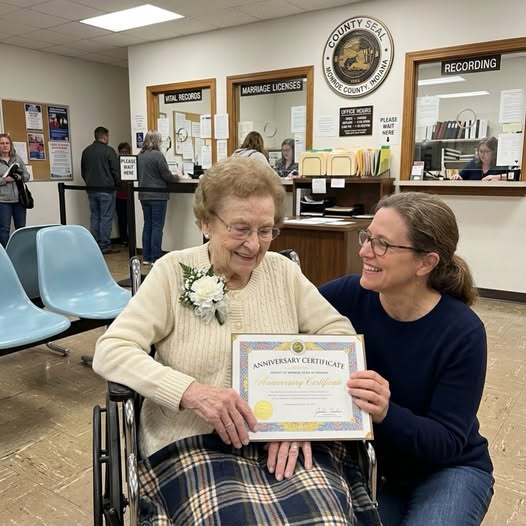
Annette in her wheelchair beneath the county seal, corsage on her cardigan, certificate in her lap, her daughter kneeling beside her with one arm around the chair.
In the photo, Annette is looking slightly to the left of the camera.
Toward the doors.
Like she could still see him coming.
Two weeks later, the corrected certificate came through.
Roy Dean Whitcomb.
Annette Louise Harper Whitcomb.
Married June 14, 1974.
The daughter picked it up alone.
Her mother had passed three days after their courthouse visit.
“She kept the paper in bed with her,” she told me. “The pretty one.”
I pressed my hand over my mouth.
“She told everyone Roy had finally brought the license home.”
The daughter slid something through the window.
A copy of the photo I had taken.
On the back, she had written:
Thank you for finding them.
I taped it inside my desk drawer.
Not where the public could see it.
Just where I could.
Because people think clerk offices are only about forms.
They are not.
Sometimes they are about names that got typed wrong.
Sometimes they are about proof arriving fifty years late.
And sometimes the kindest thing a government building can do is remember that behind every record is somebody waiting to be found.