THE BOY WHO DIDN’T WANT TO JUST WATCH THE OTHER KIDS SWIM
**PART 1: **
The boy at the public pool asked if he could borrow a swimsuit from lost and found.
Not goggles. Not a towel.
A swimsuit.
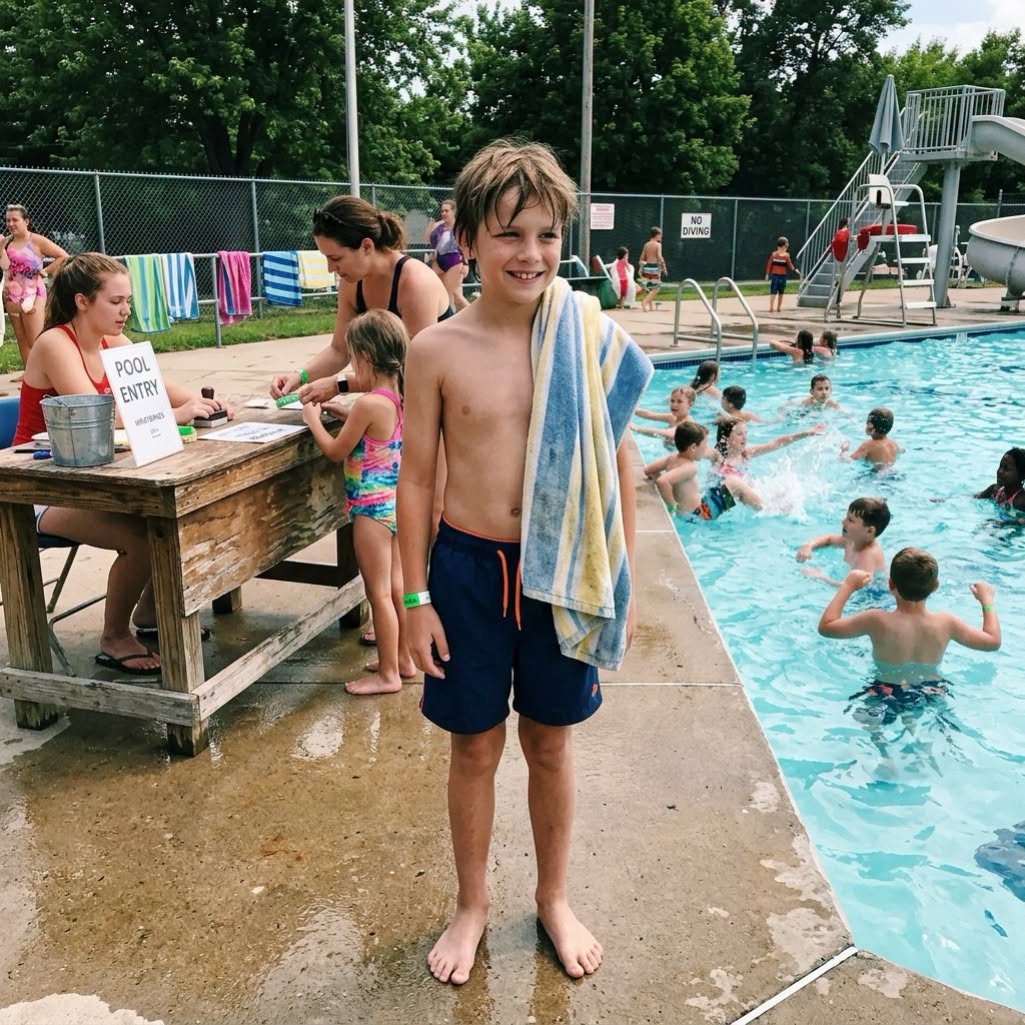
I was sitting behind the check-in desk at the city pool in Cedar Falls, Iowa, stamping wrists and pretending the snack bar nacho cheese machine wasn’t making that same angry clicking sound it made every summer.
The boy stood on the other side of the counter with a plastic grocery bag in one hand and a folded permission slip in the other.
He was maybe eleven. Skinny, sunburned across the nose, hair still wet from the sprinkler at home or maybe somebody’s apartment complex hose. His T-shirt said LINCOLN ELEMENTARY FIELD DAY 2023, and his sneakers were the kind that had been washed too many times and still never came clean.
“Do you have swimsuits people forgot?” he asked.
I looked up.
“What size?”
He looked down at himself like he had never been asked that question before.
“Kid size, I guess.”
Behind him, a group of boys from the Parks and Rec summer camp were already running toward the locker rooms, yelling about who was going to jump first. Their towels had names embroidered on them. Their backpacks had water bottles clipped to the sides. Their moms had packed sunscreen, snacks, goggles, and those little packets of sports drink mix.
The boy at my counter had a grocery bag with one towel inside.
A towel from a motel, still stamped with faded blue letters.
SLEEPY PINES INN.
I opened the lost and found bin under the counter. It smelled like chlorine, damp cotton, and old flip-flops.
There were goggles with one missing strap, a pink unicorn towel, three water shoes, and a pair of swim trunks with tiny sharks on them.
Too small.
I held them up anyway.
The boy shook his head.
“It’s okay,” he said quickly. “I can just watch.”
That sentence hit me harder than it should have.
Not because watching is sad.
Because he said it like he had practiced being fine with it.
I asked his name.
“Eli.”
His permission slip had been signed in blue pen by someone named MARIA HERNANDEZ. Under emergency contact, there was only one number, written twice.
“You with the camp?” I asked.
He nodded.
“My mom paid for the week,” he said. “She said there was swimming today. I thought these were okay.”
He tugged at the basketball shorts he was wearing. They were cotton. Pool rules said no street clothes in the water. We had signs everywhere saying it in big red letters.
NO COTTON CLOTHING IN POOL.
Rules are easy until a kid is standing in front of them.
I called over to Brad, the manager, who was testing the shallow end with a plastic tube and looking like he already knew the day was going to be long.
“Brad,” I said quietly, “do we have any extra trunks in the office?”
He gave me the look managers give when they can hear a problem before you finish explaining it.
“Nope,” he said. “Health code. Liability. We can’t hand out personal clothing.”
Eli heard him.
Kids always hear the part you wish they wouldn’t.
His ears turned red.
“That’s okay,” he said again. “I’ll watch.”
Then he picked up his motel towel and walked toward the bleachers.
He didn’t cry.
That was the worst part.
Crying would have made people notice. Crying would have made someone uncomfortable enough to help. But Eli just climbed to the top row of the bleachers, folded that motel towel on his lap, and watched twenty-seven other kids cannonball into the water.
For twenty minutes, he sat perfectly still.
He laughed when the other boys laughed.
He clapped when a counselor did a terrible belly flop.
He even waved when one kid yelled, “Eli, come on!”
Then he looked down at his shoes and pretended he hadn’t heard.
I kept stamping wrists.
Every stamp felt louder than the last.
At lunch, I walked to the Dollar General two blocks away.
I told Brad I was getting paper towels for the bathroom. That was true. I did buy paper towels.
I also bought a pair of navy swim trunks, size youth large, with a drawstring waist. They cost $8.50.
At the register, the cashier asked if I wanted a bag.
“No,” I said.
I folded the receipt around the tag and walked back with the shorts tucked under the paper towels like I was smuggling kindness past a committee.
When I got back, Eli was still on the bleachers.
His camp group was eating sandwiches at the picnic tables. He had half a peanut butter sandwich wrapped in foil and a small bag of plain chips.
I walked up and sat two rows below him.
“Eli,” I said, “you’re not going to believe this.”
He looked at me carefully.
“What?”
“Somebody just turned these in from the locker room.”
I held up the trunks.
He stared at them.
“Those are new,” he said.
I looked at the tag I had forgotten to pull off.
Kids notice everything.
I sat there with the chlorine smell in my hair and no good lie left.
“They are,” I said. “And I’m not supposed to give them to you.”
He looked away.
“But I’m going to,” I said, “because sometimes rules are written for normal days, and today isn’t one.”
His mouth opened a little.
“I don’t have money.”
“I didn’t ask for money.”
“My mom can pay you Friday.”
“Eli.”
He looked at me.
“Go swim.”
**PART 2: THE SWIMSUIT THAT LET A BOY BELONG FOR ONE AFTERNOON**
For a second, he didn’t move.
Then he took the trunks like they were breakable.
When he came out of the locker room, the other boys were halfway through a game of Marco Polo. One of them yelled, “Eli!” and splashed so hard it soaked the lifeguard chair.
Eli ran.
Not walked. Not shuffled.
Ran.
He jumped into the pool with both knees tucked to his chest, making a splash big enough to hit the first row of bleachers.
When he came up, he was laughing.
Real laughing.
The kind that comes from deep in a kid’s body before the world teaches him to check who’s watching.
I went back to the desk and pretended to organize wristbands until my eyes stopped burning.
At 4:30, Maria Hernandez came in wearing scrubs and work shoes that looked like they had carried her through twelve hours on tile floor.
Eli ran to her with wet hair, a towel around his shoulders, and the trunks rolled up in his grocery bag.
He whispered something to her.
She looked over at me.
I braced myself.
Some parents don’t like strangers helping. Some people have had pride stepped on so many times that even kindness feels like a shoe.
But Maria walked to the counter and placed both hands flat on it.
“How much do I owe you?” she asked.
“Nothing.”
Her jaw tightened.
“I don’t take handouts.”
“I know,” I said. “Neither does he.”
She blinked.
I slid the Dollar General receipt across the counter.
“It was $8.50,” I said. “But he paid me already.”
Her eyes dropped to the receipt.
“How?”
I looked past her at Eli, who was standing by the door with his wet towel and his grocery bag, smiling at the pool like he was trying to memorize it.
“He reminded me why this place exists.”
Maria pressed her lips together.
For a moment, she looked too tired to stand.
Then she folded the receipt and put it in her scrub pocket like it was something important.
The next Monday, there was an envelope taped to the pool office door.
Inside was $8.50 in cash.
And a note written in careful handwriting.
Not from Maria.
From Eli.
It said:
THANK YOU FOR NOT MAKING ME WATCH.
I kept that note in the drawer by the wrist stamps all summer.
Every time someone complained about the snack bar prices or yelled because we closed the deep end for thunder, I opened that drawer and looked at it.
Because sometimes a swimsuit is not a swimsuit.
Sometimes it is the difference between being included and being invisible.
And sometimes the smallest thing you hand a child becomes the day they remember someone let them belong.