Tessa Evans: The Girl Born Without a Nose Who Continues to Inspire
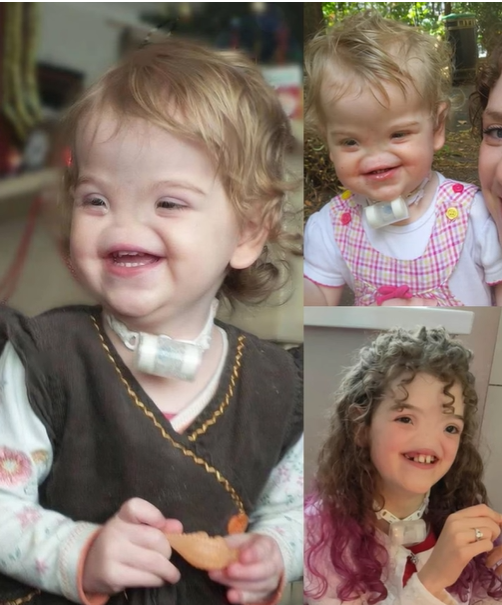
From the moment she was born on Valentine’s Day 2013, Tessa Evans captured attention because of an extraordinarily rare condition that made her appearance truly unique. Although some people later nicknamed her “Little Voldemort,” her family has always seen something far more important—a beautiful little girl with an incredible spirit.
Tessa, from Maghera in County Londonderry, Northern Ireland, was born with complete congenital arhinia (also linked to Bosma arhinia microphthalmia syndrome, or BAMS). This means she arrived in the world without a nose or nasal cavities and could only breathe through her mouth. The condition is so uncommon that fewer than 100 cases have been reported worldwide, making Tessa one of the rarest known children with this difference. She has no sense of smell, limited taste related to smell, and no sinuses. A tracheostomy provides a secure secondary airway. Some associated eye differences affect her vision, though she retains useful sight.
Her parents, Grainne and Nathan Evans, learned of facial abnormalities on a mid-pregnancy scan but were still shocked at birth. Initial online information was scarce and often bleak, with some older medical advice even suggesting termination. The family chose instead to focus on love, awareness, and practical support. They connected with other rare-arhinia families around the world and have openly shared Tessa’s journey to challenge stigma and show that children with the condition can thrive.
At the age of two, Tessa made medical history. She became the first person to receive a pioneering custom nasal implant created with 3D-printing technology at Great Ormond Street Hospital in London. The implant was placed under the skin through a hidden incision in the hairline, gradually stretching tissue to form a nasal profile without large facial scars. The procedure is designed to be repeated as she grows, allowing the reconstructed area to keep pace with her facial development. Additional refinements, such as medical tattooing for nostrils and contours, have been part of the long-term plan.
Despite the medical challenges, Tessa has lived a full and joyful childhood. She attends school, enjoys toys and activities like any other child, has appeared on television (including a memorable moment on RTÉ’s Late Late Toy Show), and continues regular specialist care. Her family repeatedly emphasizes that she is charming, courageous, and beautiful with or without a conventional nose. Ongoing monitoring addresses the hormonal aspects of BAMS, eye health, airway management, and further reconstructive steps.
Congenital arhinia is a profound developmental difference that requires lifelong multidisciplinary care. Early airway support, staged reconstructive surgery, and strong family advocacy have allowed Tessa to move far beyond the isolation her parents once felt. Her story remains a powerful reminder that rarity does not define worth, and that love and innovative medicine can help a child born without a nose grow into a confident young person who simply gets on with living.
Sources
- BBC News, Belfast Telegraph, Express, and Metro reports (2014–2015) on Tessa Evans’s birth with congenital arhinia / BAMS, early challenges, and pioneering 3D-printed nasal implant surgery at Great Ormond Street Hospital
- Later family and media updates (Irish News, Newsletter, Newsner, and related coverage through 2023–2026) detailing her continued growth, additional procedures, public appearances, and the family’s positive outlook