VICTORIA KOMADA: THE LITTLE GIRL WHO BEAT THE ODDS AND TOOK HER FIRST STEPS
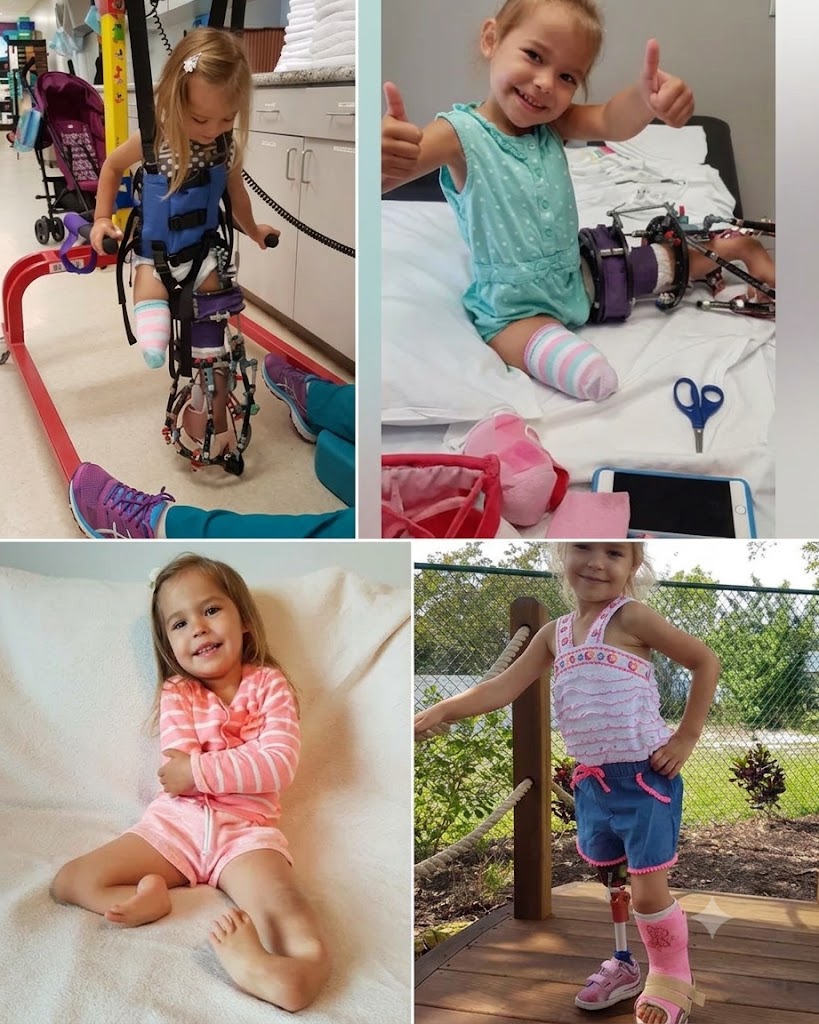
Doctors in Poland told her parents that amputation might be the only way forward. Her family refused to accept that as the end of the story. After an international fundraising campaign brought her to Florida, a pioneering surgical team attempted a complex reconstruction — and years later, Victoria was able to stand and walk independently.
When Victoria Komada was born in Poland, her parents, Marzena and Dariusz, immediately faced a medical reality they had never imagined.
Their daughter had been born with bilateral tibial hemimelia, an exceptionally rare congenital limb disorder in which the tibia — the larger bone of the lower leg — is partially or completely absent.
Victoria’s condition was severe.
Both of her legs were dramatically malformed, with major deficiencies in the bones needed for normal lower-limb development. Her feet and lower legs were positioned abnormally, making conventional walking impossible.
By the time Victoria was three years old, doctors in Poland reportedly told her parents that bilateral amputation was the only realistic option.
For Marzena and Dariusz, that was devastating.
But they were not ready to give up.
A FAMILY REFUSED TO ACCEPT “IMPOSSIBLE”
Instead of accepting the recommendation as their daughter’s only future, Victoria’s parents began searching for specialists around the world.
Their search eventually led them to the United States and to Dr. Dror Paley, one of the world’s leading specialists in complex limb reconstruction and limb-lengthening surgery.
Paley had developed and refined techniques for treating severe congenital limb deformities, including conditions that had traditionally been treated with amputation.
For Victoria’s family, he represented something they desperately needed:
another possibility.
But getting their daughter to the United States required money the family did not have.
So they began an international fundraising campaign.
Friends, relatives and strangers joined the effort, helping raise the funds needed to bring Victoria to Florida for treatment.
The campaign transformed the family’s hope into an opportunity.
A NINE-HOUR OPERATION
Victoria eventually traveled to Florida for treatment.
Her left leg presented an extraordinary surgical challenge.
Rather than simply removing the malformed limb, the surgical team attempted to reconstruct it so that it could eventually provide functional support.
The operation lasted more than nine hours.
The surgeons had to work around severely abnormal anatomy while reconstructing the bones, joints and soft tissues necessary for the leg to become functional.
This type of surgery is vastly more complicated than a conventional orthopedic procedure.
The goal was not simply to make the leg look different.
It was to create a limb that could eventually bear weight and allow Victoria to stand and walk.
Her other leg was treated with a prosthetic solution designed around her unique anatomy.
The strategy therefore combined reconstruction and prosthetic technology rather than relying on amputation of both legs.
THE HARD PART CAME AFTER SURGERY
The operation was only the beginning.
Victoria faced months of intensive rehabilitation.
Her body had to adapt to its reconstructed limb.
Her muscles had to become stronger.
Her balance had to develop.
And her brain had to learn how to coordinate movements that had never previously been possible.
For a young child, rehabilitation after such an extensive reconstruction requires extraordinary patience.
There were exercises.
Therapy sessions.
Setbacks.
Pain.
And countless attempts to achieve movements that other children perform without thinking.
But Victoria kept trying.
THEN CAME THE MOMENT EVERYONE HAD WAITED FOR
Eventually, something extraordinary happened.
Victoria stood.
Then she took a step.
And another.
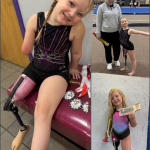
The little girl whose parents had once been told that amputation was the only option was now walking independently.
For her family, the moment was overwhelming.
It represented more than a successful operation.
It represented years of refusing to surrender.
The campaign.
The travel.
The surgery.
The rehabilitation.
Every painful step had led to that moment.
WHAT IS TIBIAL HEMIMELIA?
Tibial hemimelia is an extremely rare congenital condition involving partial or complete absence of the tibia.
The condition can affect one or both legs and varies significantly in severity.
Children may have shortened legs, unstable knees, abnormal feet and other skeletal deformities. In severe bilateral cases, conventional walking can be extremely difficult or impossible without major reconstruction, prosthetic treatment or amputation.
Because the condition is so rare, treatment must be highly individualized.
Some children may be candidates for reconstruction, while others may require amputation and prosthetic rehabilitation.
The decision depends on the specific anatomy, the presence or absence of joints, the condition of the foot and ankle, limb length and the child’s overall function.
Victoria’s case was particularly challenging because the condition affected both legs.
A NEW DEFINITION OF POSSIBILITY
Victoria’s story became widely known because of the dramatic contrast between the future originally predicted for her and what she ultimately achieved.
The doctors who recommended amputation were not necessarily giving her family a hopeless prognosis.
They were evaluating the options available to them based on the severity of her condition.
But her parents continued searching until they found another medical team willing to attempt reconstruction.
That distinction matters.
Modern medicine does not always offer a single “right” answer.
Sometimes different specialists can look at the same condition and propose different paths — each with its own risks, benefits and uncertainties.
For Victoria’s family, the reconstruction offered a chance worth pursuing.
And she made the most of it.
FROM SURGERY TO CHILDHOOD
Walking was only the beginning.
With her mobility improving, Victoria could begin experiencing childhood in ways that once seemed impossible.
She could play.
Explore.
Move independently.
And dream about the future without having her disability determine every possibility.
Her story became an example of how advanced orthopedic surgery, prosthetic technology, rehabilitation and family determination can work together.
But no operation can guarantee a perfect future.
Children with complex congenital limb differences often require ongoing monitoring, additional procedures, physical therapy and adjustments as their bodies grow.
Victoria’s progress therefore represents not an instant miracle, but a long process.
THE PEOPLE BEHIND THE MIRACLE
It is tempting to describe stories like Victoria’s as medical miracles.
But behind the dramatic transformation are real people.
Her parents refused to stop searching.
Donors helped make the journey possible.
Surgeons accepted an extraordinarily difficult challenge.
Therapists helped her rebuild strength and coordination.
And Victoria herself had to endure the hardest part: learning to use her reconstructed body.
Every step she took was the result of all of them working together.
A LITTLE GIRL WHO LEARNED TO WALK TOWARD HER FUTURE
Victoria Komada was born with a condition so rare that her legs developed in ways that made ordinary walking seem impossible.
At three years old, her parents were told that both legs might need to be amputated.
Instead, they traveled across the world searching for another answer.
A nine-hour operation reconstructed her left leg.
A specialized prosthetic solution helped address the right.
Months of therapy followed.
And then, one day, Victoria stood on her own.
She took her first independent steps.
Those steps were not just movement.
They were the visible result of a family refusing to accept that a diagnosis had already written their daughter’s future.
Victoria’s story is a reminder that sometimes hope does not mean believing that everything will be easy.
Sometimes hope simply means believing that there may be another way — and being brave enough to search for it.
SOURCES
- Paley Orthopedic & Spine Institute: medical background on Dr. Dror Paley and complex limb reconstruction, limb deformity correction and limb-lengthening procedures.
- Paley Institute / International Center for Limb Lengthening: information on congenital limb deficiencies and reconstructive orthopedic treatment.
- The Mirror: contemporary reporting on Victoria Komada, her diagnosis, her family’s fundraising campaign and treatment in the United States.
- Daily Mail: reporting on Victoria’s rare bilateral tibial hemimelia, the family’s journey to Florida and her subsequent treatment.
- National Organization for Rare Disorders (NORD): medical background on tibial hemimelia and congenital limb deficiencies.
Editorial note: The personal details in the supplied Spanish account — including the exact nine-hour duration of Victoria’s operation, the precise division of treatment between her two legs and the exact circumstances surrounding her first independent steps — have been retained as part of the original account but should not be interpreted as independently verified clinical details unless confirmed by the treating institution or the family’s primary records. The medical explanation of tibial hemimelia and the general principles of limb reconstruction are based on established medical sources.