Four Missing People Found De*d on Jeju Island in Three Days, Raising Questions Over Police Handling


Four Missing People Found Dead on Jeju Island in Three Days, Raising Questions Over Police Handling
JEJU ISLAND, South Korea — August 26, 2026 — A disturbing series of missing-person cases on South Korea’s popular Jeju Island has drawn national and international attention after four people reported missing were found dead over a period of just three days.
The discoveries have become especially controversial because two of the cases were allegedly mishandled by the same police officer, who is accused of closing missing-person investigations without properly confirming that the individuals were safe. Police are now reviewing all 298 missing-person reports handled by the officer during approximately one year and five months of work in the missing-persons unit. (Reuters)
The investigation has also prompted calls from South Korea’s political leadership for stronger police accountability and changes to the country’s missing-person investigation system.

Four discoveries in a matter of days
The sequence of discoveries began as authorities were conducting searches connected to missing-person reports across Jeju.
According to Yonhap News Agency, a man in his 60s was found dead in northeastern Jeju on Saturday, August 22. His family had previously reported him missing, and the case later became connected to allegations involving the police officer who had handled another missing-person investigation.
On Sunday, August 23, the Jeju Coast Guard found the body of a man believed to be in his 70s in waters near eastern Jeju. Authorities said he had been reported missing the previous day. The Coast Guard is investigating the circumstances surrounding his death. (Thông Tấn Xã Yonhap)
A fourth discovery followed on Monday, August 24, when another missing person was found near a valley in western Jeju.
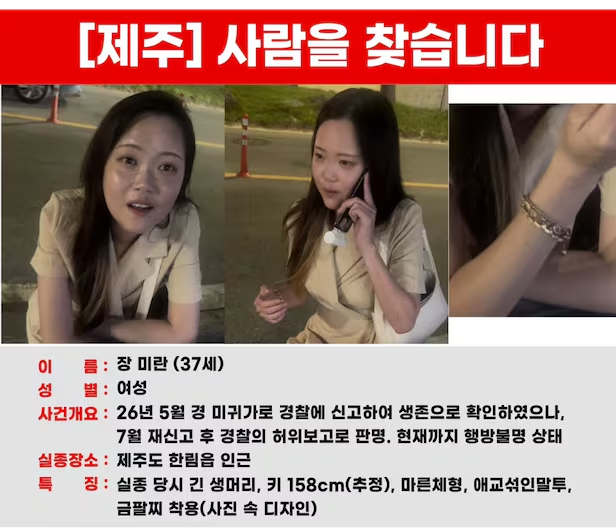
The most closely watched case involved 37-year-old Jang Mi-ran, who had disappeared in May. Her body was found Monday morning in a forested area near Hallim-eup, approximately one kilometer from the accommodation where she had been staying.
By Tuesday, police had confirmed through an autopsy that the body was Jang’s. Investigators said her remains were severely decomposed, making it difficult to determine whether there had been external trauma. A separate DNA analysis was still underway, while investigators continued examining her phone and other evidence to establish the exact circumstances of her death. (Thông Tấn Xã Yonhap)
Reuters reported that four people reported missing on Jeju had been found dead over three days through August 24. Authorities have emphasized that the cases themselves were unrelated, even though two became linked to the same police officer’s alleged mishandling of missing-person investigations. (Reuters)

Jang Mi-ran’s disappearance and the alleged police failure
Jang was last seen leaving the accommodation where she had been staying on May 12. Her disappearance was reported to police on May 15.
What has caused particular public anger is what happened afterward.
The officer assigned to the case allegedly told people close to Jang that he had spoken with her and confirmed that she was safe. However, investigators later found no telephone records supporting the claimed conversation.
According to Yonhap, the officer allegedly closed the case prematurely and deleted information related to Jang from the police missing-person profiling system. The search for her was therefore not conducted with the urgency that would normally be expected from an unresolved missing-person report. (Yonhap News)
Jang’s body was eventually discovered only about a kilometer from the accommodation where she had been staying. Another Korean media report described the location as roughly a 10-minute walk from the accommodation.
The discovery came after authorities launched a much larger search operation involving hundreds of people. (경향신문)
The proximity of the discovery site has intensified criticism of the original handling of the case, although authorities have not concluded that Jang could necessarily have been saved had the search begun earlier. Her exact cause of death remains under investigation.
The officer at the center of the controversy
The police officer, identified in Korean reports by his surname Boo, is 34 years old and worked at Jeju Western Police Station.
Investigators allege that he improperly closed not only Jang’s case but another missing-person case involving a man in his 60s. That man was later found dead after his family reported him missing again and authorities resumed the search. (Internazionale)
The officer is accused of dereliction of duty, falsifying official electronic records and obstructing official duties through deceptive means.
However, the legal situation is still developing. Yonhap reported that a Jeju court on August 24 ordered the officer released after reviewing the legality of his emergency arrest, finding that the legal requirements for an emergency detention without a warrant had not been met. The investigation itself was continuing. (Yonhap News)
The officer has denied wrongdoing and reportedly maintained that he had contacted missing individuals, according to Reuters. (Reuters)
Why 298 cases are now being reviewed
Perhaps the most alarming development is the scale of the review now underway.
Officials confirmed that the officer had handled 298 missing-person reports during roughly 17 months in the missing-persons unit.
Police have ordered a complete examination of those cases to determine whether other investigations were improperly closed. Media reports said approximately 10 cases were being examined more closely for possible improper closure, although investigators have not established that all 298 cases involved misconduct. (Reuters)
That distinction is important.
The 298 cases represent the officer’s workload, not 298 confirmed examples of misconduct. Authorities are still determining whether additional cases were affected.
The controversy has nevertheless raised broader questions about how missing-person reports are monitored, how officers are supervised, and whether one individual should have been able to close cases without adequate verification.
Government promises reforms
The scandal has quickly moved beyond Jeju and into national politics.
Acting National Police Commissioner Yoo Jae-seong apologized publicly and promised a comprehensive review. Police have ordered supervisory approval for missing-person case closures while the case-management system is being upgraded. (Reuters)
Prime Minister Han Seong-sook also ordered a nationwide examination of missing-person investigations and called for strict punishment if wrongdoing is confirmed. Her office said the government would look for weaknesses in the system and consider separating investigative authority from the authority to close a case. (Thông Tấn Xã Yonhap)
President Lee Jae Myung has also called for greater police accountability, saying that responsibility should increase alongside the authority given to law-enforcement institutions. His comments come at a significant moment for South Korea, where police are scheduled to receive expanded investigative responsibilities later this year. (Reuters)
Official figures cited by Reuters show that South Korean police received 70,814 reports of missing adults in 2025. More than 70,000 such reports have been filed annually since 2022, although authorities say the overwhelming majority are resolved within 30 days. (Reuters)
Safety concerns spread online
Jeju is one of South Korea’s most popular tourist destinations, known for its beaches, volcanic landscapes and natural attractions. The recent cases have therefore attracted considerable attention on social media, with some people expressing concern about personal safety and questioning whether they should travel to the island.
However, there is currently no evidence that Jeju as a whole has become unsafe for tourists because of these cases. The four incidents have been described by authorities as unrelated, and the controversy centers largely on missing-person investigations and alleged police misconduct rather than a confirmed threat targeting visitors. Reuters reported that the cases had nevertheless fueled safety concerns and criticism on social media. (Reuters)
For now, the most important question is not whether Jeju itself is dangerous, but whether authorities can determine exactly how the missing-person cases were handled and whether other people may have been affected.
The discovery of four missing people over such a short period has shocked the island and placed intense pressure on police. For Jang Mi-ran’s family and the families of the other missing people, the investigation is about far more than statistics or institutional reforms.
It is about unanswered questions, accountability and the consequences of a missing-person report that may not have received the attention it deserved.
As the review of 298 cases continues, South Korea is now watching closely to see whether the Jeju scandal represents an isolated failure or exposes deeper weaknesses in the country’s system for finding missing people.
The investigation remains ongoing, and authorities have not yet determined whether additional cases were improperly closed or whether any of the four deaths were connected.
Foreign sources used
- Reuters — South Korea’s Lee calls for greater police accountability after Jeju missing-person cases
- CNA — South Korea’s Lee calls for greater police accountability after Jeju missing-person cases
- Yonhap News Agency — Presumed body of missing woman found on Jeju Island
- Yonhap News Agency — Discovered body confirmed to be of woman missing in Jeju
- The Straits Times — Senior police officers in South Korea’s Jeju removed from duty over missing-person scandal