The ‘Mickey Mouse’ Head Wasn’t His Condition — It Was Part of a Remarkable Treatment
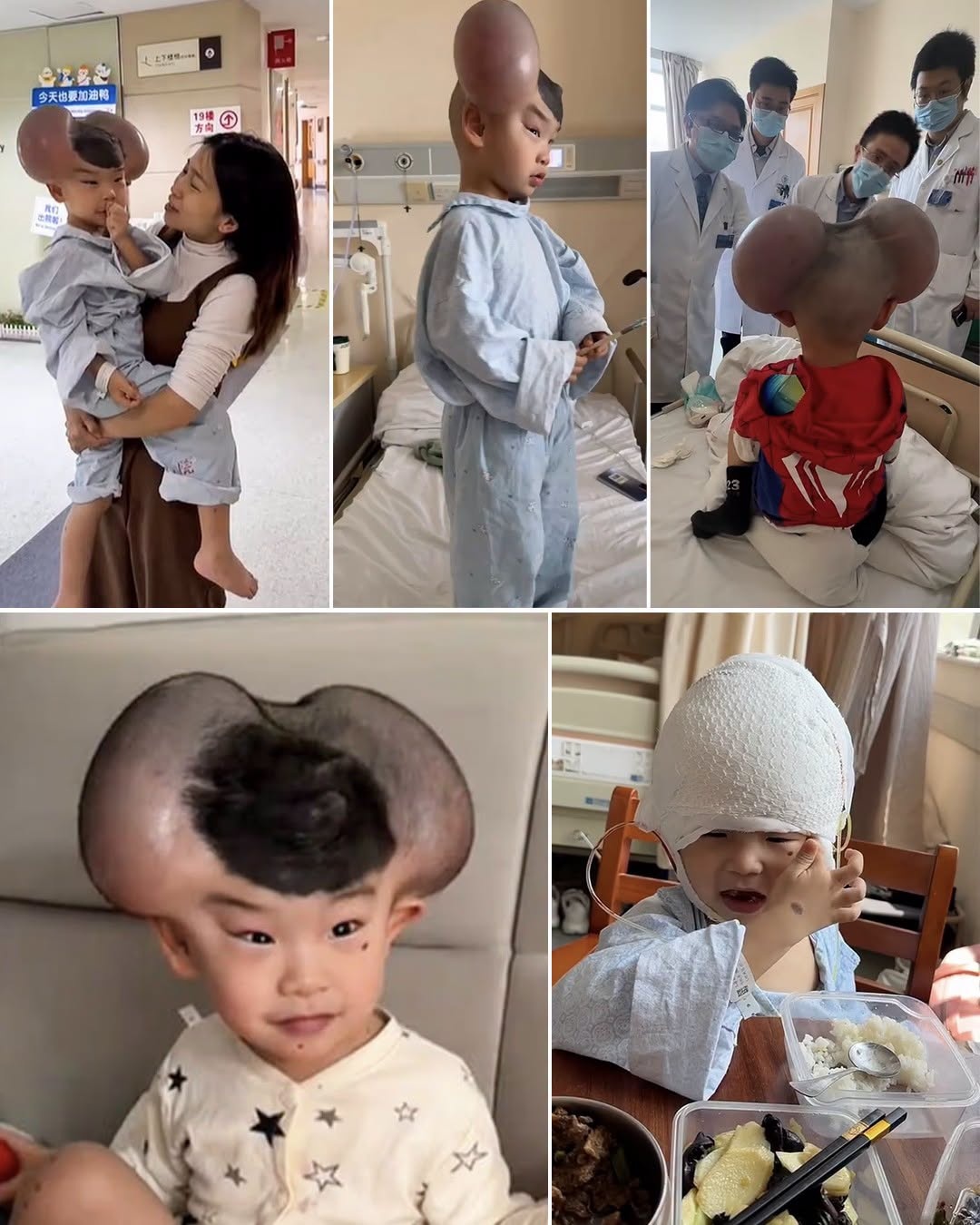
When photos of a three-year-old Chinese boy named Qibao began circulating online, many people were shocked by the enormous, rounded bulges on both sides of his head. Some even cruelly compared his appearance to the ears of Mickey Mouse.
But the unusual shape of Qibao’s head was not the rare condition he was born with.
It was part of an advanced reconstructive treatment designed to help doctors remove the extensive abnormal skin covering his scalp.
Born With a Rare Congenital Skin Condition
Qibao, from Fujian Province in China, was born with extensive congenital melanocytic naevi (CMN), a condition in which clusters of pigment-producing melanocytes develop in the skin before birth. Large or giant CMN can cover substantial areas of the body and may become more prominent as a child grows.
Congenital melanocytic naevi are relatively uncommon in their larger forms. DermNet notes that small CMN occur in roughly 1 in 100 births, while giant CMN are much rarer, occurring in approximately 1 in 20,000 live births.
For children with extensive lesions on visible areas such as the scalp, the condition can create more than a physical challenge. Large CMN may affect self-image and can lead to anxiety, social stigma and emotional distress.
Qibao’s family reportedly faced painful reactions from other people because of his appearance. His mother later described the emotional difficulty of the experience, saying the family wiped away their tears and continued moving forward.
The Problem Doctors Faced
Doctors in Shanghai determined that the abnormal tissue could be surgically removed. But removing such a large area from Qibao’s scalp created another serious problem: there would not be enough healthy skin available to close the surgical wounds.
Instead of simply removing the affected tissue and leaving a large defect, specialists used a reconstructive technique known as tissue expansion.
The principle is surprisingly ingenious.
A soft, balloon-like expander is placed beneath healthy skin. Over time, it is gradually filled with saline, causing the skin above it to stretch and generate additional tissue. Once enough skin has been created, surgeons can use that expanded tissue to cover an area where skin has been removed.
Tissue expansion is particularly useful for scalp reconstruction because the expanded scalp retains its own blood supply and hair-bearing characteristics, helping surgeons achieve a more natural reconstruction.
Why His Head Became So Unusual
As the expanders were gradually filled, the healthy skin on both sides of Qibao’s scalp stretched outward.
The result was dramatic.
Two enormous, rounded bulges developed on either side of his head, giving him a temporary appearance that resembled the ears of the famous cartoon character Mickey Mouse. Images and videos of Qibao during this stage spread widely online, unfortunately attracting cruel comments and teasing.
Yet medically, those strange-looking bulges represented something very different.
They were extra healthy tissue being created for his reconstruction.
The American Society of Plastic Surgeons explains that the bulging appearance produced by tissue expanders can be particularly noticeable during scalp reconstruction, but the temporary distortion is part of the process of growing enough skin for the final operation.
In Qibao’s case, the process reportedly continued for around five months before surgeons proceeded with the major operation. Reports said the affected tissue was then removed and the newly expanded scalp tissue was used to cover the resulting areas.
A Difficult Journey Ends With a Smile
After the surgery, photographs and video showed Qibao recovering in hospital with his head covered in bandages. Instead of the enormous rounded expanders, his head had a much more natural shape.
He was also shown smiling and playing in the hospital, giving his family a moment of relief after months of difficult treatment.
Reports described the main operation as successful, marking the end of a treatment journey that had required patience from both the child and his family.
The story attracted widespread attention because the very feature that had caused people to mock Qibao was actually evidence that his treatment was progressing.
More Than an Appearance
There is also an important medical reason why extensive congenital melanocytic naevi receive close attention.
Most CMN are benign, but the risk of melanoma is higher in large and giant lesions. DermNet estimates that lifetime melanoma risk in giant CMN has been reported at around 5–10%, although estimates vary between studies. Large and giant CMN can also be associated with neurocutaneous melanosis, a rare condition involving melanocytes in the central nervous system.
However, treatment decisions are highly individualized. The size, location, depth and characteristics of a lesion all matter, and surgical removal does not necessarily eliminate every melanoma-related risk.
Qibao’s case therefore illustrates both the complexity of treating extensive congenital skin conditions and the possibilities offered by modern reconstructive surgery.
The Meaning Behind the “Mickey Mouse” Ears
At first glance, the huge bulges on Qibao’s head looked frightening and unusual.
But they were not simply another manifestation of his condition.
They were the result of doctors deliberately creating extra healthy skin so that his scalp could later be reconstructed.
What looked like an extraordinary deformity was, in fact, a temporary stage of healing.
Qibao’s journey is a powerful reminder that medical treatment does not always look beautiful while it is happening. Sometimes, the strangest part of the process is also the part that makes recovery possible.
And behind those two enormous “ears” was a simple purpose: to give a little boy the healthy scalp and a more normal childhood that his family had been hoping for.
Sources:
- News.com.au
- Newsner
- DermNet