A Remarkable Orthopedic Transformation: DeShawn’s Journey Toward a Straighter, More Independent Life
For a child living with a severe spinal deformity, everyday activities that most people take for granted can become extraordinary challenges. Walking upright, sleeping comfortably and maintaining balance may all be affected when the spine develops an extreme curvature.
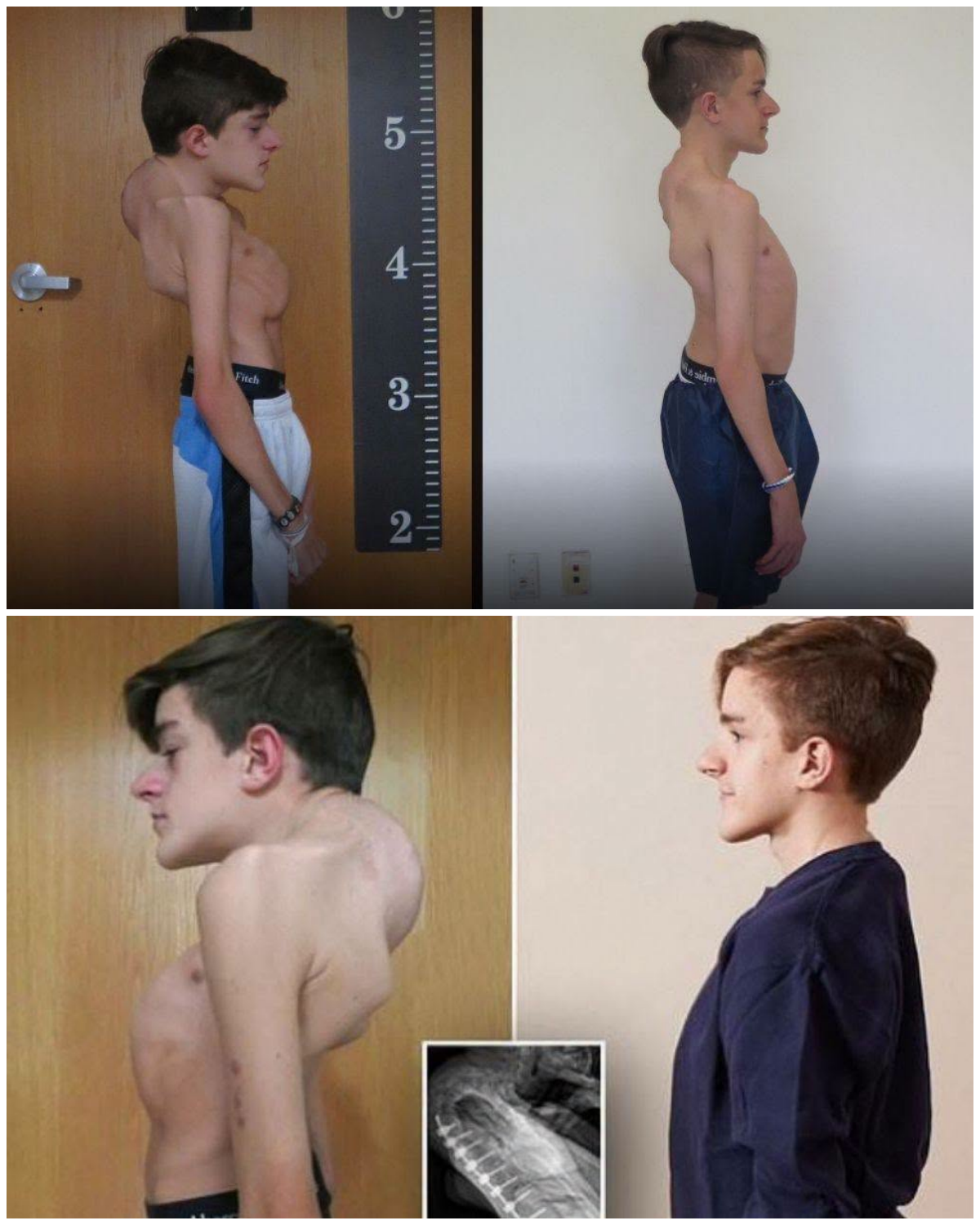
According to the account provided about DeShawn, he was born with a serious spinal abnormality that progressively worsened as he grew. Over the years, the curvature reportedly became so pronounced that standing upright was difficult and discomfort interfered with his daily life.
His treatment involved complex spinal reconstruction performed with the assistance of surgeons associated with the Foedus Foundation. The reported procedure included a vertebral osteotomy—a surgical technique used to reshape or remove part of a vertebra in order to correct a rigid spinal deformity—together with spinal instrumentation intended to stabilize the corrected alignment.
Such surgery is reserved for particularly complex cases. Medical literature describes vertebral column resection and other spinal osteotomies as technically demanding procedures that may be considered when severe pediatric spinal deformities are too rigid to correct through instrumentation alone. Research involving children has demonstrated that these operations can produce substantial improvements in spinal alignment, although they also carry significant risks and require highly specialized surgical teams.
Metal rods and screws are commonly used in spinal reconstruction to maintain the corrected position while the spine heals. Modern pediatric spine surgery increasingly uses advanced imaging and navigation systems to improve the accuracy of implant placement, particularly because children’s spinal structures are smaller and lie close to the spinal cord, nerves and major blood vessels.
The rehabilitation period can be just as important as the operation itself. After major spinal reconstruction, patients generally require careful monitoring and physical rehabilitation as they gradually regain strength, mobility and confidence.
In DeShawn’s reported story, the transformation following treatment was dramatic. He reportedly gained several centimeters in height and progressed from struggling to stand and sleep comfortably to walking more confidently and with substantially less pain.
While the specific details of DeShawn’s case could not be independently verified through publicly available medical or institutional sources, his reported experience reflects a broader reality in modern pediatric orthopedics: advances in spinal reconstruction can give children with severe deformities an opportunity to improve posture, mobility and quality of life.
For families facing complex spinal conditions, such outcomes also highlight the importance of specialized pediatric spine teams, individualized treatment plans and long-term follow-up. Severe spinal deformity surgery can be life-changing, but it is never a simple procedure; published studies emphasize both its potential for major correction and the possibility of neurological, mechanical and other complications.
DeShawn’s reported journey therefore stands as a powerful reminder of what perseverance, specialized orthopedic care and rehabilitation can mean for a child whose physical limitations once seemed overwhelming.
Sources
- Mayo Clinic — Scoliosis: Diagnosis and Treatment
- Mayo Clinic — Reshaping the Future of Pediatric Scoliosis Surgery (August 18, 2026)
- PubMed — Posterior Only Vertebral Column Resection for the Treatment of Severe Spinal Deformities in Pediatric Patients
- PubMed — Spinal osteotomy techniques in management of severe pediatric spinal deformity and analysis of postoperative complications
- PubMed — Complications after 147 consecutive vertebral column resections for severe pediatric spinal deformity
- PubMed — Posterior vertebral column resection for pediatric rigid spinal deformity