THE EXTRAORDINARY CASE OF DEEPAK PASWAN: THE BOY WHO WAS BORN WITH A PARASITIC TWIN
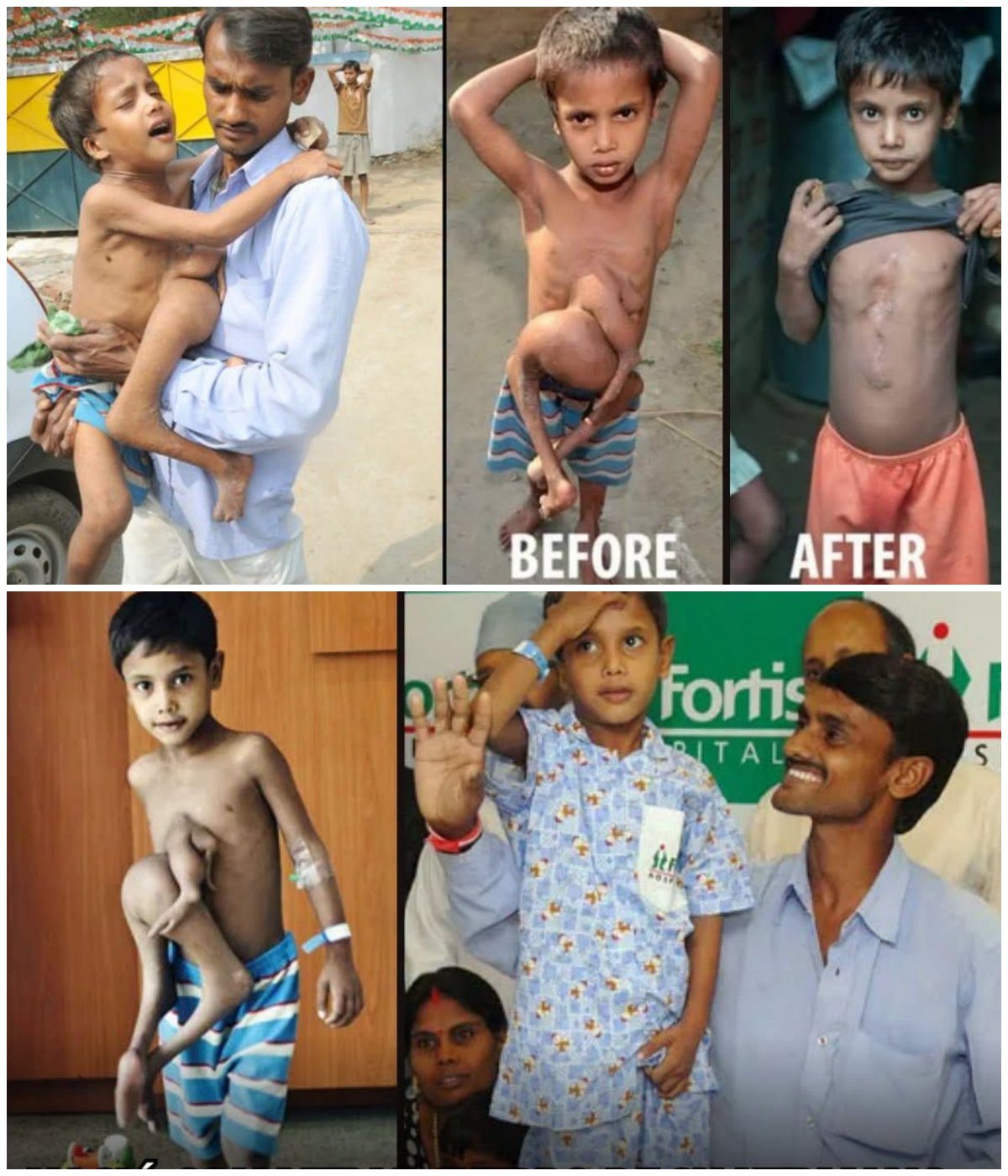
In 2010, the story of Deepak Paswan, a seven-year-old boy from Bihar, India, drew worldwide attention after surgeons successfully removed a parasitic twin that had been attached to his abdomen and torso.
Deepak was born with four arms and four legs but only one head. The additional limbs belonged to an incompletely developed parasitic twin. His condition was extremely rare and made everyday life difficult for the child.
A childhood marked by an extraordinary condition
Deepak was born in the village of Belahari in Bihar. His family had limited access to medical care, and his mother had reportedly received no prenatal ultrasound that could have revealed the unusual fetal development before his birth.
When he was born, his family was shocked to discover that he had eight limbs. His parents initially took him to doctors near their home, but they were told that surgery would be difficult and that his survival could not be guaranteed. Because the family could not afford specialized treatment, Deepak returned home.
His unusual appearance also exposed him to considerable social stigma. Some people regarded him as a divine figure, while others treated him as something frightening. Reports said that people sometimes visited the family to worship him, while Deepak was also mocked and harassed by other children.
The extra limbs belonged to a parasitic twin
Deepak’s condition was described by doctors as conjoined parasitic twinning.
In this rare developmental abnormality, two embryos begin developing together, but one twin fails to develop completely. Instead of becoming an independent fetus, the incompletely developed twin remains physically attached to the more fully developed twin.
In Deepak’s case, the parasitic twin had four limbs attached to his torso. Importantly, contemporary medical reports stated that scans showed Deepak was not sharing major organs with the parasitic twin, which made surgical separation possible.
However, the operation was still dangerous.
Doctors discovered that a major artery supplied blood to the parasitic twin, creating a serious risk of hemorrhage during surgery. The surgical team therefore had to determine which structures belonged to Deepak and which belonged to the parasitic twin before removing it.
A four-hour operation in Bangalore
Deepak’s opportunity for treatment came after Fortis Hospital in Bangalore agreed to perform the surgery.
On May 30, 2010, a team of approximately 15 doctors carried out the complicated procedure. The operation lasted around four hours.
Surgeons carefully separated the additional arms and legs from Deepak’s body and worked around the blood vessels and internal structures connecting the parasitic twin to him.
According to India Today, doctors also had to separate the parasitic twin’s intestines from Deepak’s enlarged liver before the twin could finally be removed.
The operation was completed successfully.
Walking again after surgery
The result was remarkable.
Only days after the operation, reports said Deepak was up and walking, and he was able to cycle and play with his younger sister.
His father, Viresh Paswan, had spent years hoping that his son could undergo surgery. He said the family’s main wish had always been to remove the extra limbs so Deepak could live without being treated as a religious object or spectacle.
The lead surgeon, Dr. Ramcharan Thiagrajan, said Deepak had been fortunate because he did not share major organs with the parasitic twin. Doctors nevertheless continued to monitor him because they were concerned about how his intestines would function after the operation.
A life beyond the headlines
Deepak’s case became famous not simply because of its rarity, but because of the dramatic change the operation brought to his everyday life.
Before surgery, the additional limbs weighed approximately three kilograms, a substantial burden for a child whose body weighed only around 12 kilograms. The extra weight made physical activity difficult and contributed to discomfort and social problems.
After the operation, his family hoped he would be able to return to school, play with other children and live without the physical burden and stigma associated with his condition.
His case also became associated with another famous Indian case, Lakshmi Tatma, a girl born with a parasitic twin who underwent a major separation operation in Bangalore in 2007. The two cases demonstrated the extraordinary challenges—and possibilities—of treating parasitic twinning.
Deepak’s story is therefore not accurately described as a simple “miracle.” It was the result of rare embryological development, detailed imaging and planning, and a high-risk operation performed by a large multidisciplinary surgical team.
Most importantly, the available reports confirm that the surgery succeeded and that Deepak was walking and recovering shortly afterward.
Sources
- India Today — “Deepak’s parasitic twin removed from his chest,” June 9, 2010.
- Agence France-Presse (AFP) — “Boy with eight limbs has successful surgery,” June 2010.
- Dawn — “Indian boy with eight limbs has successful surgery,” June 10, 2010.
- Fortis Hospital Bangalore — Contemporary statements concerning Deepak’s operation.
- Daijiworld / Deccan Herald report — “Surgeons Relieve him of his ‘Little Brother’,” June 9, 2010.